




A 1.5 meter tall boy saw the top of a building under construction at an elevation of \[30^\circ \]. The completed building was 10 meters higher and the boy saw its top at an elevation of \[60^\circ \] from the same spot. What is the height of the building?
Answer
 Verified
672k+ views
Hint: Use trigonometry ratio \[\tan \theta = \dfrac{{{\text{Perpendicular}}}}{{{\text{Base}}}}\] in the triangle making \[30^\circ \] and find the base from this then use this trigonometry ratio in the triangle making \[60^\circ \] and use the obtained base value into this.
Complete step-by-step answer:
First, we will draw the figure to understand the question,
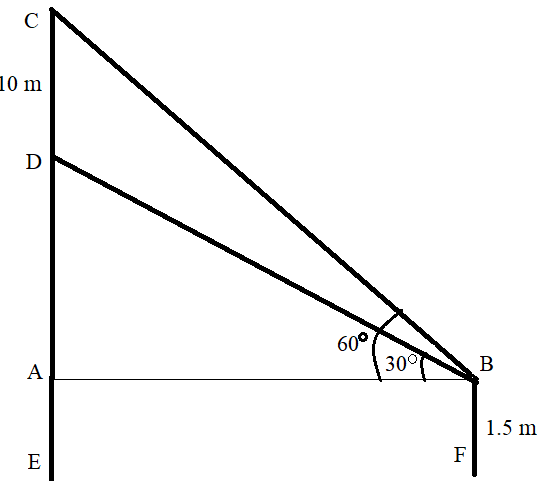
From the figure, the height of the building is CE.
As we know that, \[\tan \theta = \dfrac{{{\text{Perpendicular}}}}{{{\text{Base}}}}\] .
We will first use this trigonometry ratio in triangle ABD and find the base AB then we will use this trigonometry ratio in the triangle ABC to find AC.
Now we are applying this trigonometric ratio into the triangle ABD and substituting the values into trigonometric ratio,
\[\tan 30^\circ = \dfrac{{{\text{AD}}}}{{{\text{AB}}}}\]
From this, we can find AB as,
\[AB = \dfrac{{AD}}{{\tan 30^\circ }}\]
Now we are applying this trigonometric ratio into the triangle ABC and substituting the values into trigonometric ratio,
\[\tan 60^\circ = \dfrac{{{\text{AC}}}}{{{\text{AB}}}}\]
We know the value of AB, substituting the value of AB.
\[
\tan 60^\circ = \dfrac{{{\text{AC}}}}{{\left( {\dfrac{{AD}}{{\tan 30^\circ }}} \right)}} \\
= \dfrac{{{\text{AC}}\tan 30^\circ }}{{AD}} \\
\]
From the figure, AC is sum of AD and DC. Replacing AC by \[AD + CD\],
\[\tan 60^\circ = \dfrac{{\left( {AD + CD} \right)\tan 30^\circ }}{{AD}}\]
Substituting the value of CD,
\[
\tan 60^\circ = \dfrac{{\left( {AD + 10} \right)\tan 30^\circ }}{{AD}} \\
\dfrac{{\tan 60^\circ }}{{\tan 30^\circ }} = \dfrac{{AD + 10}}{{AD}} \\
\]
As we know \[\tan 30^\circ = \dfrac{{\text{1}}}{{\sqrt 3 }}\] and \[\tan 60^\circ = \sqrt 3 \], substituting these values,
\[
\dfrac{{\sqrt 3 }}{{\left( {\dfrac{{\text{1}}}{{\sqrt 3 }}} \right)}} = \dfrac{{AD + 10}}{{AD}} \\
\dfrac{{\sqrt 3 \cdot \sqrt 3 }}{1} = \dfrac{{AD + 10}}{{AD}} \\
3 = \dfrac{{AD + 10}}{{AD}} \\
\]
Now solve for AD,
\[
3AD = AD + 10 \\
3AD - AD = 10 \\
2AD = 10 \\
AD = \dfrac{{10}}{2} \\
AD = 5 \\
\]
Now we know the height AD, DC and AE. Adding all these to find the height of the tower,
\[
AE + AD + DC = 1.5 + 5 + 10 \\
= 16.5 \\
\]
Thus, the height of the building is \[16.5\] m.
Note:
Any of the trigonometric functions can be used to find the answer but while solving these types of questions we have to first focus on “what we have to find” and then on “what data we have” so make our calculation shorter.
Complete step-by-step answer:
First, we will draw the figure to understand the question,
From the figure, the height of the building is CE.
As we know that, \[\tan \theta = \dfrac{{{\text{Perpendicular}}}}{{{\text{Base}}}}\] .
We will first use this trigonometry ratio in triangle ABD and find the base AB then we will use this trigonometry ratio in the triangle ABC to find AC.
Now we are applying this trigonometric ratio into the triangle ABD and substituting the values into trigonometric ratio,
\[\tan 30^\circ = \dfrac{{{\text{AD}}}}{{{\text{AB}}}}\]
From this, we can find AB as,
\[AB = \dfrac{{AD}}{{\tan 30^\circ }}\]
Now we are applying this trigonometric ratio into the triangle ABC and substituting the values into trigonometric ratio,
\[\tan 60^\circ = \dfrac{{{\text{AC}}}}{{{\text{AB}}}}\]
We know the value of AB, substituting the value of AB.
\[
\tan 60^\circ = \dfrac{{{\text{AC}}}}{{\left( {\dfrac{{AD}}{{\tan 30^\circ }}} \right)}} \\
= \dfrac{{{\text{AC}}\tan 30^\circ }}{{AD}} \\
\]
From the figure, AC is sum of AD and DC. Replacing AC by \[AD + CD\],
\[\tan 60^\circ = \dfrac{{\left( {AD + CD} \right)\tan 30^\circ }}{{AD}}\]
Substituting the value of CD,
\[
\tan 60^\circ = \dfrac{{\left( {AD + 10} \right)\tan 30^\circ }}{{AD}} \\
\dfrac{{\tan 60^\circ }}{{\tan 30^\circ }} = \dfrac{{AD + 10}}{{AD}} \\
\]
As we know \[\tan 30^\circ = \dfrac{{\text{1}}}{{\sqrt 3 }}\] and \[\tan 60^\circ = \sqrt 3 \], substituting these values,
\[
\dfrac{{\sqrt 3 }}{{\left( {\dfrac{{\text{1}}}{{\sqrt 3 }}} \right)}} = \dfrac{{AD + 10}}{{AD}} \\
\dfrac{{\sqrt 3 \cdot \sqrt 3 }}{1} = \dfrac{{AD + 10}}{{AD}} \\
3 = \dfrac{{AD + 10}}{{AD}} \\
\]
Now solve for AD,
\[
3AD = AD + 10 \\
3AD - AD = 10 \\
2AD = 10 \\
AD = \dfrac{{10}}{2} \\
AD = 5 \\
\]
Now we know the height AD, DC and AE. Adding all these to find the height of the tower,
\[
AE + AD + DC = 1.5 + 5 + 10 \\
= 16.5 \\
\]
Thus, the height of the building is \[16.5\] m.
Note:
Any of the trigonometric functions can be used to find the answer but while solving these types of questions we have to first focus on “what we have to find” and then on “what data we have” so make our calculation shorter.
Recently Updated Pages
Master Class 10 Computer Science: Engaging Questions & Answers for Success

Differentiate between voluntary action and reflex class 10 biology CBSE
The uses of bleaching powder are A It is used bleaching class 10 chemistry CBSE
Fill in the blanks with abstract nouns of the words class 10 english CBSE
How many threedigit numbers are there class 10 maths CBSE
What is a reflex arc class 10 biology CBSE
Trending doubts
Explain the Treaty of Vienna of 1815 class 10 social science CBSE
10 examples of evaporation in daily life with explanations
Which country is known as "The land of Fire and Ice"?
What is the full form of POSCO class 10 social science CBSE
Make a sketch of the human nerve cell What function class 10 biology CBSE
In which year voting age was reduced from 21 to 18?