




A $1.2m$ tall girl spots a balloon moving with the wind in a horizontal line at a height of $88.2m$ from the ground. The angle of elevation of the balloon from the eyes of the girl at any instant is $60^\circ $. After some time, the angle of elevation reduces to $30^\circ $. Find the distance travelled by the balloon during the interval.
A.$17\sqrt 2 m$
B.$34m$
C.$58\sqrt 3 m$
D.$67m$
Answer
 Verified
526.8k+ views
Hint- In this question, we will consider $\vartriangle ACE$ and $\vartriangle BCG$ and apply tangent of angles in these triangles to calculate $CE$ and $CG$ to calculate $EG$ which is the required distance travelled by the balloon.
Complete step-by-step answer:
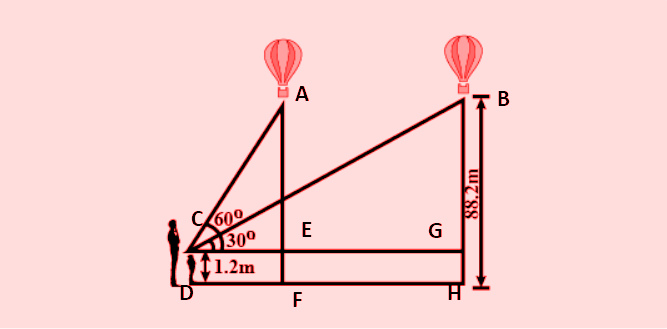
According to question,
We need to calculate the distance travelled by balloon that is from E to G,
So, considering $\vartriangle ACE$,
$ \Rightarrow \dfrac{{AE}}{{CE}} = \tan 60^\circ $
$ \Rightarrow \dfrac{{88.2 - 1.2}}{{CE}} = \sqrt 3 $
$ \Rightarrow CE = 29\sqrt 3 m$ …(1)
Considering $\vartriangle BCG$,
$ \Rightarrow \dfrac{{BG}}{{CG}} = \tan 30^\circ $
$ \Rightarrow \dfrac{{88.2 - 1.2}}{{CG}} = \dfrac{1}{{\sqrt 3 }}$
$ \Rightarrow CG = 87\sqrt 3 m$ …(2)
We have to calculate $EG$ which is the distance travelled by the balloon,
$ \Rightarrow EG = CG - CE$
$ \Rightarrow EG = 87\sqrt 3 - 29\sqrt 3 $
$ \Rightarrow EG = 58\sqrt 3 m$
Hence, we obtain the distance travelled by the balloon equal to $58\sqrt 3 m$. So, option (C) is correct.
Note- For solving any question based on height and distance, the first and foremost thing is the diagram. So, we should make the diagram first and label it according to the question. Our next step should be to find the angle and triangle which are important with respect to the unknown in the question, and then apply sine, cosine, tangent in triangles to obtain the result as required.
Complete step-by-step answer:
According to question,
We need to calculate the distance travelled by balloon that is from E to G,
So, considering $\vartriangle ACE$,
$ \Rightarrow \dfrac{{AE}}{{CE}} = \tan 60^\circ $
$ \Rightarrow \dfrac{{88.2 - 1.2}}{{CE}} = \sqrt 3 $
$ \Rightarrow CE = 29\sqrt 3 m$ …(1)
Considering $\vartriangle BCG$,
$ \Rightarrow \dfrac{{BG}}{{CG}} = \tan 30^\circ $
$ \Rightarrow \dfrac{{88.2 - 1.2}}{{CG}} = \dfrac{1}{{\sqrt 3 }}$
$ \Rightarrow CG = 87\sqrt 3 m$ …(2)
We have to calculate $EG$ which is the distance travelled by the balloon,
$ \Rightarrow EG = CG - CE$
$ \Rightarrow EG = 87\sqrt 3 - 29\sqrt 3 $
$ \Rightarrow EG = 58\sqrt 3 m$
Hence, we obtain the distance travelled by the balloon equal to $58\sqrt 3 m$. So, option (C) is correct.
Note- For solving any question based on height and distance, the first and foremost thing is the diagram. So, we should make the diagram first and label it according to the question. Our next step should be to find the angle and triangle which are important with respect to the unknown in the question, and then apply sine, cosine, tangent in triangles to obtain the result as required.
Recently Updated Pages
Master Class 11 Computer Science: Engaging Questions & Answers for Success

Master Class 11 Business Studies: Engaging Questions & Answers for Success
Master Class 11 Economics: Engaging Questions & Answers for Success
Master Class 11 English: Engaging Questions & Answers for Success
Master Class 11 Maths: Engaging Questions & Answers for Success
Master Class 11 Biology: Engaging Questions & Answers for Success
Trending doubts
One Metric ton is equal to kg A 10000 B 1000 C 100 class 11 physics CBSE
There are 720 permutations of the digits 1 2 3 4 5 class 11 maths CBSE
Discuss the various forms of bacteria class 11 biology CBSE
Draw a diagram of a plant cell and label at least eight class 11 biology CBSE
State the laws of reflection of light
Explain zero factorial class 11 maths CBSE