




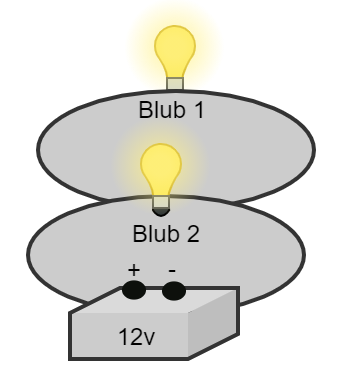
A $12$ volt battery is connected to two light bulbs, as drawn in figure $1$. Light bulb $1$
has resistance $3$ ohms, while light bulb $2$has resistance $6$ ohms. The battery has essentially no internal resistance, and all the wires are essentially resistance less too. When a light bulb is unscrewed, no current flows through that branch of the circuit. For instance, if a light bulb $2$ is unscrewed, current flows only around the lower loop of the circuit, which consists of the battery and light bulb $1$. The more current flows through a light bulb, their equivalent resistance is ${R_{eq}} = {R_1} + {R_2}$. By contrast, when two resistors are wired in parallel, their net resistance is given by $\dfrac{1}{{{R_{eq}}}} = \dfrac{1}{{{R_1}}} + \dfrac{1}{{{R_2}}}$.Bulb $2$ is now screwed in as a result, bulb $1$ :
A. Turns off
B. Becomes dimmer
C. Stays about the same brightness
D. Becomes brighter
Answer
 Verified
544.2k+ views
Hint: Here the two bulbs are connected in parallel. Each bulb sees the maximum voltage while the bulbs are in parallel. If a bulb glows brighter, the ones in parallel will shine brighter as it gets more power. Parallel combination of resistors lowers the circuit’s effective resistance.A circuit is said to be parallel when the electric current has multiple paths to flow through. The components that are a part of the parallel circuits will have a constant voltage across all ends.
Complete step by step answer:
There are two terminals of a bulb. There is a spiral wound wire, a filament, within the bulb. This filament is sustained by two thick wires at the ends. An electric cell is attached to the bulb’s terminals. Electricity from it, therefore, passes through the bulb. It glows and emits light from the filament in the bulb.All components are linked across each other in a parallel circuit, forming exactly two sets of electrically common points. A branch in parallel circuit is a path formed by one of the load components for the electric circuit.
When two bulbs are connected in series, the resistance rises in the circuit because of the bulbs. With the difference in electric potential being the same, the current reduces and the bulbs glow dimly. Both bulbs will glow with the same brightness in case of a parallel circuit.If only bulb $1$ is attached, the voltage is $12V$ through it.Now bulb $2$ is connected to bulb $1$ in parallel, so both bulbs are going to have $12\,V$ through them. Since, the voltage in bulb $1$ does not change, the current will not change so the brightness will not change.
Note:
Here we have to see whether the bulbs are connected in series or parallel.If they were connected in series, the answer would have been different.A branch in parallel circuit is a path formed by one of the load components for the electric circuit.The major difference between series and the parallel circuit is the amount of current that flows through each of the components in the circuit. In a series circuit, the same amount of current flows through all the components placed in it. On the other hand, in parallel circuits, the components are placed in parallel with each other due to this the circuit splits the current flow.
Complete step by step answer:
There are two terminals of a bulb. There is a spiral wound wire, a filament, within the bulb. This filament is sustained by two thick wires at the ends. An electric cell is attached to the bulb’s terminals. Electricity from it, therefore, passes through the bulb. It glows and emits light from the filament in the bulb.All components are linked across each other in a parallel circuit, forming exactly two sets of electrically common points. A branch in parallel circuit is a path formed by one of the load components for the electric circuit.
When two bulbs are connected in series, the resistance rises in the circuit because of the bulbs. With the difference in electric potential being the same, the current reduces and the bulbs glow dimly. Both bulbs will glow with the same brightness in case of a parallel circuit.If only bulb $1$ is attached, the voltage is $12V$ through it.Now bulb $2$ is connected to bulb $1$ in parallel, so both bulbs are going to have $12\,V$ through them. Since, the voltage in bulb $1$ does not change, the current will not change so the brightness will not change.
Note:
Here we have to see whether the bulbs are connected in series or parallel.If they were connected in series, the answer would have been different.A branch in parallel circuit is a path formed by one of the load components for the electric circuit.The major difference between series and the parallel circuit is the amount of current that flows through each of the components in the circuit. In a series circuit, the same amount of current flows through all the components placed in it. On the other hand, in parallel circuits, the components are placed in parallel with each other due to this the circuit splits the current flow.
Recently Updated Pages
Master Class 11 Computer Science: Engaging Questions & Answers for Success

Master Class 11 Business Studies: Engaging Questions & Answers for Success
Master Class 11 Economics: Engaging Questions & Answers for Success
Master Class 11 English: Engaging Questions & Answers for Success
Master Class 11 Maths: Engaging Questions & Answers for Success
Master Class 11 Biology: Engaging Questions & Answers for Success
Trending doubts
One Metric ton is equal to kg A 10000 B 1000 C 100 class 11 physics CBSE
There are 720 permutations of the digits 1 2 3 4 5 class 11 maths CBSE
Discuss the various forms of bacteria class 11 biology CBSE
Draw a diagram of a plant cell and label at least eight class 11 biology CBSE
State the laws of reflection of light
Explain zero factorial class 11 maths CBSE