




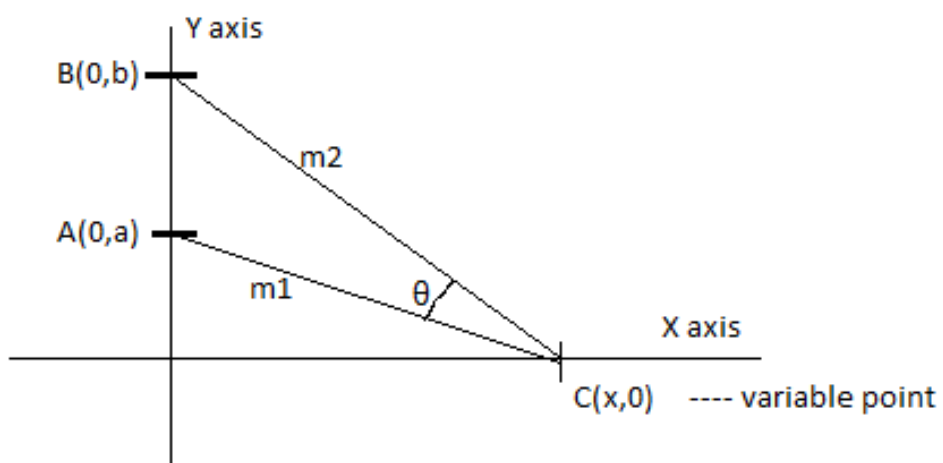
A (0, a) and B (0, b), a, b > 0 are two vertices of a triangle ABC where the vertex C (x, 0) is a variable. The value of x when the angle ∠ACB is maximum is?
\[ {\text{A}}{\text{. }}\dfrac{{{\text{a + b}}}}{2} \\
{\text{B}}{\text{. }}\sqrt {{\text{ab}}} \\
{\text{C}}{\text{. }}\dfrac{{2{\text{a}}}}{{{\text{a + b}}}} \\
{\text{D}}{\text{. }}\dfrac{{{\text{ab}}}}{{{\text{a + b}}}} \\ \]
Answer
 Verified
606.9k+ views
Hint: To find the value of x when the angle ACB is maximum, we use the given coordinates of the points A and B and find the slope of the line from A and B to the point C. Then we apply the formula of the angle between two lines using the slopes of lines AC and BC. Take the maximum value of the angle.
Complete step-by-step solution:
Given Data,
A (0, a) and B (0. b) and C (x, 0)
Let us construct an appropriate figure showing the given data, for our reference.
Now the slope between two points with coordinates (p, q) and (r, s) is given by the formula,
Slope: ${\text{m = }}\dfrac{{{\text{s - q}}}}{{{\text{r - p}}}}$.
Now the slope of the line AC with coordinates (0, a) and (x, 0) is given by
${{\text{m}}_1}{\text{ = }}\dfrac{{{\text{0 - a}}}}{{{\text{x - 0}}}} = - \dfrac{{\text{a}}}{{\text{x}}}$
Now the slope of the line BC with coordinates (0, b) and (x, 0) is given by
${{\text{m}}_2}{\text{ = }}\dfrac{{{\text{0 - b}}}}{{{\text{x - 0}}}} = - \dfrac{{\text{b}}}{{\text{x}}}$
We know the angle between two lines with respective slopes is given by the formula,
${\text{Tan }}\theta {\text{ = |}}\dfrac{{{{\text{m}}_2} - {{\text{m}}_1}}}{{1 + {{\text{m}}_1}{{\text{m}}_2}}}{\text{|}}$, where θ is the angle between the two lines and ${{\text{m}}_1}$and ${{\text{m}}_2}$are the slopes of the respective lines.
Now let the angle between the lines AC and BC be θ, which is given by
$\Rightarrow {\text{Tan }}\theta {\text{ = }}\left| {\dfrac{{ - \dfrac{{\text{b}}}{{\text{x}}}{\text{ + }}\dfrac{{\text{a}}}{{\text{x}}}}}{{1 + \dfrac{{{\text{ab}}}}{{{{\text{x}}^2}}}}}} \right| \\
\Rightarrow {\text{Tan }}\theta {\text{ = }}\left| {{\text{a - b}}} \right|\left| {\dfrac{1}{{{\text{x}} + \dfrac{{{\text{ab}}}}{{\text{x}}}}}} \right| \\ $
Now the angle θ is maximum only when the denominator of this term is the minimum.
For the term,${\text{x}} + \dfrac{{{\text{ab}}}}{{\text{x}}}$ we know AM ≥ GM
$\Rightarrow {\text{x = }}\dfrac{{{\text{ab}}}}{{\text{x}}} \\
\Rightarrow {{\text{x}}^2}{\text{ = ab}} \\
\Rightarrow {\text{x = }}\sqrt {{\text{ab}}} \\ $
The value of x when the angle ∠ACB is maximum is$\sqrt {{\text{ab}}} $.
Option B is the correct answer.
Note: In order to solve this type of question the key is to know the formula of relevant geometrical identities like the slope of a line with two-point coordinates, the angle between two lines, etc.
The most important step is to know that the value of the angle between two lines is maximum when the denominator is minimum. Since the Tan function’s value of an angle is directly proportional to its angle, the more the value of the Tan function, the maximum the angle is.
Any value inside the modulus function represented by | | only gives us the positive value of that function.
Complete step-by-step solution:
Given Data,
A (0, a) and B (0. b) and C (x, 0)
Let us construct an appropriate figure showing the given data, for our reference.
Now the slope between two points with coordinates (p, q) and (r, s) is given by the formula,
Slope: ${\text{m = }}\dfrac{{{\text{s - q}}}}{{{\text{r - p}}}}$.
Now the slope of the line AC with coordinates (0, a) and (x, 0) is given by
${{\text{m}}_1}{\text{ = }}\dfrac{{{\text{0 - a}}}}{{{\text{x - 0}}}} = - \dfrac{{\text{a}}}{{\text{x}}}$
Now the slope of the line BC with coordinates (0, b) and (x, 0) is given by
${{\text{m}}_2}{\text{ = }}\dfrac{{{\text{0 - b}}}}{{{\text{x - 0}}}} = - \dfrac{{\text{b}}}{{\text{x}}}$
We know the angle between two lines with respective slopes is given by the formula,
${\text{Tan }}\theta {\text{ = |}}\dfrac{{{{\text{m}}_2} - {{\text{m}}_1}}}{{1 + {{\text{m}}_1}{{\text{m}}_2}}}{\text{|}}$, where θ is the angle between the two lines and ${{\text{m}}_1}$and ${{\text{m}}_2}$are the slopes of the respective lines.
Now let the angle between the lines AC and BC be θ, which is given by
$\Rightarrow {\text{Tan }}\theta {\text{ = }}\left| {\dfrac{{ - \dfrac{{\text{b}}}{{\text{x}}}{\text{ + }}\dfrac{{\text{a}}}{{\text{x}}}}}{{1 + \dfrac{{{\text{ab}}}}{{{{\text{x}}^2}}}}}} \right| \\
\Rightarrow {\text{Tan }}\theta {\text{ = }}\left| {{\text{a - b}}} \right|\left| {\dfrac{1}{{{\text{x}} + \dfrac{{{\text{ab}}}}{{\text{x}}}}}} \right| \\ $
Now the angle θ is maximum only when the denominator of this term is the minimum.
For the term,${\text{x}} + \dfrac{{{\text{ab}}}}{{\text{x}}}$ we know AM ≥ GM
$\Rightarrow {\text{x = }}\dfrac{{{\text{ab}}}}{{\text{x}}} \\
\Rightarrow {{\text{x}}^2}{\text{ = ab}} \\
\Rightarrow {\text{x = }}\sqrt {{\text{ab}}} \\ $
The value of x when the angle ∠ACB is maximum is$\sqrt {{\text{ab}}} $.
Option B is the correct answer.
Note: In order to solve this type of question the key is to know the formula of relevant geometrical identities like the slope of a line with two-point coordinates, the angle between two lines, etc.
The most important step is to know that the value of the angle between two lines is maximum when the denominator is minimum. Since the Tan function’s value of an angle is directly proportional to its angle, the more the value of the Tan function, the maximum the angle is.
Any value inside the modulus function represented by | | only gives us the positive value of that function.
Recently Updated Pages
Master Class 11 Economics: Engaging Questions & Answers for Success

Master Class 11 English: Engaging Questions & Answers for Success
Master Class 11 Maths: Engaging Questions & Answers for Success
Class 11 Question and Answer - Your Ultimate Solutions Guide
Master Class 11 Social Science: Engaging Questions & Answers for Success
Master Class 11 Business Studies: Engaging Questions & Answers for Success
Trending doubts
Differentiate between an exothermic and an endothermic class 11 chemistry CBSE
One Metric ton is equal to kg A 10000 B 1000 C 100 class 11 physics CBSE
There are 720 permutations of the digits 1 2 3 4 5 class 11 maths CBSE
In what year Guru Nanak Dev ji was born A15 April 1469 class 11 social science CBSE
Difference Between Prokaryotic Cells and Eukaryotic Cells
Draw a diagram of a plant cell and label at least eight class 11 biology CBSE