




How should 5 capacitors each of capacitance $1\mu F$ be connected so as to produce a total capacitance of $\dfrac{3}{7}\mu F$?
Answer
 Verified
574.2k+ views
Hint: Capacitors can be connected in combinations in two ways; series and parallel. Select the number of capacitors to be connected in series and the number of capacitors in parallel individually and then connect their equivalent into a combination which gives the required capacitance.
Formula Used:
$\dfrac{1}{{{C}_{eq}}}=\dfrac{1}{{{C}_{1}}}+\dfrac{1}{{{C}_{2}}}+.......\dfrac{1}{{{C}_{n}}}$
${{C}_{eq}}={{C}_{1}}+{{C}_{2}}+......{{C}_{n}}$
Complete step-by-step solution:
The capacitance of a conductor is its ability to store charge on it. Its SI unit is farad ($F$).
There are two ways to connect capacitors in combinations; series and parallel combinations
In series combination, the reciprocals of the capacitance get added. The equivalent capacitance is smaller than the smallest value.
$\dfrac{1}{{{C}_{eq}}}=\dfrac{1}{{{C}_{1}}}+\dfrac{1}{{{C}_{2}}}+.......\dfrac{1}{{{C}_{n}}}$
In parallel combination, capacitance gets simply added. The equivalent capacitance is larger than the largest value.
${{C}_{eq}}={{C}_{1}}+{{C}_{2}}+......{{C}_{n}}$
In order to get an equivalence of $\dfrac{3}{7}\mu F$, first we can add two capacitors in series, their equivalence will be-
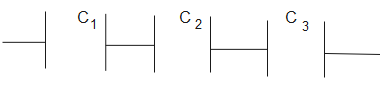
$\dfrac{1}{C}=1+1$
$\therefore C=\dfrac{1}{2}$ - (1)
The remaining set of capacitors can be connected in parallel, their equivalence will be-
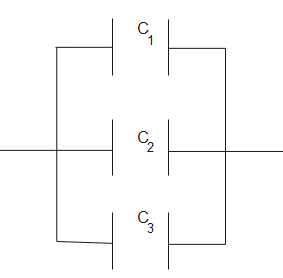
$C'=1+1+1$
$\therefore C'=3$ - (2)
The first set of capacitors connected in series and the second set of capacitors connected in parallel can now be connected in series giving a new equivalent as-
$\begin{align}
& \dfrac{1}{C''}=\dfrac{1}{\dfrac{1}{2}}+\dfrac{1}{3} \\
& \Rightarrow \dfrac{1}{C''}=2+\dfrac{1}{3} \\
& \Rightarrow \dfrac{1}{C''}=\dfrac{7}{3} \\
\end{align}$
$\therefore C''=\dfrac{3}{7}$
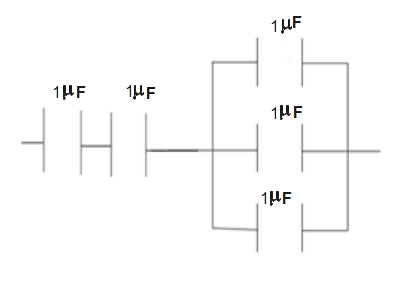
(Each capacitor is of $1\mu F$)
Additional information:
When capacitors are being charged, charge is being stored on their plates and it takes them $t=\infty $ to get charged. When a capacitor is fully charged, the arm in which the capacitor is connected is assumed to have been short-circuited. Half of the total work done by the battery is stored as energy in the capacitor whereas half of it is dissipated as heat.
Note:
Capacitors are devices used to store electrical energy in the presence of an electrical field. Combinations in capacitors are analogous to combinations in resistors. The capacitance of a conductor depends on the permeability of space inside the capacitor, area of cross section and distance between the plates.
Formula Used:
$\dfrac{1}{{{C}_{eq}}}=\dfrac{1}{{{C}_{1}}}+\dfrac{1}{{{C}_{2}}}+.......\dfrac{1}{{{C}_{n}}}$
${{C}_{eq}}={{C}_{1}}+{{C}_{2}}+......{{C}_{n}}$
Complete step-by-step solution:
The capacitance of a conductor is its ability to store charge on it. Its SI unit is farad ($F$).
There are two ways to connect capacitors in combinations; series and parallel combinations
In series combination, the reciprocals of the capacitance get added. The equivalent capacitance is smaller than the smallest value.
$\dfrac{1}{{{C}_{eq}}}=\dfrac{1}{{{C}_{1}}}+\dfrac{1}{{{C}_{2}}}+.......\dfrac{1}{{{C}_{n}}}$
In parallel combination, capacitance gets simply added. The equivalent capacitance is larger than the largest value.
${{C}_{eq}}={{C}_{1}}+{{C}_{2}}+......{{C}_{n}}$
In order to get an equivalence of $\dfrac{3}{7}\mu F$, first we can add two capacitors in series, their equivalence will be-
$\dfrac{1}{C}=1+1$
$\therefore C=\dfrac{1}{2}$ - (1)
The remaining set of capacitors can be connected in parallel, their equivalence will be-
$C'=1+1+1$
$\therefore C'=3$ - (2)
The first set of capacitors connected in series and the second set of capacitors connected in parallel can now be connected in series giving a new equivalent as-
$\begin{align}
& \dfrac{1}{C''}=\dfrac{1}{\dfrac{1}{2}}+\dfrac{1}{3} \\
& \Rightarrow \dfrac{1}{C''}=2+\dfrac{1}{3} \\
& \Rightarrow \dfrac{1}{C''}=\dfrac{7}{3} \\
\end{align}$
$\therefore C''=\dfrac{3}{7}$
(Each capacitor is of $1\mu F$)
Additional information:
When capacitors are being charged, charge is being stored on their plates and it takes them $t=\infty $ to get charged. When a capacitor is fully charged, the arm in which the capacitor is connected is assumed to have been short-circuited. Half of the total work done by the battery is stored as energy in the capacitor whereas half of it is dissipated as heat.
Note:
Capacitors are devices used to store electrical energy in the presence of an electrical field. Combinations in capacitors are analogous to combinations in resistors. The capacitance of a conductor depends on the permeability of space inside the capacitor, area of cross section and distance between the plates.
Recently Updated Pages
Basicity of sulphurous acid and sulphuric acid are

Master Class 12 English: Engaging Questions & Answers for Success
Master Class 12 Social Science: Engaging Questions & Answers for Success
Master Class 12 Maths: Engaging Questions & Answers for Success
Master Class 12 Economics: Engaging Questions & Answers for Success
Master Class 12 Physics: Engaging Questions & Answers for Success
Trending doubts
Which are the Top 10 Largest Countries of the World?
Draw a labelled sketch of the human eye class 12 physics CBSE
Draw ray diagrams each showing i myopic eye and ii class 12 physics CBSE
Give 10 examples of unisexual and bisexual flowers
Coming together federation is practiced in A India class 12 social science CBSE
Write the formula to find the shortest distance between class 12 maths CBSE