




35 students like either tea or coffee or both. 25 students like both. How many students like exactly one drink?
A.15
B.18
C.20
D.10
Answer
 Verified
609.3k+ views
Hint: In this question the number the number of students who like both the tea and the coffee is given and also the number of students who like both the tea and the coffee is given so we will plot these given data in the Venn diagram and then from the Venn diagram we will find the number of students liking either tea or the coffee.
Complete step-by-step answer:
Number of students liking either tea or coffee or both \[ = 35\]
Number of students liking both tea and coffee\[ = 25\]
Now let’s represent this on the Venn diagram
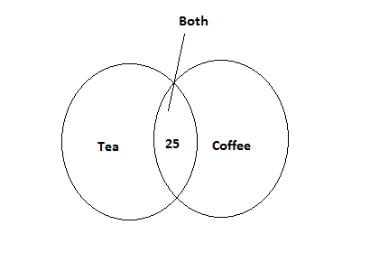
According to the question, we can write
\[n\left( {T \cup C} \right) = 35\] and \[n\left( {T \cap C} \right) = 25\]
Now we have to find the number of students who likes only one drink, i.e. \[n\left( T \right)\]or \[n\left( C \right)\]
So the number of students who like only one drink will be given by the difference in the number of students who like either tea or coffee and the number of students who likes both tea and coffee. Mathematically, \[n\left( {T{\text{ }}or{\text{ }}C} \right) = n\left( {T \cup C} \right) - n\left( {T \cap C} \right)\] where, \[n\left( {T \cup C} \right) = 35\] is the number of students who likes either tea or coffee and \[n\left( {T \cap C} \right) = 25\] is the number of students who likes both tea and coffee.
So, substituting the values in the equation
\[\Rightarrow n\left( {T{\text{ }}or{\text{ }}C} \right) = n\left( {T \cup C} \right) - n\left( {T \cap C} \right)\], we get
\[
\Rightarrow n\left( {T{\text{ }}or{\text{ }}C} \right) = n\left( {T \cup C} \right) - n\left( {T \cap C} \right) \\
= 35 - 25 \\
= 10 \;
\]
Hence the number of student who like only one drink\[ = 10\]
So, the correct answer is “Option D”.
Note: Two events are said to be mutually exclusive when the occurrence of one doesn’t affect the occurrence of another event. Union between the events indicates the summation of the events while the intersection between the events signifies the common values between the events.
\[P\left( {A \cap B} \right) = P\left( A \right) + P\left( B \right) - P\left( {A \cup B} \right)\] where, A and B are two mutually exclusive independent events.
Complete step-by-step answer:
Number of students liking either tea or coffee or both \[ = 35\]
Number of students liking both tea and coffee\[ = 25\]
Now let’s represent this on the Venn diagram
According to the question, we can write
\[n\left( {T \cup C} \right) = 35\] and \[n\left( {T \cap C} \right) = 25\]
Now we have to find the number of students who likes only one drink, i.e. \[n\left( T \right)\]or \[n\left( C \right)\]
So the number of students who like only one drink will be given by the difference in the number of students who like either tea or coffee and the number of students who likes both tea and coffee. Mathematically, \[n\left( {T{\text{ }}or{\text{ }}C} \right) = n\left( {T \cup C} \right) - n\left( {T \cap C} \right)\] where, \[n\left( {T \cup C} \right) = 35\] is the number of students who likes either tea or coffee and \[n\left( {T \cap C} \right) = 25\] is the number of students who likes both tea and coffee.
So, substituting the values in the equation
\[\Rightarrow n\left( {T{\text{ }}or{\text{ }}C} \right) = n\left( {T \cup C} \right) - n\left( {T \cap C} \right)\], we get
\[
\Rightarrow n\left( {T{\text{ }}or{\text{ }}C} \right) = n\left( {T \cup C} \right) - n\left( {T \cap C} \right) \\
= 35 - 25 \\
= 10 \;
\]
Hence the number of student who like only one drink\[ = 10\]
So, the correct answer is “Option D”.
Note: Two events are said to be mutually exclusive when the occurrence of one doesn’t affect the occurrence of another event. Union between the events indicates the summation of the events while the intersection between the events signifies the common values between the events.
\[P\left( {A \cap B} \right) = P\left( A \right) + P\left( B \right) - P\left( {A \cup B} \right)\] where, A and B are two mutually exclusive independent events.
Recently Updated Pages
Master Class 12 Economics: Engaging Questions & Answers for Success

Master Class 12 English: Engaging Questions & Answers for Success
Master Class 12 Social Science: Engaging Questions & Answers for Success
Master Class 12 Maths: Engaging Questions & Answers for Success
Master Class 12 Physics: Engaging Questions & Answers for Success
Master Class 9 General Knowledge: Engaging Questions & Answers for Success
Trending doubts
Find the sum of series 1 + 2 + 3 + 4 + 5 + + 100 class 9 maths CBSE
Difference Between Plant Cell and Animal Cell
Fill the blanks with the suitable prepositions 1 The class 9 english CBSE
What is pollution? How many types of pollution? Define it
Name 10 Living and Non living things class 9 biology CBSE
What is the full form of pH?