



$ 2\;{\rm{cm}} $ of rain has fallen on a square kilometer of land. Assuming that $ 50\% $ of the rain drops could have been collected and contained in a pool having a $ 100\;{\rm{m}} \times {\rm{10}}\;{\rm{m}} $ base, by what level would the water level in the pool have increased?
Answer
 Verified
591.6k+ views
Hint: In this question, we have to calculate the change in the level of water of land if $ 50\% $ of the rainwater is collected in a pool. The units given for the area and the height are different, so first, we convert all the units into Metric units.
The conversion formulas are given by-
$
1{\rm{ kilometer = 1000 meter}}\\
1{\rm{ }}{\left( {{\rm{kilometer}}} \right)^2} = {\left( {1000{\rm{meter}}} \right)^2}\\
1{\rm{ centimeter = }}\dfrac{1}{{100}}{\rm{ meter}}
$
Complete step-by-step answer:
The area of the land is,
$
\Rightarrow A = {\left( {1\;{\rm{km}}} \right)^2}\\
= {\left( {1000\;{\rm{m}}} \right)^2}
$
The height of the fallen rain on the land is,
$
\Rightarrow h = 2\;{\rm{cm}}\\
{\rm{ = 0}}{\rm{.02}}\;{\rm{m}}
$
The area of the pool base is,
\[
\Rightarrow {A_p} = 100\;{\rm{m}} \times 10\;{\rm{m}}\\
= 1000\;{{\rm{m}}^2}
\]
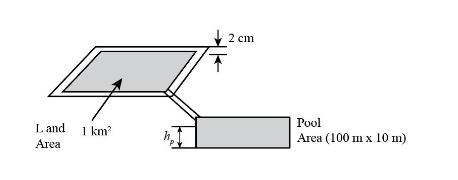
The total volume of the rain falling on the land is given by,
$
\Rightarrow V = {\text{ The area of the land }} \times {\text{ The height of the fallen rain on the land}}\\
= A \times h
$
Substituting the values of $ A $ and $ h $ in the equation we get,
$\Rightarrow V = {1000^2}\;{{\rm{m}}^{\rm{2}}} \times {\rm{0}}{\rm{.02}}\;{\rm{m}} $
Solving this we get,
$ V = 20000\;{{\rm{m}}^3} $
Now according to the question $ 50\% $ of the total volume of rain is collected and contained in the pool, so
The volume of the rain water collected in the pool is,
$\Rightarrow {V_p} = 0.5 \times V $
Substituting the value of $ V $ in the equation we get,
$
\Rightarrow {V_p} = 0.5 \times 20000\;{{\rm{m}}^3}\\
\Rightarrow {V_p} = 10000\;{{\rm{m}}^3}
$
Let us suppose the level of the water in the pool be $ {h_p} $ then,
\[\Rightarrow {\text{The increase in the level of water in the pool = }}\dfrac{{{\text{The volume of the rain water collected in the pool}}}}{{{\text{The area of pool base}}}}\]
Or,
$\Rightarrow {h_p} = \dfrac{{{V_p}}}{{{A_p}}} $
Substituting the values of $ {V_p} {\text{ and } }{A_p} $ in the equation we get,
$
\Rightarrow {h_p} = \dfrac{{10000\;{{\rm{m}}^3}}}{{1000\;{{\rm{m}}^2}}}\\
\Rightarrow {h_p} = 10\;{\rm{m}}
$
Therefore, the increase in the water level in the pool is $ 10{\rm{m}} $ .
Note: It should be noted that while working with different units, the first step should be to convert all the relevant units to Metric Units. The most commonly used Metric units are as following-
(i) Metre for Length or Distance
(ii) Second for Time
(iii) Kilogram for Mass
The conversion formulas are given by-
$
1{\rm{ kilometer = 1000 meter}}\\
1{\rm{ }}{\left( {{\rm{kilometer}}} \right)^2} = {\left( {1000{\rm{meter}}} \right)^2}\\
1{\rm{ centimeter = }}\dfrac{1}{{100}}{\rm{ meter}}
$
Complete step-by-step answer:
The area of the land is,
$
\Rightarrow A = {\left( {1\;{\rm{km}}} \right)^2}\\
= {\left( {1000\;{\rm{m}}} \right)^2}
$
The height of the fallen rain on the land is,
$
\Rightarrow h = 2\;{\rm{cm}}\\
{\rm{ = 0}}{\rm{.02}}\;{\rm{m}}
$
The area of the pool base is,
\[
\Rightarrow {A_p} = 100\;{\rm{m}} \times 10\;{\rm{m}}\\
= 1000\;{{\rm{m}}^2}
\]
The total volume of the rain falling on the land is given by,
$
\Rightarrow V = {\text{ The area of the land }} \times {\text{ The height of the fallen rain on the land}}\\
= A \times h
$
Substituting the values of $ A $ and $ h $ in the equation we get,
$\Rightarrow V = {1000^2}\;{{\rm{m}}^{\rm{2}}} \times {\rm{0}}{\rm{.02}}\;{\rm{m}} $
Solving this we get,
$ V = 20000\;{{\rm{m}}^3} $
Now according to the question $ 50\% $ of the total volume of rain is collected and contained in the pool, so
The volume of the rain water collected in the pool is,
$\Rightarrow {V_p} = 0.5 \times V $
Substituting the value of $ V $ in the equation we get,
$
\Rightarrow {V_p} = 0.5 \times 20000\;{{\rm{m}}^3}\\
\Rightarrow {V_p} = 10000\;{{\rm{m}}^3}
$
Let us suppose the level of the water in the pool be $ {h_p} $ then,
\[\Rightarrow {\text{The increase in the level of water in the pool = }}\dfrac{{{\text{The volume of the rain water collected in the pool}}}}{{{\text{The area of pool base}}}}\]
Or,
$\Rightarrow {h_p} = \dfrac{{{V_p}}}{{{A_p}}} $
Substituting the values of $ {V_p} {\text{ and } }{A_p} $ in the equation we get,
$
\Rightarrow {h_p} = \dfrac{{10000\;{{\rm{m}}^3}}}{{1000\;{{\rm{m}}^2}}}\\
\Rightarrow {h_p} = 10\;{\rm{m}}
$
Therefore, the increase in the water level in the pool is $ 10{\rm{m}} $ .
Note: It should be noted that while working with different units, the first step should be to convert all the relevant units to Metric Units. The most commonly used Metric units are as following-
(i) Metre for Length or Distance
(ii) Second for Time
(iii) Kilogram for Mass
Recently Updated Pages
Basicity of sulphurous acid and sulphuric acid are

Master Class 9 Social Science: Engaging Questions & Answers for Success
Master Class 9 Science: Engaging Questions & Answers for Success
Master Class 9 Maths: Engaging Questions & Answers for Success
Master Class 9 General Knowledge: Engaging Questions & Answers for Success
Class 9 Question and Answer - Your Ultimate Solutions Guide
Trending doubts
Fill the blanks with the suitable prepositions 1 The class 9 english CBSE
Difference Between Plant Cell and Animal Cell
Find the sum of series 1 + 2 + 3 + 4 + 5 + + 100 class 9 maths CBSE
Distinguish between Conventional and nonconventional class 9 social science CBSE
What is pollution? How many types of pollution? Define it
Describe the 4 stages of the Unification of German class 9 social science CBSE