




2-Chloro-1,3-butadiene is also known as –
A.Chloroprene
B.Neoprene
C.Isoprene
D.Buna - N
Answer
 Verified
593.1k+ views
Hint: This question demands information on 2-Chloro-1,3-butadiene. We should know its IUPAC and the structure. It is also known as 2-chlor-1,3 diene, its molecular mass is 88.53g/mol. It is a colourless liquid. Let’s understand more about it.
Complete answer:
The common name of 2-chloro-1,3 butadiene is Chloroprene.
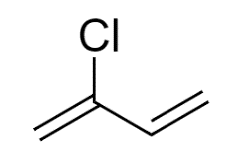
It is a monomer that is used to produce polymer i.e polychloroprene also known as neoprene which is a type of synthetic rubber. Chloroprene is a colorless, volatile liquid. Polymerization should not be done inside the container as it could explode.
The production of chloroprene occurs in three steps-
First, The process of chlorination happens
Second, Isomerization of part of the product stream occur
Third, the Dehydrochlorination of 3,4 dichlorobut-1-ene occurs.
A certain amount of Cl is added to 1,3-butadiene so that we could get a mixture of 3,4-dichlorobut-1-ene and 1,4-dichlorobut-2-ene. Then the isomerization of 1,4-dichloro occurs to form 3,4 isomers, It is treated with a base so that dehydrochlorination could be done to 2-chlorobuta-1,3-diene. Due to dehydrohalogenation loss of H atom occurs at 3 position and loss of Cl atom occurs at 4 position. It results in the formation of a double bond between carbon 3 and 4.
So, 2-Chloro-1,3-butadiene is also known as Option(A) chloroprene.
Note:
Chloroprene could be toxic, If someone gets exposed to a high concentration of it, They could face issues like headaches, dizziness, fatigue, loss of sleep, respiratory problems, nausea, gastrointestinal issues, hair loss, conjunctivitis, chest pain, cancer, dermatitis, liver function problems, the immune system could become weak. In animals, there could be tumors in multiple organs.
Complete answer:
The common name of 2-chloro-1,3 butadiene is Chloroprene.
It is a monomer that is used to produce polymer i.e polychloroprene also known as neoprene which is a type of synthetic rubber. Chloroprene is a colorless, volatile liquid. Polymerization should not be done inside the container as it could explode.
The production of chloroprene occurs in three steps-
First, The process of chlorination happens
Second, Isomerization of part of the product stream occur
Third, the Dehydrochlorination of 3,4 dichlorobut-1-ene occurs.
A certain amount of Cl is added to 1,3-butadiene so that we could get a mixture of 3,4-dichlorobut-1-ene and 1,4-dichlorobut-2-ene. Then the isomerization of 1,4-dichloro occurs to form 3,4 isomers, It is treated with a base so that dehydrochlorination could be done to 2-chlorobuta-1,3-diene. Due to dehydrohalogenation loss of H atom occurs at 3 position and loss of Cl atom occurs at 4 position. It results in the formation of a double bond between carbon 3 and 4.
So, 2-Chloro-1,3-butadiene is also known as Option(A) chloroprene.
Note:
Chloroprene could be toxic, If someone gets exposed to a high concentration of it, They could face issues like headaches, dizziness, fatigue, loss of sleep, respiratory problems, nausea, gastrointestinal issues, hair loss, conjunctivitis, chest pain, cancer, dermatitis, liver function problems, the immune system could become weak. In animals, there could be tumors in multiple organs.
Recently Updated Pages
Which will be the least stable resonating structure class 11 chemistry CBSE

How many 5 digit telephone numbers can be construc-class-11-maths-CBSE
How do you find the angle of the resultant vector class 11 physics CBSE
Draw labelled diagram of the following i Gram seed class 11 biology CBSE
What is the need and importance of classification class 11 biology CBSE
The way in which the sparrows expressed their sorrow class 11 english CBSE
Trending doubts
One Metric ton is equal to kg A 10000 B 1000 C 100 class 11 physics CBSE
Find the value of the expression given below sin 30circ class 11 maths CBSE
1 Quintal is equal to a 110 kg b 10 kg c 100kg d 1000 class 11 physics CBSE
Draw a diagram of nephron and explain its structur class 11 biology CBSE
10 examples of friction in our daily life
Proton was discovered by A Thomson B Rutherford C Chadwick class 11 chemistry CBSE