




2-butanol is converted into 2-methylbutanoic acid by:
A. (i) Cu (ii) HCN (iii) ${{H}_{3}}{{O}^{+}}$
B. (i) HCN (ii) ${{H}_{3}}{{O}^{+}}$
C. (i) $PC{{l}_{5}}$ (ii) KCN (iii) ${{H}_{3}}{{O}^{+}}$
D. (i) KCN (ii) ${{H}_{3}}{{O}^{+}}$
Answer
 Verified
581.1k+ views
Hint: Butanol is a molecule containing 4 carbon atoms along with an alcoholic group that’s why the suffix ol is attached with it. While butanoic acid is those compounds in which an acidic group is present.
Complete answer:
Butanol is primarily used as a solvent and as an intermediate in chemical synthesis and also used as a fuel. 2-butanol describes the position of alcoholic group i.e. OH group is present on 2nd carbon atom which can be shown as:

2-methylbutanoic acid tells that a 2nd carbon methyl group is attached and an acidic group is present on the first position. It exists in two enantiomeric forms which are defined as (R) and (S)-2-methylbutanoic acid. (R)-2-methylbutanoic acid occurs naturally in cocoa beans and (S)-2-methylbutanoic is present in many fruits such as apples and apricots.
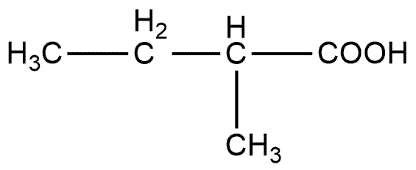
2-butanol is converted into 2-methylbutanoic acid step by step:
Ist step converts 2-butanol to 2-chlorobutane

In second step, 2-chlorobutane reacts with KCN and get Cl group get replaced with CN group which can be shown as:

In third step, it reacts with ${{H}_{3}}{{O}^{+}}$and get converted into 2-methylbutanoic acid which can be shown as:

Thus we can say that option C is the correct answer.
Note:
2-methylbutanoic acid is a slightly volatile, colorless liquid with a pungent cheesy odor. The smell differs significantly between the two enantiomeric forms i.e. (S)-2-Methylbutyric acid has a pleasantly sweet, fruity odor while (R)-2-methylbutanoic acid has a cheesy, sweaty odor. The main use of the materials and their esters used as flavours and food additives.
Complete answer:
Butanol is primarily used as a solvent and as an intermediate in chemical synthesis and also used as a fuel. 2-butanol describes the position of alcoholic group i.e. OH group is present on 2nd carbon atom which can be shown as:
2-methylbutanoic acid tells that a 2nd carbon methyl group is attached and an acidic group is present on the first position. It exists in two enantiomeric forms which are defined as (R) and (S)-2-methylbutanoic acid. (R)-2-methylbutanoic acid occurs naturally in cocoa beans and (S)-2-methylbutanoic is present in many fruits such as apples and apricots.
2-butanol is converted into 2-methylbutanoic acid step by step:
Ist step converts 2-butanol to 2-chlorobutane
In second step, 2-chlorobutane reacts with KCN and get Cl group get replaced with CN group which can be shown as:
In third step, it reacts with ${{H}_{3}}{{O}^{+}}$and get converted into 2-methylbutanoic acid which can be shown as:
Thus we can say that option C is the correct answer.
Note:
2-methylbutanoic acid is a slightly volatile, colorless liquid with a pungent cheesy odor. The smell differs significantly between the two enantiomeric forms i.e. (S)-2-Methylbutyric acid has a pleasantly sweet, fruity odor while (R)-2-methylbutanoic acid has a cheesy, sweaty odor. The main use of the materials and their esters used as flavours and food additives.
Recently Updated Pages
Basicity of sulphurous acid and sulphuric acid are

Master Class 11 English: Engaging Questions & Answers for Success
Master Class 11 Physics: Engaging Questions & Answers for Success
Master Class 11 Computer Science: Engaging Questions & Answers for Success
Master Class 11 Chemistry: Engaging Questions & Answers for Success
Master Class 11 Social Science: Engaging Questions & Answers for Success
Trending doubts
What will happen if the mucus is not secreted by the class 11 biology CBSE
The dimensional formula for coefficient of thermal class 11 physics CBSE
The actual molecular mass of chlorine is A 5893 times class 11 chemistry CBSE
How do I convert ms to kmh Give an example class 11 physics CBSE
The oxidation number of sulphur in Caros acid H2SO5 class 11 chemistry CBSE
Name the Largest and the Smallest Cell in the Human Body ?