




2,6 - Dimethylheptane on monochlorination produces..................derivatives.
A) 5
B) 6
C) 3
D) 4
Answer
 Verified
555.9k+ views
Hint: Monochlorination is the addition of chlorine at the terminal methyl groups. The chlorine atom replaces the hydrogen from the methyl group and gets attached to the carbon of the methyl group. Monochlorination means only single chlorine is being added, although multiple chlorine atoms can bind with the molecule based on the availability of methyl groups.
Complete answer:
2,6 - Dimethylheptane is a disubstituted alkane. Two methyl groups are attached to the second and sixth carbon atoms on the chain. The structure of the 2,6 - Dimethylheptane can be drawn as-
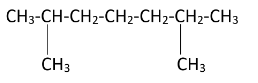
As the diagram suggests, there are four free terminal methyl groups. Monochlorination can occur on all of them. The products formed after mono chlorination will be -
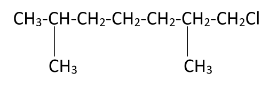
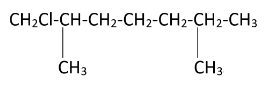
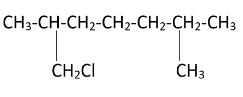
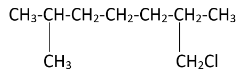
Hence, we can see that there are four possible monochlorination products.
So the correct option is D) 4.
Note:
The products formed can be named as – [7-chloro, 2,6 dimethylheptane], [1-chloro, 2,6 dimethylheptane], [2-chloromethyl, 6-methyl heptane], [6-chloromethyl, 2-methyl heptane]. Simultaneous chlorination can also occur at all the methyl groups present in the molecule resulting in tetrachloro substitution.
Complete answer:
2,6 - Dimethylheptane is a disubstituted alkane. Two methyl groups are attached to the second and sixth carbon atoms on the chain. The structure of the 2,6 - Dimethylheptane can be drawn as-
As the diagram suggests, there are four free terminal methyl groups. Monochlorination can occur on all of them. The products formed after mono chlorination will be -
Hence, we can see that there are four possible monochlorination products.
So the correct option is D) 4.
Note:
The products formed can be named as – [7-chloro, 2,6 dimethylheptane], [1-chloro, 2,6 dimethylheptane], [2-chloromethyl, 6-methyl heptane], [6-chloromethyl, 2-methyl heptane]. Simultaneous chlorination can also occur at all the methyl groups present in the molecule resulting in tetrachloro substitution.
Recently Updated Pages
Which will be the least stable resonating structure class 11 chemistry CBSE

How many 5 digit telephone numbers can be construc-class-11-maths-CBSE
How do you find the angle of the resultant vector class 11 physics CBSE
Draw labelled diagram of the following i Gram seed class 11 biology CBSE
1 Quintal is equal to a 110 kg b 10 kg c 100kg d 1000 class 11 physics CBSE
What is the need and importance of classification class 11 biology CBSE
Trending doubts
Find the value of the expression given below sin 30circ class 11 maths CBSE
One Metric ton is equal to kg A 10000 B 1000 C 100 class 11 physics CBSE
10 examples of friction in our daily life
Draw a diagram of a plant cell and label at least eight class 11 biology CBSE
Difference between physical and chemical change class 11 chemistry CBSE
Proton was discovered by A Thomson B Rutherford C Chadwick class 11 chemistry CBSE