




(2,1) is a point, which belongs to the line
A. $x=y$
B. $y=x+1$
C. $2y=x$
D. $xy=1$
Answer
 Verified
575.1k+ views
Hint: To solve the given particular problem one should know about the equations of lines and have the knowledge of four quadrants also. And also, should know that any point lying on the line should satisfy the equation clearly. Here we need to check for all the equations given in the options that whether the point holds correctly into it or not.
Complete step by step solution:
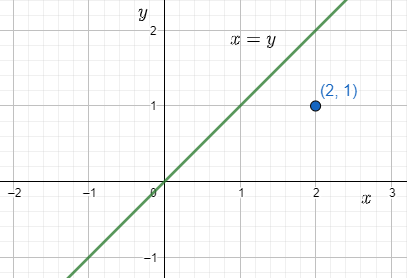
In equation A. $x=y$
Clearly, we can say the two are not equal to one.
So, we can say that point $(2,1)$ does not satisfy the given first equation.
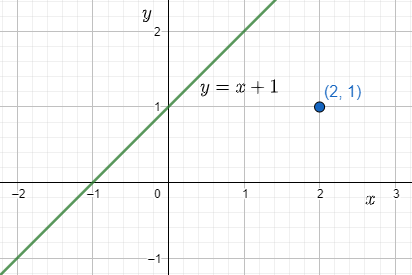
In equation B. $y=x+1$
We have RHS = $1$ and LHS = $2+1=3$
So, we get LHS $\ne $ RHS
Clearly, $(2,1)$ does not satisfy the second equation of the line $x=y$.
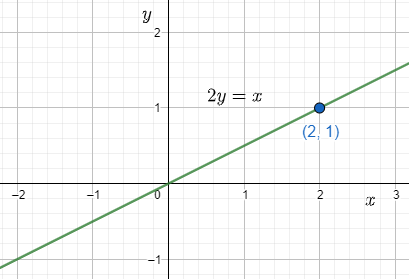
Then in option C. $2y=x$
We have RHS = $2(1)=2$ and LHS = $2$
Hence, we get that $(2,1)$ does satisfy the equation C. So the answer for this question is C.
We can try the fourth option also for confirming whether the answer found is correct or not.
Checking on to the fourth option we could get to know that LHS is not equal to RHS and the given point does not satisfy the particular equation in the option.
Hence, we can go with the correct option that is option C. $2y=x$.
Note: To find the answer for the given problem one should have the knowledge of solving algebraic equation where the point is given. As an alternative method we can plot the graphs for each line and then check which line will satisfy the condition given in the problem. Now Graph is plotted as shown below,
Option A.
Option B.
Option C.
Option D.
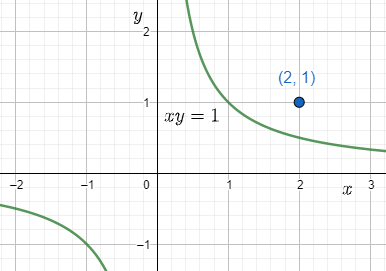
We can see that the graph for option C passes through the point (2,1), so option C is the correct answer.
Complete step by step solution:
In equation A. $x=y$
Clearly, we can say the two are not equal to one.
So, we can say that point $(2,1)$ does not satisfy the given first equation.
In equation B. $y=x+1$
We have RHS = $1$ and LHS = $2+1=3$
So, we get LHS $\ne $ RHS
Clearly, $(2,1)$ does not satisfy the second equation of the line $x=y$.
Then in option C. $2y=x$
We have RHS = $2(1)=2$ and LHS = $2$
Hence, we get that $(2,1)$ does satisfy the equation C. So the answer for this question is C.
We can try the fourth option also for confirming whether the answer found is correct or not.
Checking on to the fourth option we could get to know that LHS is not equal to RHS and the given point does not satisfy the particular equation in the option.
Hence, we can go with the correct option that is option C. $2y=x$.
Note: To find the answer for the given problem one should have the knowledge of solving algebraic equation where the point is given. As an alternative method we can plot the graphs for each line and then check which line will satisfy the condition given in the problem. Now Graph is plotted as shown below,
Option A.
Option B.
Option C.
Option D.
We can see that the graph for option C passes through the point (2,1), so option C is the correct answer.
Recently Updated Pages
Master Class 12 Economics: Engaging Questions & Answers for Success

Master Class 12 English: Engaging Questions & Answers for Success
Master Class 12 Social Science: Engaging Questions & Answers for Success
Master Class 12 Maths: Engaging Questions & Answers for Success
Master Class 12 Physics: Engaging Questions & Answers for Success
Master Class 10 English: Engaging Questions & Answers for Success
Trending doubts
Explain the Treaty of Vienna of 1815 class 10 social science CBSE
Who Won 36 Oscar Awards? Record Holder Revealed
Why is it 530 pm in india when it is 1200 afternoon class 10 social science CBSE
What is the full form of POSCO class 10 social science CBSE
Define Potential, Developed, Stock and Reserved resources
The speaker of the Lok Sabha is elected by the APresident class 10 social science CBSE