



Where do $2$ perpendicular lines intersect?
Answer
 Verified
549.9k+ views
Hint: The slopes of two perpendicular lines are related by the equation \[{{m}_{1}}{{m}_{2}}=-1\]. From this, we can show that the slopes of two perpendicular lines can never be equal and therefore they must intersect. To answer the above question, we need to consider two perpendicular lines, say ${{L}_{1}}$ and ${{L}_{2}}$. By terminating both of the lines ${{L}_{1}}$ and ${{L}_{2}}$ at the point of intersection, we will have one case. And by not terminating them at the intersecting point, we will have the other case.
Complete step by step solution:
Let us consider two lines ${{L}_{1}}$ and ${{L}_{2}}$, which are perpendicular to each other. We know that the slopes of two perpendicular lines are related such that their product is equal to the negative of one, that is, $-1$. So if the slope of the first line ${{L}_{1}}$ is equal to \[{{m}_{1}}\] and that of the second line ${{L}_{2}}$ is equal to ${{m}_{2}}$, then these can be related by the below equation
\[\begin{align}
& \Rightarrow {{m}_{1}}{{m}_{2}}=-1 \\
& \Rightarrow {{m}_{2}}=-\dfrac{1}{{{m}_{2}}} \\
\end{align}\]
Clearly, from the above equation we can say that two perpendicular lines can never have equal slopes. And we know that two lines having unequal slopes do intersect each other at a point.
Now, the intersection of two perpendicular lines can have two cases. For this, let us represent these two perpendicular lines ${{L}_{1}}$ and ${{L}_{2}}$ in the below figure.
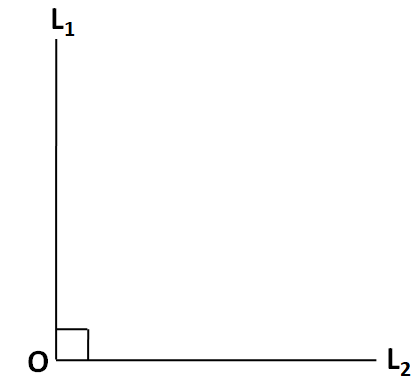
In the above figure, we can see that the two perpendicular lines ${{L}_{1}}$ and ${{L}_{2}}$ are intersecting at the point O. The two lines are forming a corner at the point O, since they are terminating at the point O.
From the definition of a line, we know that a line is not of a finite length. Therefore, it is not necessary that the two lines ${{L}_{1}}$ and ${{L}_{2}}$ must terminate at O. They can also extend beyond O infinitely, as shown in the below figure.
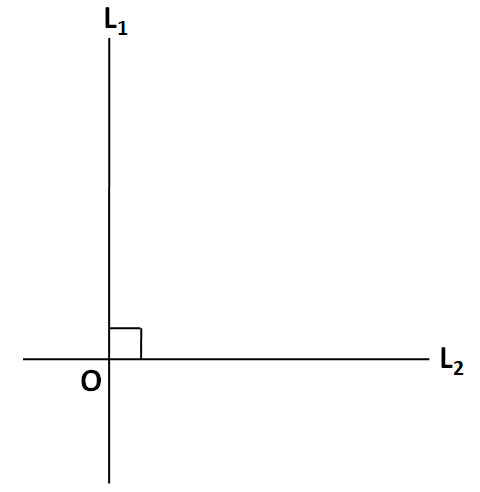
Hence, from the above two cases considered, we can conclude that two perpendicular liens can either terminate at the intersection point to form a corner, or they can continue their respective paths after getting intersected.
Note: It is necessary to show mathematically that the two perpendicular lines can never have equal slopes by using the condition \[{{m}_{1}}{{m}_{2}}=-1\]. Do not get confused that we have opposed the infinite length definition of the line in the first case considered above, where the two lines terminate at the point O. They are still infinitely long, since their initial point is not labeled in the first figure.
Complete step by step solution:
Let us consider two lines ${{L}_{1}}$ and ${{L}_{2}}$, which are perpendicular to each other. We know that the slopes of two perpendicular lines are related such that their product is equal to the negative of one, that is, $-1$. So if the slope of the first line ${{L}_{1}}$ is equal to \[{{m}_{1}}\] and that of the second line ${{L}_{2}}$ is equal to ${{m}_{2}}$, then these can be related by the below equation
\[\begin{align}
& \Rightarrow {{m}_{1}}{{m}_{2}}=-1 \\
& \Rightarrow {{m}_{2}}=-\dfrac{1}{{{m}_{2}}} \\
\end{align}\]
Clearly, from the above equation we can say that two perpendicular lines can never have equal slopes. And we know that two lines having unequal slopes do intersect each other at a point.
Now, the intersection of two perpendicular lines can have two cases. For this, let us represent these two perpendicular lines ${{L}_{1}}$ and ${{L}_{2}}$ in the below figure.
In the above figure, we can see that the two perpendicular lines ${{L}_{1}}$ and ${{L}_{2}}$ are intersecting at the point O. The two lines are forming a corner at the point O, since they are terminating at the point O.
From the definition of a line, we know that a line is not of a finite length. Therefore, it is not necessary that the two lines ${{L}_{1}}$ and ${{L}_{2}}$ must terminate at O. They can also extend beyond O infinitely, as shown in the below figure.
Hence, from the above two cases considered, we can conclude that two perpendicular liens can either terminate at the intersection point to form a corner, or they can continue their respective paths after getting intersected.
Note: It is necessary to show mathematically that the two perpendicular lines can never have equal slopes by using the condition \[{{m}_{1}}{{m}_{2}}=-1\]. Do not get confused that we have opposed the infinite length definition of the line in the first case considered above, where the two lines terminate at the point O. They are still infinitely long, since their initial point is not labeled in the first figure.
Recently Updated Pages
Master Class 8 Social Science: Engaging Questions & Answers for Success

Master Class 8 English: Engaging Questions & Answers for Success
Class 8 Question and Answer - Your Ultimate Solutions Guide
Master Class 8 Maths: Engaging Questions & Answers for Success
Master Class 8 Science: Engaging Questions & Answers for Success
Master Class 9 General Knowledge: Engaging Questions & Answers for Success
Trending doubts
What is BLO What is the full form of BLO class 8 social science CBSE
Citizens of India can vote at the age of A 18 years class 8 social science CBSE
Full form of STD, ISD and PCO
Advantages and disadvantages of science
Right to vote is a AFundamental Right BFundamental class 8 social science CBSE
What are the 12 elements of nature class 8 chemistry CBSE