




1-methylcyclohexene on treatment with HCl gas gives:
(A) 1-chloro-2-methylcyclohexane
(B) 1-chloro-1-methylcyclohexane
(C) 1-chloro-cyclohexane
(D) None of these
Answer
 Verified
591.9k+ views
Hint: In this question, 1- methylcyclohexene is an asymmetric alkene whereas HCl is a hydrogen halide. So, to solve this question we first need to know how the reaction between an asymmetric alkene and a hydrogen halide takes place.
Complete answer:
We know that hydrogen halides (HX) are protic acids. i.e., these acids produce protons as they ionize in solutions.
Now, when an asymmetric alkene reacts with a protic acid, the unsaturated carbon atom which has the most number of alkyl substituents will form a bond with the halide group whereas the unsaturated carbon atom which has the most number of hydrogen substituent will bind with the acidic hydrogen to form the major saturated product.
This phenomenon is known as Markovnikov's rule.
\[R-CH=C{{H}_{2}}+HX\to R-CH(X)-C{{H}_{3}}\text{ (major)}\]
So, according to this rule, the reaction between 1-methylcyclohexene and hydrochloric acid (HCl) will be as follows.
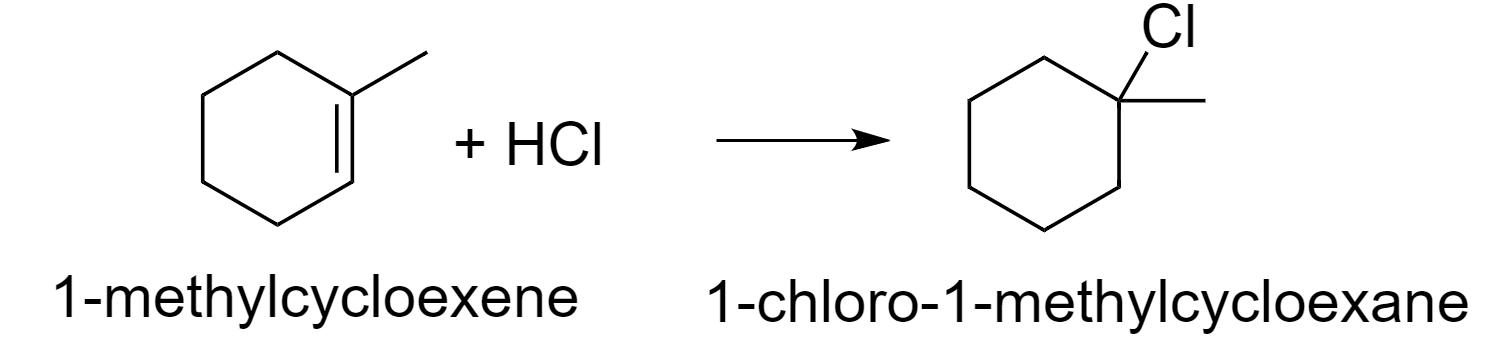
1-methylcyclohexene on treatment with HCl gas gives option (B) 1-chloro-1-methylcyclohexane
Additional information:
The speed of the reaction of the addition of hydrogen halide to alkene depends upon the hydrogen halide. The reaction rate increases as we go from HF to HI.
HF < HCl < HBr < HI
This is because, with the increase in the size of the halide atom, the bond strength of the hydrogen halide decreases, and the bonds break easily, which further helps in increasing the rate of the reaction.
Note:
It should be noted that when hydrogen bromide (HBr) is added to an asymmetrical alkene in the presence of an organic peroxide, the reaction follows the free radical mechanism, and the products are formed according to the anti-Markovnikov's rule which states that the protic acid is added to the more alkyl-substituted carbon atom.
Complete answer:
We know that hydrogen halides (HX) are protic acids. i.e., these acids produce protons as they ionize in solutions.
Now, when an asymmetric alkene reacts with a protic acid, the unsaturated carbon atom which has the most number of alkyl substituents will form a bond with the halide group whereas the unsaturated carbon atom which has the most number of hydrogen substituent will bind with the acidic hydrogen to form the major saturated product.
This phenomenon is known as Markovnikov's rule.
\[R-CH=C{{H}_{2}}+HX\to R-CH(X)-C{{H}_{3}}\text{ (major)}\]
So, according to this rule, the reaction between 1-methylcyclohexene and hydrochloric acid (HCl) will be as follows.
1-methylcyclohexene on treatment with HCl gas gives option (B) 1-chloro-1-methylcyclohexane
Additional information:
The speed of the reaction of the addition of hydrogen halide to alkene depends upon the hydrogen halide. The reaction rate increases as we go from HF to HI.
HF < HCl < HBr < HI
This is because, with the increase in the size of the halide atom, the bond strength of the hydrogen halide decreases, and the bonds break easily, which further helps in increasing the rate of the reaction.
Note:
It should be noted that when hydrogen bromide (HBr) is added to an asymmetrical alkene in the presence of an organic peroxide, the reaction follows the free radical mechanism, and the products are formed according to the anti-Markovnikov's rule which states that the protic acid is added to the more alkyl-substituted carbon atom.
Recently Updated Pages
Which will be the least stable resonating structure class 11 chemistry CBSE

How many 5 digit telephone numbers can be construc-class-11-maths-CBSE
How do you find the angle of the resultant vector class 11 physics CBSE
Draw labelled diagram of the following i Gram seed class 11 biology CBSE
What is the need and importance of classification class 11 biology CBSE
The way in which the sparrows expressed their sorrow class 11 english CBSE
Trending doubts
One Metric ton is equal to kg A 10000 B 1000 C 100 class 11 physics CBSE
Find the value of the expression given below sin 30circ class 11 maths CBSE
1 Quintal is equal to a 110 kg b 10 kg c 100kg d 1000 class 11 physics CBSE
Draw a diagram of nephron and explain its structur class 11 biology CBSE
10 examples of friction in our daily life
Proton was discovered by A Thomson B Rutherford C Chadwick class 11 chemistry CBSE