




1. Height of place A is 1800 m above sea level. Another place B is 700 m below sea level. What is the difference between the levels of these two places ?
2. In a test, $ + 3 $ marks are given for every correct answer and $ - 1 $ mark are given for every incorrect answer. Sona attempted all the questions and scored $ + 20 $ marks though she got 10 correct answers.
(i) How many incorrect answers has she attempted ?
(ii) How many questions were given in the test ?
Answer
 Verified
582k+ views
Hint: Question 1 is based upon difference in direction. As one place is above sea level and one is below sea level. In such questions having opposite directions we can take one as negative and other as positive to make further calculations.
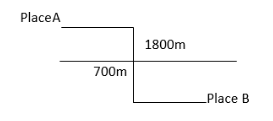
And for this question we will make a diagram according to information given in question to get better understanding towards the question. Then we will solve it in the solution section.
Complete step-by-step answer:
It is Given that
Height of the place A $ = $ 1800m $ ( $ above the level of the sea $ ) $
Height of the place B $ = $ 700m $ ( $ below the level of the sea $ ) $
Here,
We should consider the place B’s height as, $ - 700 $ since it is below the sea level
Therefore
$ \Rightarrow $ Difference between the two places $ = $ height of place A $ - $ height of place B
\[ = 1800-\left( { - 700} \right) = 1800 + 700\]
\[ = 2500m\]
Therefore, the level difference between the two places A and B $ = $ 2500 m
2. In this question $ + 3 $ is given for correct answer and $ - 1 $ is for every wrong answer
The total correct answer given by Sona was 10 but she obtained 20 marks.
$ \because $ 1 correct answer of 3 marks then
(i) Marks cut for the incorrect answer $ = $ total marks obtained by her $ - $ total marks for her correct answers.
\[20 - 10 \times 3 = 20 - 30 = - 10\]
Since it is given in question that for every incorrect answer 1 mark is deducted from total marks.
And from our above calculation we got total deducted marks as 10 so, total number of incorrect questions will be \[ = 10/1 = 10\]
(ii) Total correct answer given $ = $ 10
Ans from part (i) we know that,
Total incorrect answer given $ = $ 10
Therefore, the total question asked in the test (examination) \[ = 10 + 10 = 20\]
Note: 1. We can take any of the directions as negative or positive when they both are just opposite to each other.
2. We should take care of minus sign $ ( - ) $ before the bracket. According to rule we need to change the signs inside that bracket when there is a minus sign outside the bracket.
3. If nothing is given in question then we should take deducted marks as negative and marks for correct answer as positive to make the calculation easy.
And for this question we will make a diagram according to information given in question to get better understanding towards the question. Then we will solve it in the solution section.
Complete step-by-step answer:
It is Given that
Height of the place A $ = $ 1800m $ ( $ above the level of the sea $ ) $
Height of the place B $ = $ 700m $ ( $ below the level of the sea $ ) $
Here,
We should consider the place B’s height as, $ - 700 $ since it is below the sea level
Therefore
$ \Rightarrow $ Difference between the two places $ = $ height of place A $ - $ height of place B
\[ = 1800-\left( { - 700} \right) = 1800 + 700\]
\[ = 2500m\]
Therefore, the level difference between the two places A and B $ = $ 2500 m
2. In this question $ + 3 $ is given for correct answer and $ - 1 $ is for every wrong answer
The total correct answer given by Sona was 10 but she obtained 20 marks.
$ \because $ 1 correct answer of 3 marks then
(i) Marks cut for the incorrect answer $ = $ total marks obtained by her $ - $ total marks for her correct answers.
\[20 - 10 \times 3 = 20 - 30 = - 10\]
Since it is given in question that for every incorrect answer 1 mark is deducted from total marks.
And from our above calculation we got total deducted marks as 10 so, total number of incorrect questions will be \[ = 10/1 = 10\]
(ii) Total correct answer given $ = $ 10
Ans from part (i) we know that,
Total incorrect answer given $ = $ 10
Therefore, the total question asked in the test (examination) \[ = 10 + 10 = 20\]
Note: 1. We can take any of the directions as negative or positive when they both are just opposite to each other.
2. We should take care of minus sign $ ( - ) $ before the bracket. According to rule we need to change the signs inside that bracket when there is a minus sign outside the bracket.
3. If nothing is given in question then we should take deducted marks as negative and marks for correct answer as positive to make the calculation easy.

Recently Updated Pages
Master Class 8 Social Science: Engaging Questions & Answers for Success

Master Class 8 English: Engaging Questions & Answers for Success
Class 8 Question and Answer - Your Ultimate Solutions Guide
Master Class 8 Maths: Engaging Questions & Answers for Success
Master Class 8 Science: Engaging Questions & Answers for Success
Master Class 9 General Knowledge: Engaging Questions & Answers for Success
Trending doubts
What is BLO What is the full form of BLO class 8 social science CBSE
Citizens of India can vote at the age of A 18 years class 8 social science CBSE
Full form of STD, ISD and PCO
Advantages and disadvantages of science
Right to vote is a AFundamental Right BFundamental class 8 social science CBSE
What are the 12 elements of nature class 8 chemistry CBSE