




Epipetalous and syngenesious stamens occur in
a.Solanaceae
b.Brassicaceae
c.Fabaceae
d.Asteraceae
Answer
 Verified
666k+ views
Hint:Epipetalous and Syngenesious stamens occur in family Asteraceae. This family possesses free filaments and fused anther.
Complete answer:
The union of stamens with other members i.e., perianth, petal or gynoecium is known as adhesion. Epipetalous is a condition in which the stamens are inserted on the corolla i.e, a flower having stamens attached to the petal.
The union of stamens among themselves is known as cohesion. Syngenesious is a condition in which the antlers are united in a bundle, but the filaments remain free.
>In the case of Solanaceae family: The no. of stamens 5, epipetalous i.e, and the stamens are attached with petals. But the anthers are not united in a bundle, it remains free.so, here syngenesious condition is not found.
>In case of Brassicaceae: The no. Of stamens 6, of which outer 2 short and inner 4 long i.e., tetradynamous (2+4). Stamens are not inserted on corolla. So, epipetalous condition is absent in this family and the anthers and filaments are also free. So, syngenesious conditions are also absent in the Brassicaceae family.
>In case of Fabaceae: The no. of stamens 10 or many. Stamens are not inserted on corolla. So, epipetalous condition is absent and others are not united together. Hence, epipetalous and syngenesious both conditions are absent.
>In case of Asteraceae: In this family the stamens are inserted on corolla, so epipetalous condition is found here. And anthers are united together to form a tube like structure but the filaments remain free. So, syngenesious conditions are also present.
These two types of conditions are found in the family Asteraceae.
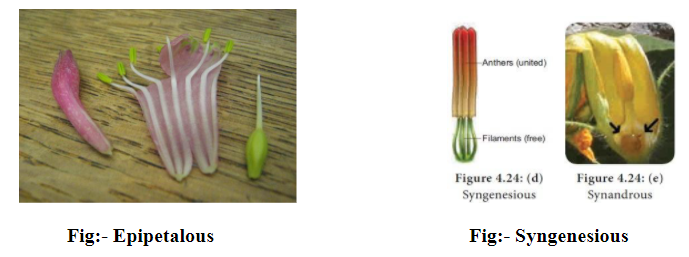
Notes: Asteraceae or Compositae is a very large and widespread family of flowering plants. It is also known as the sunflower family. These two types of conditions are found in the family Asteraceae but only epipetalous stamens are found in Solanaceae family.
Complete answer:
The union of stamens with other members i.e., perianth, petal or gynoecium is known as adhesion. Epipetalous is a condition in which the stamens are inserted on the corolla i.e, a flower having stamens attached to the petal.
The union of stamens among themselves is known as cohesion. Syngenesious is a condition in which the antlers are united in a bundle, but the filaments remain free.
>In the case of Solanaceae family: The no. of stamens 5, epipetalous i.e, and the stamens are attached with petals. But the anthers are not united in a bundle, it remains free.so, here syngenesious condition is not found.
>In case of Brassicaceae: The no. Of stamens 6, of which outer 2 short and inner 4 long i.e., tetradynamous (2+4). Stamens are not inserted on corolla. So, epipetalous condition is absent in this family and the anthers and filaments are also free. So, syngenesious conditions are also absent in the Brassicaceae family.
>In case of Fabaceae: The no. of stamens 10 or many. Stamens are not inserted on corolla. So, epipetalous condition is absent and others are not united together. Hence, epipetalous and syngenesious both conditions are absent.
>In case of Asteraceae: In this family the stamens are inserted on corolla, so epipetalous condition is found here. And anthers are united together to form a tube like structure but the filaments remain free. So, syngenesious conditions are also present.
These two types of conditions are found in the family Asteraceae.
Notes: Asteraceae or Compositae is a very large and widespread family of flowering plants. It is also known as the sunflower family. These two types of conditions are found in the family Asteraceae but only epipetalous stamens are found in Solanaceae family.
Recently Updated Pages
Lysosomes are known as suicidal bags of cell why class 11 biology CBSE

Father s age is three times the sum of the ages of-class-11-maths-CBSE
Give a comparative account of the classes of kingdom class 11 biology CBSE
The ceiling of a long hall is 25m high What is the class 11 physics CBSE
Proton was discovered by A Thomson B Rutherford C Chadwick class 11 chemistry CBSE
Name the Largest and the Smallest Cell in the Human Body ?
Trending doubts
Find the value of the expression given below sin 30circ class 11 maths CBSE
One Metric ton is equal to kg A 10000 B 1000 C 100 class 11 physics CBSE
10 examples of friction in our daily life
Draw a diagram of a plant cell and label at least eight class 11 biology CBSE
Draw a diagram of nephron and explain its structur class 11 biology CBSE
Difference between physical and chemical change class 11 chemistry CBSE