









How to Divide Money with Step by Step Method and Solved Examples
Because it increases the amount, money division is less enjoyable to think about as money addition or multiplication. After all, most of us would choose to increase our income over dividing it. However, the capacity to divide the money is an important skill for good money management. It helps us calculate things like the cost of an item per ounce or a good.
Division of Money
What is Division?
The basic purpose of the division is to produce equal groups or to verify how many individuals are in each category following a fair distribution.
The four main parts of division are the dividend, the divisor, the quotient, and the remainder. Every day, we use the division approach in various situations.
How Division Works
Let's start by splitting some numbers; it's not that difficult. Remember to fit the decimal points in the dividend, and the quotient is, by far, the most important factor.
When you are dividing to calculate the unit cost of something or anything else that could create a rupee value, remember the rupee symbol first. Second, you don't need to divide money amounts by more than three decimal places because we can't pay in fractions of paisa. Using three decimal places serves the primary task of providing that we know whether to round up or down.
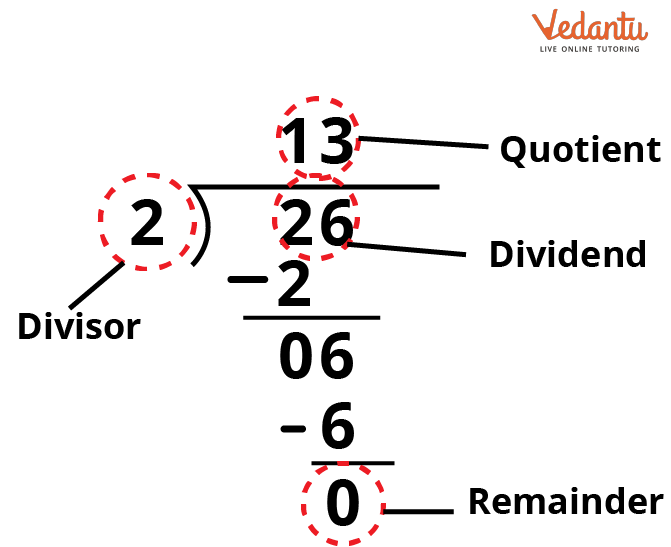
Parts of Division
Money Divider Calculator
Long division is used to divide a given sum of money into an exact number of equal individual units, known as money division.
To divide the money, enter any amount of money and the number you want to divide it into the calculator. Given the other factors, this calculator can also calculate either the initial sum or the total number of divisions.
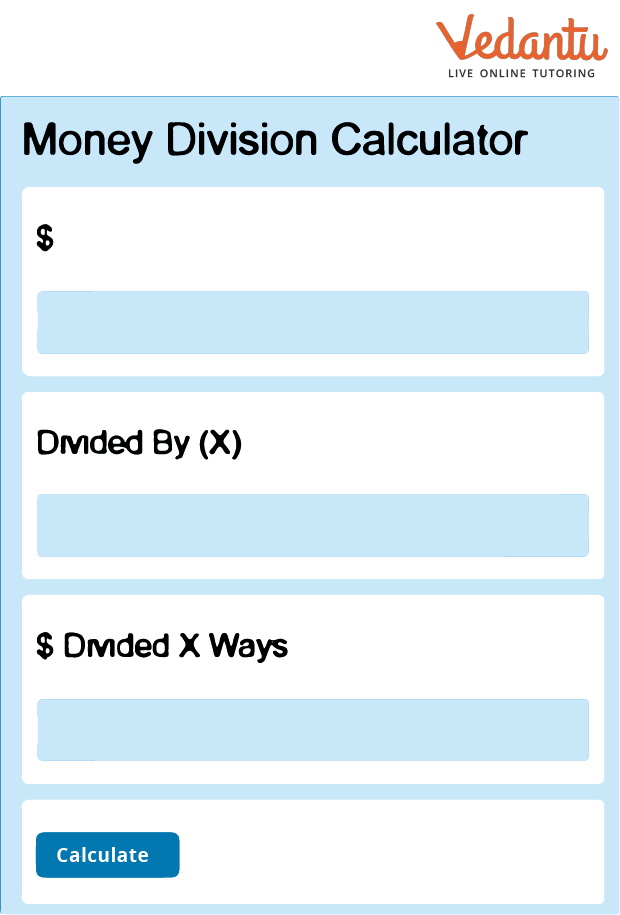
Money Calculator
The formula used to calculate money division is $MD = \dfrac{D}{X}$.
Where MD has divided the money, D is the original amount, and X is the number to divide with.
Examples of Money Division
Let us look at some money division examples:
Example 1: Find the quotient.
$5\overline{)626.63}$
Solution:
We need to find the quotient when 626.63 is divided by 5.
We will perform the long division,
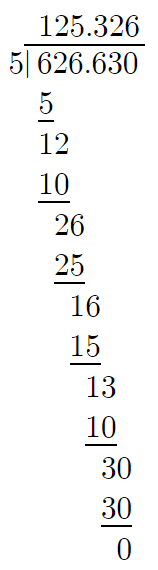
626.63/5
The quotient obtained by dividing 626.63 by 5 is 125.326.
As there cannot be more than 2 digits after the decimal, then we will have to round off the decimal places. On rounding off, we get 125.33.
Therefore, on performing long division on 626.63 by 5, the quotient we get is 125.33.
Example 2: Find the quotient.
$5\overline{)3,295.15}$
Solution:
We need to find the quotient when 3,295.15 is divided by 2.
We will perform the long division,
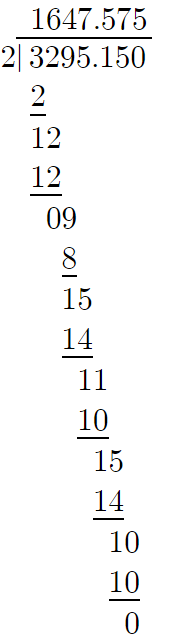
3295.15/2
The quotient obtained by dividing 3,295.15 by 2 is 1,647.575.
As there cannot be more than 2 digits after the decimal, then we will have to round off the decimal places. On rounding off, we get 1,647.58.
Therefore, on performing long division on 3,295.15 by 2, the quotient we get is 1,647.58.
Example 3: Find the quotient:
$7\overline{)2,341.92}$
Solution:
We need to find the quotient when 2,341.92 is divided by 7.
We will perform the long division,
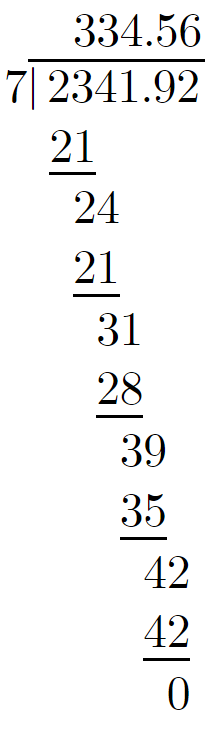
2341.92/7
Therefore, on performing the long division on 2,341.15 by 7, the quotient we get is 334.56.
Dividing Money Worksheets
Do your children realise who gets the money worksheet's free answer key? You people, of course! So, let’s get started:
Q1: Find the quotient:
$6\overline{)21.6}$
Solution:
We need to find the quotient when 21.6 is divided by 6.
We will perform the long division,
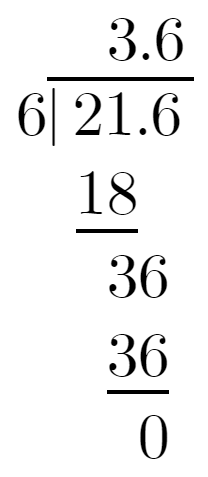
21.6/6
On performing the long division on 21.6 by 6, the quotient is 3.6.
Q2: Find the quotient:
$6\overline{)82.74}$
Solution:
We need to find the quotient when 82.74 is divided by 6.
We will perform the long division,
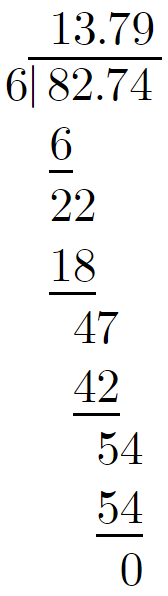
82.74/6
On performing the long division on 82.74 by 6, the quotient is 13.79.
Q3: Sima was asked to distribute ₹942.12 to 9 of her classmates. How much will each one of her classmates receive in terms of money?
Solution:
To divide ₹942.12 among 9 of Sima’s classmates.
We will have to perform the long division,
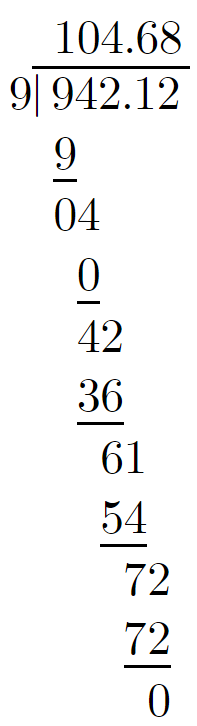
942.12/9
Dividing ₹942.12 among 9 of Sima’s classmates is ₹104.68.
Q4: Simba bought five chocolates for ₹56.25. How much does one chocolate cost?
Solution:
From the given question,
The cost of 5 chocolates is ₹56.25.
To find the cost of 1 chocolate, we will have to perform a long division where ₹56.25 is divided by 5 chocolates.
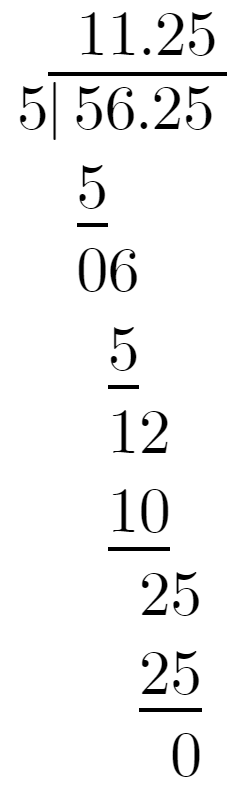
56.25/5
The cost of 1 chocolate that Simba bought is ₹11.25.
Conclusion
In this article, we have learned about the basic arithmetic operation, i.e. division. The division is used to distribute things equally. Division breaks down a large group into smaller parts. Division can also be separated into two parts, areas or groups. Every arithmetic operation has its unique symbol. In division, the sign is ‘÷’ or ‘/’ or ‘_’.
FAQs on Understanding Money Division in Mathematics
1. What is money division in maths?
Money division is the process of splitting a total amount of money equally or proportionally among a given number of people or parts. It follows the same rules as numerical division but includes decimal points for rupees, dollars, or cents.
- Formula: Total Money ÷ Number of People
- Used in sharing bills, distributing profits, or dividing expenses
- Always write the final answer in proper currency format (e.g., ₹, $, £)
2. How do you divide money equally between two or more people?
To divide money equally, divide the total amount by the number of people.
- Step 1: Write the total amount
- Step 2: Divide by the number of people
- Step 3: Express the answer in currency form
3. How do you divide money with decimals?
To divide money with decimals, perform normal division while keeping the decimal point in the correct place.
- Example: ₹45.60 ÷ 4
- 4560 paise ÷ 4 = 1140 paise
- Convert back → ₹11.40
4. What is the formula for dividing money in a ratio?
To divide money in a ratio, use the formula (Individual Share = Total Money × Ratio Part ÷ Sum of Ratio Parts).
- Example: ₹600 in ratio 2:1
- Sum of ratio parts = 2 + 1 = 3
- First share = 600 × 2/3 = ₹400
- Second share = 600 × 1/3 = ₹200
5. How do you divide money between partners based on investment?
Money between partners is divided in the ratio of their investments.
- Step 1: Find the investment ratio
- Step 2: Add the ratio parts
- Step 3: Use ratio division formula
- First partner = 9000 × 1/3 = ₹3,000
- Second partner = 9000 × 2/3 = ₹6,000
6. How do you divide money when there is a remainder?
If money division leaves a remainder, convert it into smaller currency units like cents or paise to divide completely.
- Example: ₹100 ÷ 3
- 100 ÷ 3 = 33 remainder 1
- Convert ₹1 to 100 paise → 100 ÷ 3 = 33.33 paise
7. How do you divide a bill equally among friends?
To split a bill equally, divide the total bill amount by the number of friends.
- Example: Bill = ₹1,250
- Number of friends = 5
- 1250 ÷ 5 = ₹250
8. What is the difference between dividing money equally and in ratio?
Dividing money equally gives everyone the same amount, while dividing in ratio gives shares based on proportional values.
- Equal division: Total ÷ Number of people
- Ratio division: Based on parts of a given ratio
9. How do you solve word problems on money division?
To solve money division word problems, identify the total amount and how it should be shared, then apply division or ratio formulas.
- Step 1: Read and find total money
- Step 2: Identify number of people or ratio
- Step 3: Apply appropriate formula
- Step 4: Write answer with currency symbol
10. What are common mistakes when dividing money in maths?
Common mistakes in money division include misplacing the decimal point and ignoring smaller units like cents or paise.
- Forgetting to align decimal points correctly
- Not converting remainder into smaller units
- Incorrect ratio calculation
- Rounding too early in calculations
