








What Is a Key in a Pictograph With Examples and Uses
Have you ever seen the traffic lights? What does each light mean? Each has a specific meaning. Red—Stop, Yellow—Ready to Go, and Green—Go. These are the ‘keys’ to specify the meaning of each light. Probably, we all learn about it in our school. Here, ‘keys’ are the meaning of the symbol written somewhere to understand the symbols.

Traffic Lights
In Mathematics, keys have the same meaning, but it is usually written with their symbol.
Key—Maths Definition
Keys are the meaning of the symbols used in a graph or map. Keys are also called ‘legend’. Keys are written along with the graph or map. In other words, a key includes the variables or objects used in the chart or graph along with an example (symbol) of what they look like.
Key in Graph
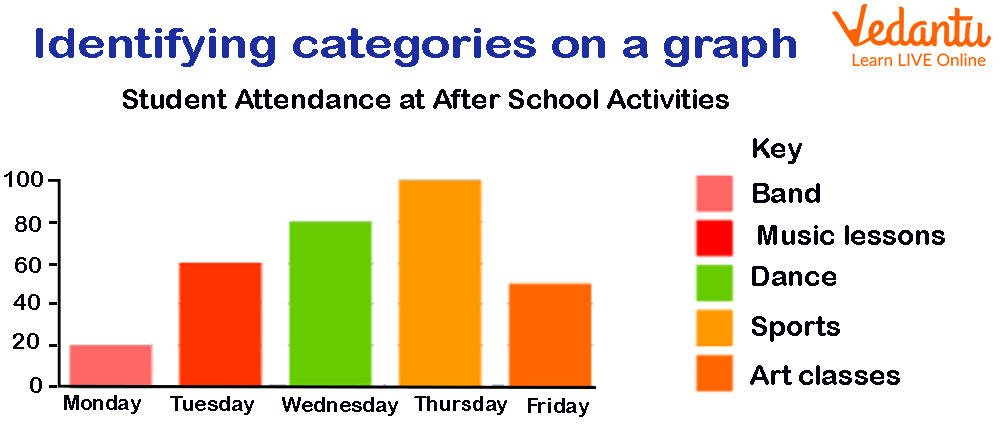
Keys are necessary to use with any graph to make the meaning of the graph clearer. Here is an example of students' activities after school.
Key Meaning in Mathematics
In the above-given graph, students attend different activities after school. We can see each day there are different activities. Pink represents ‘Band’. It tells us that on Monday, 20 students attend the ‘Band’ session. Similarly, on Tuesday, Wednesday, Thursday, and Friday, 60 students attend the ‘Music Lessons’ activity, 80 students attend the ‘Dance’ activity, 100 students attend the ‘Sports’ activity, and 50 students attend the ‘Art Classes’ activity, respectively.
Without keys, we are unable to identify the significance of using different colours. Isn’t it?
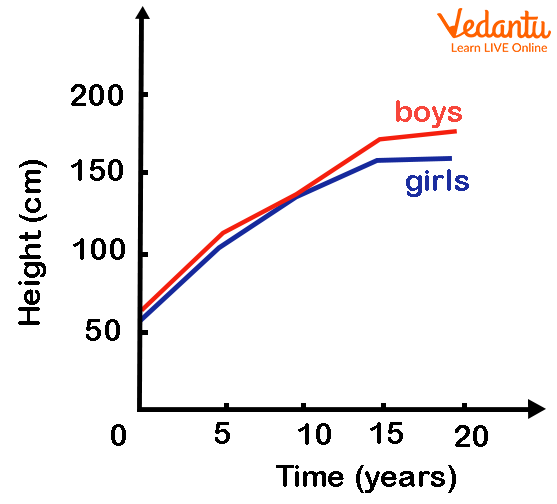
To understand it more, here we will consider an example of a line chart.
Key Usage in Line Chart
In the above figure of a line chart, time is given along the X-axis while height (in cm) is given along the Y-axis. As the age increases, the height of a child increases. In the blue colour line, how the height of a girl increases over time is represented by the blue colour whereas the red colour line shows the change in height of a boy over years. By that, we concluded that the age of a boy increases with a higher proportion than a girl. So, the representation of the meaning of each colour is known as ‘Key’.
What if the key is not given? We could not conclude the result as we might have a question about why two lines are given or what each line represents. Isn't it?
Keys in Maps
Keys in maps are very useful to identify the places. A person who draws maps is called a cartographer.
Here, a map is given. In the map, a key or legend is given on the right side.
In this map of Mistry Falls Park, different obstacles are given along with some related information. While roaming here and there, in need of anything or to decide what path to follow, we can simply look at the map and the keys or legend provided to mark their location.

Keys used in Map
Conclusion
We have learnt what a key or legend is. Keys are very useful as they make the meaning of a graph or chart clearer. In maps, it is necessary to use the keys else a person might get confused about what he found next in his path.
To know more about Mathematical terms, explore our website.
FAQs on Key Definition in Mathematics Explained
1. What is a definition in mathematics?
A definition in mathematics is a precise statement that explains the exact meaning of a mathematical term or concept. It removes ambiguity and ensures everyone understands the concept in the same way.
- Definitions use clear and specific language.
- They often describe properties or conditions that must be satisfied.
- Example: An even number is an integer divisible by 2.
2. Why are definitions important in mathematics?
Definitions are important in mathematics because they provide a clear and exact meaning for concepts used in formulas, theorems, and proofs. Without definitions, mathematical statements would be unclear or misleading.
- They ensure logical consistency.
- They prevent misunderstanding of terms.
- They help in building proofs and deriving results.
3. What is the difference between a definition and a theorem?
A definition explains the meaning of a term, while a theorem is a statement that has been proven true using definitions and logical reasoning.
- A definition does not need proof.
- A theorem must be proved using axioms and definitions.
- Example: Defining a prime number versus proving there are infinitely many prime numbers.
4. Can you give an example of a key definition in algebra?
A key definition in algebra is the definition of a linear equation: an equation of the form ax + b = 0, where a ≠ 0.
- Here, a and b are constants.
- x is the variable.
- The highest power of the variable is 1.
5. What is a formal definition in mathematics?
A formal definition in mathematics is a logically precise statement written using mathematical language and symbols. It leaves no room for interpretation.
- It specifies necessary and sufficient conditions.
- It often uses symbolic notation.
- Example: A function f: A → B assigns each element of set A exactly one element in set B.
6. What is the definition of a function?
A function is a relation that assigns each input exactly one output. In mathematical notation, f: A → B means every element of set A maps to one element in set B.
- The input is called the domain.
- The output is called the range or codomain value.
- Example: f(x) = x² assigns each number its square.
7. How do you write a clear mathematical definition?
A clear mathematical definition states the exact conditions that must be satisfied for a concept to apply.
- Use precise mathematical language.
- Include necessary and sufficient conditions.
- Avoid vague or informal wording.
8. What is the definition of a prime number?
A prime number is a natural number greater than 1 that has exactly two positive divisors: 1 and itself.
- Examples: 2, 3, 5, 7.
- 2 is the only even prime number.
- Numbers with more than two divisors are called composite numbers.
9. What is the definition of a rational number?
A rational number is any number that can be written in the form p/q, where p and q are integers and q ≠ 0.
- Examples: 1/2, -3/4, 5 (since 5 = 5/1).
- Rational numbers have terminating or repeating decimals.
10. What is the definition of an angle in geometry?
An angle is formed by two rays that share a common endpoint called the vertex.
- The rays are called the sides of the angle.
- Angles are measured in degrees (°) or radians.
- Example: A right angle measures exactly 90°.
