








How to Identify the Hundredths Place with Examples
What is the Hundredth Place?
The second number to the right of the decimal point represents the hundredth place in a decimal. Let's examine a few instances. Now for the decimal: 41.256. What number comes in at position 100? You may find 5 by adding two integers to the right of the decimal point. Consider the following: 123.684 The number 8 is found by adding two integers to the right of the decimal point.The second digit after the decimal represents the hundredth place (in the right direction). There is also the tenth place, which is the first digit after the decimal. In this article, we keep our focus on the hundredth place.
E.g
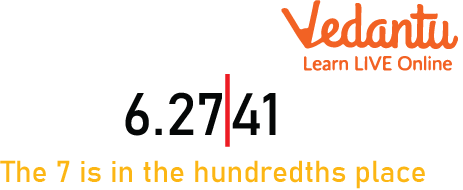
Hundredth Place in Decimals
How To Convert The Whole Number Into Decimal Form?
If you are given a whole number, such as 6, and asked to convert it, we write it as a decimal to the tenth place, which is the first place after the decimal, so we write it as 5.0, and if you asked for the hundredth place, which is the second place after the decimal, we write it as 5.00.
So we got to the point where we asked for a decimal and then just put zeros based on that.
i.e.
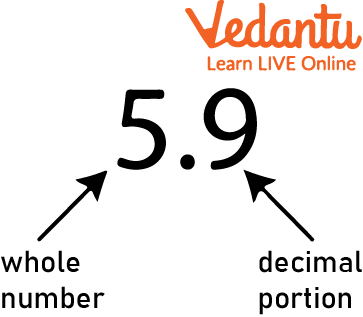
Number with Whole and Integer Part
Example:
1. Write 2 rupees and 50 paise into decimal form.
Ans: It will be 2.50 rupees.
2. Convert 6 into decimal form?
Ans: It will be written as 6.00.
How To Find The Hundredth Place
If we have a number in decimal form so, to find the hundredth place, just look to the second place after the decimal in the right direction
e.g. 5.67 here 7 is the hundredth place
2.30 here 0 is the hundredth place
Representing The Hundredth Place in \[10 \times 10\] Square Sheet
We represent the hundredth place when we write a decimal number with two places. Let us take a plane sheet, which represents one whole. Now, we divide the sheet into 100 equal parts.
i.e
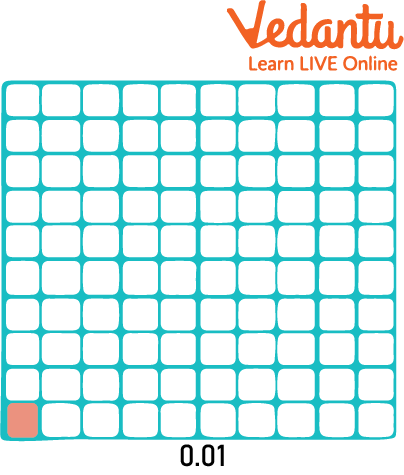
Representing the Hundredth Place in Decimal
Each part represents one-hundredths of the whole. It is written as \[\dfrac{1}{{100}}\]. In decimal form, it is written as 0.01. It is read as zero point zero one.
Solved Examples
1. Let us represents \[\dfrac{{35}}{{100}}\] on a square sheet.
i.e
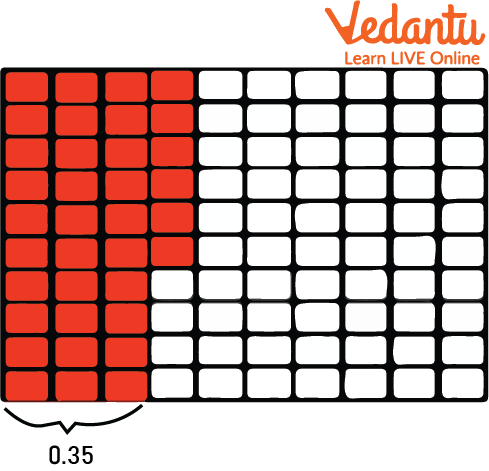
35 of a hundred equal parts are coloured. We write this as 0.35 in decimal form, where 3 represents 3 tenths, and 5 represents 5 hundredths. In the place value chart, 3 is written in the tenth column, and 5 is written in the hundredths column.
2. Is a decimal number with two palaces similar to a decimal number up to the hundredth place?
Ans. Yes, they are the same

Decimal with Two Places
In this image, you can see 5 is the hundredth place
3. How to find the thousandth place in a decimal?
Ans. The third digit to the right of the decimal point is in the thousandth place.
i.e.
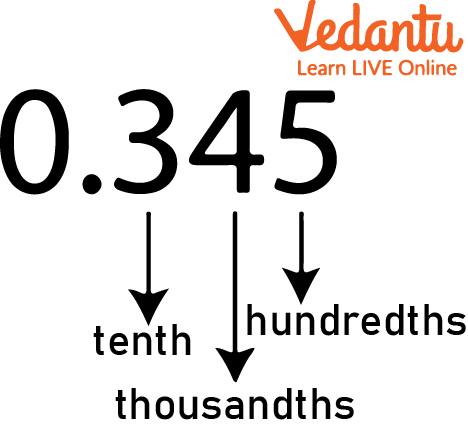
Decimal Number in Which Different Places are Represented
4. Now represent \[\dfrac{{50}}{{100}}\] on a sheet
Ans.
Representing 50/100
As you can see if fill the colour in 50 boxes out of 100 to get our required fraction
Conclusion
This article taught us decimals, finding the hundredth place, and representing the fraction up to the hundredth place on a square sheet. Let's call out the other decimal places. Consider dialling 9182.654. The numerals can be labelled as follows: Eight is in the tens place, two is in the one's place, nine is in the thousands place, one is in the hundreds place, five is in the hundredth place, and four is in the thousandth place. Let's give it another go: 547.216. This is how we may label: Six is in the thousandth place, followed by five in the hundreds place, four in the tens place, seven in the one's place, two in the tenth place, one in the hundredths place, and five in the hundreds place.
FAQs on Understanding the Hundredths Place in Decimals
1. What is the hundredths place in decimals?
The hundredths place is the second digit to the right of the decimal point in a decimal number. In place value, digits to the right of the decimal represent parts of a whole:
- First digit → tenths
- Second digit → hundredths
- Third digit → thousandths
2. How do you identify the hundredths place in a number?
To identify the hundredths place, move two digits to the right of the decimal point. Follow these steps:
- Step 1: Locate the decimal point.
- Step 2: Count one digit to the right (tenths).
- Step 3: Count the second digit to the right → this is the hundredths place.
3. What does the hundredths place mean in decimals?
The hundredths place represents parts out of 100 in a decimal number. A digit in this position shows how many hundredths are included in the value. For example, in 0.25, the digit 5 means 5 hundredths, which equals 5/100.
4. How do you round a number to the nearest hundredth?
To round to the nearest hundredth, check the digit in the thousandths place (third digit after the decimal).
- If the thousandths digit is 5 or more, increase the hundredths digit by 1.
- If it is less than 5, keep the hundredths digit the same.
5. What is the difference between tenths and hundredths?
The difference between tenths and hundredths is their place value position and size.
- Tenths: First digit after decimal → value = digit × 1/10
- Hundredths: Second digit after decimal → value = digit × 1/100
6. Can you give an example of a number with a hundredths place?
An example of a number with a hundredths place is 5.29. In this number:
- 2 is in the tenths place.
- 9 is in the hundredths place.
7. How do you write hundredths as a fraction?
To write hundredths as a fraction, place the digit over 100. For example:
- 0.07 = 7/100
- 0.45 = 45/100
8. Why is the hundredths place important in maths?
The hundredths place is important because it provides greater precision in decimal numbers. It is commonly used in:
- Money calculations (e.g., $4.25)
- Measurements (e.g., 2.35 meters)
- Rounding and estimation
9. What is the value of the digit in the hundredths place?
The value of a digit in the hundredths place is the digit multiplied by 0.01. Formula:
- Value = digit × 1/100
10. How do you compare numbers using the hundredths place?
To compare decimals using the hundredths place, compare digits from left to right starting at the whole number. If tenths are equal, compare the hundredths digit. Example:
- Compare 2.34 and 2.37
- Whole numbers equal (2)
- Tenths equal (3)
- Hundredths: 4 < 7
