







Finite and Non Finite Verbs Exercises with Rules Examples and Answers
Understanding the difference between finite and non-finite verbs is crucial for mastering English grammar. Finite verbs carry tense and agree with the subject, while non-finite verbs remain unchanged regardless of the subject or tense. In this topic, we will explore the meaning, definition, uses, and examples of finite and non-finite verbs. Additionally, we’ll provide exercises with answers to solidify your understanding. By the end, you'll be able to identify and use these verbs accurately, improving your writing and speaking skills.
 Table of Content
What are Finite and Infinite Verb?
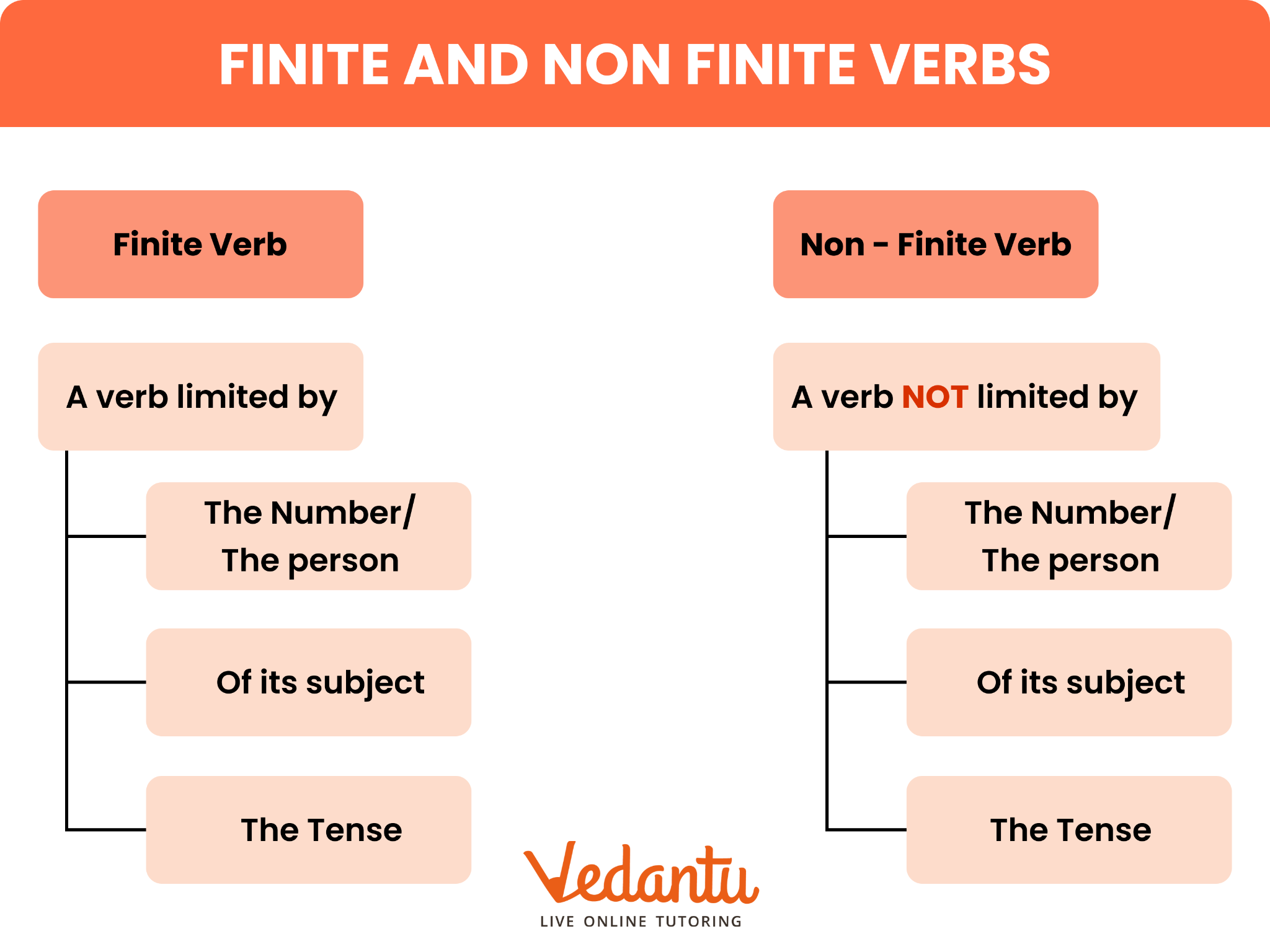
Finite Verbs: A finite verb is a verb that has a subject and can work as the main verb in a sentence. It shows tense (past, present, future) and agrees with the subject in number and person.
Non-finite Verbs: Non-finite verbs do not change according to the subject or tense. They often appear as infinitives, gerunds, or participles and do not serve as the main verb of a clause.
Examples
Finite Verbs:
She writes a letter. (Present tense)
They played football yesterday. (Past tense)
Non-finite Verbs:
To dance is my passion. (Infinitive)
I enjoy swimming. (Gerund)
Baked in the oven, the cake smelled delicious. (Past participle)
The illustration below provides a detailed explanation of Finite and Infinite Verb:
Common Confusions:
Confusion between gerunds and present participles: Both are derived from verbs but serve different functions. E.g., "Swimming is fun" (gerund as a noun) vs. "She is swimming" (present participle as part of a verb phrase).
Mistaking non-finite verbs for finite ones in complex sentences.
Tips for Mastery:
Practice identifying the main verb in sentences and see if it changes with different subjects and tenses.
Remember that finite verbs always function as the main verb of a clause, while non-finite verbs never do.
Test Your Understanding of the Topic by Completing the Following Tasks:
Identify the finite and non-finite verbs in the following sentences:
She decided to leave early.
The boy running across the field is my brother.
They had finished their homework before playing.
Check Your Answers
Finite verb: decided, Non-finite verb: to leave
Finite verb: is, Non-finite verb: running
Finite verb: had finished, Non-finite verb: Playing
Solve the Worksheet!
Part 1: Identifying Finite and Non-finite Verbs
Instructions: Read the following sentences carefully and identify whether the underlined verb is finite or non-finite. Write "Finite" or "Non-finite" next to each sentence.
She enjoys swimming in the pool.
They are planning to visit the museum next week.
He runs every morning.
Baked by the chef, the cake was delicious.
We decided to go to the park today.
I saw him running across the street.
The flowers bloom in the spring.
Having finished his homework, he went out to play.
She likes dancing in the rain.
The dog barked loudly at the stranger.
Part 2: Filling in the Blanks
Instructions: Complete the sentences below by choosing the appropriate finite or non-finite verb from the options given in parentheses.
The teacher told the students _______ (to complete/completes) their assignments on time.
The cat loves _______ (chase/chasing) mice around the house.
We _______ (decide/decided) to watch a movie tonight.
The painting, _______ (created/creating) by the artist, is stunning.
She _______ (jumps/jumping) over the fence easily.
I saw them _______ (play/playing) in the garden.
They _______ (plan/planned) to start a new business.
_______ (Running/Run) in the morning is a good habit.
He _______ (wrote/writing) a letter to his friend.
The man _______ (walking/walks) by the river is my uncle.
Part 3: Sentence Formation
Instructions: Create sentences using the given words, making sure to use finite and non-finite verbs correctly.
I / enjoy/read / books.
She / like / bake / cookies / on weekends.
They / decide/visit / the museum.
He / happy / finish / his project.
The teacher / tell / students / be quiet.
Part 4: Writing Exercise
Instructions: Write a short paragraph (4-5 sentences) about a hobby or activity you enjoy. Use at least two finite verbs and two non-finite verbs in your paragraph.
Part 5: Task Review
Instructions: After completing the exercises, review your answers with the provided answer key to see if you identified and used finite and non-finite verbs correctly.
Answer Key
Part 1: Identifying Finite and Non-finite Verbs
Non-finite
Non-finite
Finite
Non-finite
Non-finite
Non-finite
Finite
Non-finite
Non-finite
Finite
Part 2: Filling in the Blanks
to complete
chasing
decided
created
jumps
playing
planned
Running
wrote
Walking
Part 3: Sentence Formation
I enjoy reading books.
She likes baking cookies on weekends.
They decided to visit the museum.
He is happy to finish his project.
The teacher told the students to be quiet.
Takeaways from the Topic “Finite and Non-finite Verbs”
Finite verbs are crucial for constructing sentences that express time and action directly related to the subject.
Non-finite verbs serve various roles and add depth to sentences but do not show tense or agree with the subject.
Understanding the difference between these types of verbs enhances your ability to write and speak more effectively.
FAQs on Finite and Non Finite Verbs Exercises and Practice Guide
1. What are finite and non-finite verbs?
A finite verb is a verb that changes according to tense and subject, while a non-finite verb does not change according to tense or subject.
- Finite verbs show tense (past, present) and agree with the subject: She writes a letter.
- Non-finite verbs include infinitives, gerunds, and participles: She likes to write.
- A sentence must have at least one finite verb to be complete.
2. How can you identify a finite verb in a sentence?
You can identify a finite verb by checking if it shows tense and agrees with the subject.
- It changes form based on time: He plays, He played.
- It agrees with the subject: She runs, They run.
- It can stand as the main verb of a complete sentence.
3. What are the types of non-finite verbs in English?
The three main types of non-finite verbs are infinitives, gerunds, and participles.
- Infinitive: to + base verb (e.g., to read).
- Gerund: verb + ing used as a noun (e.g., reading is fun).
- Participle: used as adjectives or in verb phrases (e.g., broken glass).
4. What is the difference between finite and non-finite verbs with examples?
The main difference between finite and non-finite verbs is that finite verbs show tense and agreement, while non-finite verbs do not.
- Finite verb: She is singing a song.
- Non-finite verb: She likes singing.
5. Can a sentence have more than one finite verb?
Yes, a sentence can have more than one finite verb if it contains more than one clause.
- Example: She went home and cooked dinner.
- Each clause may have its own finite verb.
- Compound and complex sentences often include multiple finite verbs.
6. Why are non-finite verbs important in English grammar?
Non-finite verbs are important because they help add extra information without forming a new clause.
- They act as nouns: Swimming is healthy.
- They act as adjectives: The crying baby.
- They form verb phrases: She has finished her work.
7. How do you change a finite verb into a non-finite verb?
You can change a finite verb into a non-finite verb by using an infinitive, gerund, or participle form.
- Finite: She plays football.
- Infinitive: She wants to play football.
- Gerund: Playing football is fun.
8. What are some common mistakes in finite and non-finite verbs exercises?
Common mistakes in finite and non-finite verbs exercises include confusing gerunds with present continuous forms and missing subject-verb agreement.
- Incorrect: She going to school. (Missing finite verb)
- Correct: She is going to school.
- Confusion: Swimming (gerund) vs. She is swimming (finite verb phrase).
9. Is an infinitive always a non-finite verb?
Yes, an infinitive is always a non-finite verb because it does not show tense or agree with a subject.
- Form: to + base verb (e.g., to eat, to write).
- Example: She decided to leave.
- It cannot function as the main verb without a finite verb.
10. How do finite and non-finite verbs function in complex sentences?
In complex sentences, finite verbs form the main and subordinate clauses, while non-finite verbs add extra details without creating a new clause.
- Finite clause: She left early because she was feeling sick.
- Non-finite phrase: Feeling sick, she left early.
