






An Overview of Class 8 English Children At Work Worksheets
1. Who was Velu and where did he run away from?
2. Which train did Velu take and where did it stop?
3. Explain the two days spent alone by Velu?
4. Who did Velu meet on the train?
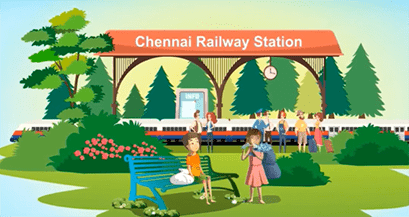
Station
5. How did Velu escape the ticket collector?
6. Why was Velu following the girl?
7. Write the meanings:
Gulped Down
Squashy
8. Where did Velu and Jaya eat food? Why was Velu hesitant to eat the food?
9. How did Velu find the city and road around him?
10. Who was Jaya selling the garbage, plastic bags and waste materials to?
11. Which canal was there in Triplicane?
12. Write two lines on the character of Velu?
13. State True or False for the following questions:
Velu’s father was very rich and still, he left his house.
Velu and Jaya became best friends.
Jaya was a rag picker.
14. State the reason for Jaya’s attitude towards Velu?
15. What was Jaya wearing which made Velu surprised?
16. Who wrote the story ‘Children at Work’?
17. What kinds of huts surprised him and why did he call them strange?
18. How waste can be valuable for people? Write the answer reflecting the lesson ‘Children at Work’.
19. Comment on the character of Jaya in the story.
20. What is the main motive of this lesson?
21. Write a few lines on the character of Velu.
22. What kind of relationship started to develop between Velu and Jaya?
23. Why did Velu leave his home?
24. Why was Jaya picking up all the trash and garbage?
25. What did Jaya do with all the trash?
Answers to the Worksheet
1. Velu was an eleven-year-old boy who ran away from his house.
2. Velu took the train called ‘Kanyakumari Express’ and it stopped at Chennai Central.
3. Velu was alone at the station. He ate some peanuts and a piece of jaggery. He was walking to Kannur for most of the day and finally sat on the train to Chennai.
4. Velu met a small girl of his age. She was collecting dirty plastic cups in the bag behind her back. She was wearing a baniyan which surprised Velu.
5. Velu did not have money to buy tickets for himself. He sat on a train to Chennai without the ticket. He got lucky because the ticket collector did not come that day to check the tickets.
6. Velu was following the girl because he had no idea about going or anything. The girl told him that to earn money everyone needs to do something. He was looking at her disappearing in the crowd and finally decided to follow her.
7.
Swallowed quickly
Crushed
8. Jaya took Velu to the back side of a mall building. There was garbage and leftover food in the bin. Jaya offered a banana leaf and vada to Velu, to which he denied saying he does not eat leftover food like a dog. Later, he realised that he was starving so he had vada and leaf. Jaya also had a banana. Velu wanted to eat more but he could not afford to leave Jaya.
9. Velu found the whole area very crowded and full of traffic. There were huge buildings, towers and big roads where he could get lost very easily. There was smoke and dust which was making him faint and his head spinning. Jaya helped him cross the road and he could not believe that they passed the traffic. Velu was clueless and surprised.
10. Jaya was selling the garbage, plastic bags and waste materialsJam Bazaar Jaggu.
11. Buckingham.
12. Velu was a small child who did not know the harsh realities of the word. Velu escaped from his house due to his father.
13.
False
False
True
14. Jaya was a brave and ambitious girl. She was busy doing her daily work. Although, she understood that Velu is unaware of how things worked so she helped her in finding food.
15. Jaya was wearing a Baniyan when Velu first met her. He was surprised to see a girl in baniyan.
16. Gita Wolf, Anushka Ravishankar and Orijit Sen are the writers of ‘Children at Work’.
17. The huts in the city were made up of wood, plastic, sheets and bricks. Velu found them strange because in his village the huts were made up of mud and palm trees.
18. Leftover food, used plastic glass, old bags, old newspapers, and sheets can be wasted by humans and we throw them in bins. It is valuable for rag pickers and people who pick trash from bins to sell it in the factories and markets for a very less amount of money. They also eat the leftover food which is valuable to them. In this lesson also, Jaya was a rag picker and plastic glass, bags, leftover food and trash were valuable to her.
19. Jaya was a very brave and sensitive girl. She knew the reality of the world and was very focused on her work. She takes pity on Velu and gets her food. She also had a sense of humour. Velu was also surprised by her and somewhere impressed as well.
20. The main motive of this lesson is to draw our attention to the evil of child labour. Small children are trapped in these evil realities of child labour. They cannot go to school or spend their childhood in a happy manner. They have to become responsible to earn at a very young age. They either support their parents or work for themselves.
21. Velu is a small boy who left his home. He was very confused about the place and the people he was travelling around. He met a small girl Jaya who helped him when he was hungry.
22. There was a bitter-sweet relationship between Jaya and Velu. Jaya was a rag picker and she helped Velu in finding food. She somehow taught him a life lesson.
23. Velu left his home due to his father. His father used to spend all their money.
24. Jaya was picking up all the trash and garbage to sell in the market. She earned money from them.
25. Jaya sold the trash to a man because she was a rag picker.
Importance of Children At Work Worksheet PDF
This chapter teaches a very good lesson to all students. It has a gripping storyline, and children at work PDFs and worksheets will help students as well adults to realise the importance of good parenting.
In the lesson, Velu belongs to a not-so-stable household where his father used to beat him. After a point, Velu could not do anything; he got frustrated and ran away from his house. In the lesson summary, students will also learn how did Velu feel about his garden.
Students will read about how old was Velu when he left home and how many hurdles he faced with arranging food for one time.
This lesson's worksheet also explains how Velu met Jaya in Chennai after leaving his home. Students can understand this chapter in detail if they pay attention while solving questions in the chapter's PDF.
This chapter teaches a vital lesson: adults should behave properly with children so that they do not have to face the consequences of their bad actions. Adults' irresponsible behaviour can lead kids to run away from home.
The chapter has a part where it narrates how with no help and food, Velu joined Jaya in rag picking and became a ragpicker. Students can understand this part of the story in detail with the help of Children At Work extra questions in the worksheet.
Questions/Answers based on the Chapter Children At Work
Here are questions and exercises based on the PDF and worksheets of this chapter. After through with these PDFs, students will be able to understand how did Velu feel about his garden answer.
1. Answer the following questions about Velu.
What did he observe at the platform?
What was he carrying along with him?
How old was Velu when he left home?
Where did Velu go along with the girl?
Where did Velu get the food from?
How did Velu feel about his garden?
2. True or False.
Velu left his home because he fought with his sister. _____
Velu met a girl named Jaya in Chennai. _____
After Velu left his home, he went to Delhi. ____
Jaya and Velu found two bananas and vada in the garbage. ____
Grab A Free PDF With Solutions with A Children At Work Worksheet
Getting a free PDF online from Vedantu's official website with questions and answers is easy. PDFs and worksheets are the best way to engage students in revision and chapter preparation because they are fun to solve and easy to understand.
Worksheets and PDFs are very easy to download, and they are compact as well. PDFs contain a detailed yet to-the-point explanation of the chapter, which is great for the students.
Students can use these PDFs anywhere they want to revise the lesson, and these PDFs are easily printable, making them portable and absolutely free.
Students can easily get topic-wise PDFs with various MCQs and exercises.
If students incorporate PDFs in their study routine they can easily answer difficult questions in chapters. For example, how did Velu feel about his garden?
Lastly, we hope our well-curated PDFs and worksheets by the expert teachers at Vedantu will help students to score good marks in their English exams. These PDFs can greatly help students if they use them for revision and solving extra questions and various exercises. Students have the advantage of carrying printable PDFs with them anywhere for last-minute revisions as well.

FAQs on Class 8 English Children At Work Worksheets Free PDF Download (Sign-in Required)
1. What are some important questions to prepare from Chapter 2, 'Children at Work', for the Class 8 English exam?
For the CBSE Class 8 exam for the 2026-27 session, important questions from 'Children at Work' typically focus on a few key areas. Students should prepare for questions related to:
- Character sketches of Velu and Jaya, highlighting their backgrounds and personalities.
- The reasons that compelled Velu to run away from his home.
- Thematic questions about child labour and survival on the streets.
- The stark contrast between city life and village life as seen through Velu's eyes.
2. What were the circumstances that forced Velu to run away from home? (3 marks)
Velu, an eleven-year-old boy, ran away from home due to constant abuse from his father. His father was a drunkard who would snatch all the money Velu and his sisters earned. More importantly, his father would beat him every day. Unable to endure this mistreatment any longer, Velu decided to escape his village in search of a better and safer life.
3. Describe the character of Jaya. What does she represent in the story 'Children at Work'?
Jaya is a young girl, about Velu's age, who is a ragpicker in Chennai. She is portrayed as:
- Resourceful and Independent: She knows the city well and understands how to survive by collecting and selling scrap.
- Pragmatic and Tough: Hardened by street life, she is not sentimental. She helps Velu but is also direct and practical about their situation.
- A Symbol of Resilience: Jaya represents the countless children who, despite facing extreme hardship and poverty, develop incredible resilience and skills to navigate their difficult lives.
4. How does the story highlight the difference between city and village life from Velu's perspective?
The story uses Velu’s experiences to show a sharp contrast between the village and the city. In his village, life was simple. In the city of Chennai, he is completely overwhelmed by the immense crowds, loud traffic noise, and giant buildings. The act of eating leftover food from a garbage bin and the 'work' of ragpicking are shocking to him. This highlights how the city is an impersonal, fast-paced, and challenging environment compared to his familiar rural life.
5. What 'work' did Jaya do, and why was Velu hesitant to do it?
Jaya's work was ragpicking. She would collect discarded materials like plastic bottles, paper, and glass from garbage bins and sell them to a scrap dealer, or 'kabadi'. Velu was hesitant to do this work because he found it dirty and demeaning. In his own words, he said, "I haven't come here to pick rubbish." It was not the kind of job he had imagined finding in a big city, and it clashed with his sense of dignity.
6. From an exam perspective, what is the central theme of 'Children at Work' that students should focus on?
The most important theme for the CBSE exam is the harsh reality of child labour and the loss of childhood due to poverty and family circumstances. Students should focus on how children like Velu and Jaya are forced into difficult and dangerous work to survive. The story also explores the theme of resilience, showing how these children adapt and find ways to live despite their struggles. A good answer would discuss both the problem and the children's coping mechanisms.
7. Why did Velu ultimately accept the job of a ragpicker, at least temporarily?
Velu accepted the job of a ragpicker out of sheer necessity and desperation. He was exhausted, extremely hungry, and had no money or food. Jaya made it clear that ragpicking was the only way to earn money for a meal at that moment. Faced with the stark choice between his initial disgust for the work and his urgent need for survival, Velu's hunger and helplessness forced him to accept the job until he could find a better one.
