



How Do You Choose the Best International School in India?
Many parents begin searching for international schools in India when they want a global curriculum, a different classroom approach, or better city-specific options for their child. In India, these schools usually offer international board pathways such as IB or Cambridge and are often chosen for conceptual learning, communication skills, and holistic development.
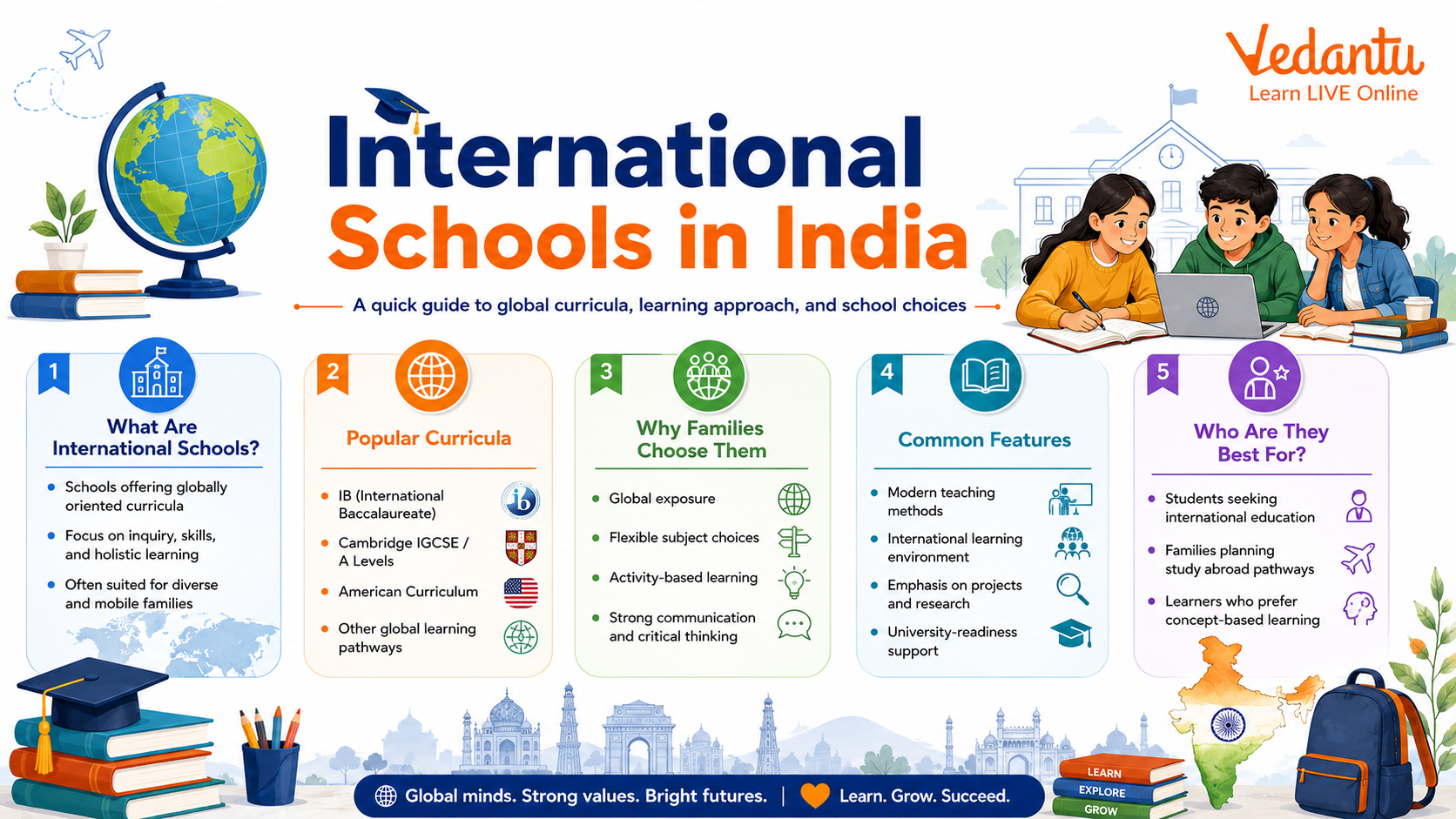
This guide explains what international schools are, how they differ from CBSE, ICSE, and state boards, what fee ranges generally look like, and how parents can compare options in cities such as Hyderabad, Bangalore, Chennai, Mumbai, Delhi, Gurgaon, Pune, and Kolkata. If your child studies in any board system and needs extra academic help, you can also explore Vedantu’s wider school education guides.
What Are International Schools in India?
International schools in India are schools that usually follow global curricula such as International Baccalaureate (IB) or Cambridge. They often focus on conceptual understanding, inquiry, communication, project-based learning, and all-round development rather than only textbook completion or board-exam scoring patterns.
However, the label “international” does not automatically mean every school is the same. Parents should still compare curriculum, teacher support, class size, assessment style, extracurricular options, travel time, and affordability before shortlisting any international board schools in India.
Why Do Parents Choose International Schools?
Families often consider international schools for a mix of academic and practical reasons.
- They may prefer a global curriculum such as IB or Cambridge.
- Some parents want stronger emphasis on communication, research, and presentation skills.
- Families that relocate between cities or countries may value curriculum continuity.
- Many schools highlight holistic learning through sports, arts, activities, and student projects.
- Some students respond better to conceptual and inquiry-led classrooms than highly exam-driven systems.
- Parents may also compare international schools near me for campus culture, infrastructure, and language exposure.
Which Curricula Do International Schools in India Offer?
The most commonly discussed pathways are IB and Cambridge. Some schools may also combine international programmes with Indian boards at certain grade levels, so parents should check the exact curriculum offered at each campus.
| Curriculum | General learning approach | Common parent interest | What to verify |
|---|---|---|---|
| IB curriculum | Conceptual, inquiry-led, interdisciplinary, skills-focused | Holistic development and international academic exposure | Programme level, teaching style, assessment support |
| Cambridge curriculum / IGCSE pathway | Structured international framework with subject flexibility in later stages | Balanced academics with wide recognition | Subjects offered, progression route, school support systems |
| Mixed international plus Indian board model | School-specific combination depending on grades and campus | Flexibility between global and Indian pathways | Exact board transition points and long-term fit |
If you want a closer curriculum-level comparison, Vedantu also has a useful read on IB vs IGCSE comparison.
How Are International Schools Different from CBSE, ICSE, and State Boards?
No board is automatically “best” for every child. The right choice depends on learning style, future plans, budget, and the kind of classroom environment a student needs.
| School system | Teaching style | Assessment tendency | Cost trend |
|---|---|---|---|
| International schools | Conceptual, inquiry-led, discussion and project oriented | Often broader than exam-only preparation | Usually higher |
| CBSE schools | Structured and syllabus-focused | Board-oriented with standardised exam focus | Usually lower to moderate |
| ICSE schools | Detailed subject coverage with language emphasis in many schools | Academic depth with formal assessments | Moderate to high |
| State board schools | Varies by state and school | Usually state syllabus and exam aligned | Often lower |
For families comparing Indian boards first, Vedantu also explains the difference between CBSE and ICSE and broader questions around Indian boards or international board.
What Is the Fee Range of International Schools in India?
International schools in India fees vary widely by city, curriculum, grade level, campus facilities, and whether the school is a day school or residential school. Since school fees change frequently, it is safer to compare broad ranges and then verify the latest fee sheet on the official school website before applying.
| Fee factor | How it affects cost |
|---|---|
| City | Metro cities and premium localities often have higher fee bands |
| Curriculum | International programmes may cost more than standard Indian board models |
| Grade level | Higher classes may have different fee structures |
| Facilities | Labs, sports, transport, activities, and campus resources can raise total cost |
Important: Verify latest official update before publishing or making admission decisions, especially for fee, transport, meal, and activity charges.
Top Cities for International Schools in India
Search behaviour is strongly city-based. Parents usually look for international schools near me or compare options by commute, campus, fee range, and curriculum availability in their own city.
International Schools in Hyderabad
International schools in Hyderabad are widely searched by families looking for IB, Cambridge, and modern campus options. Instead of relying on unsupported “top 10 international schools in Hyderabad” or “top 20 international schools in Hyderabad” lists, compare the exact curriculum offered, teacher support, transport distance, and the child’s comfort with the learning style.
When reviewing best international schools in Hyderabad, check:
- Whether the school offers IB, Cambridge, or another international pathway
- Student-teacher ratio and learning support
- Travel time across the city
- Total annual cost, not just tuition
International Schools in Bangalore
International schools in Bangalore attract strong parent interest because the city has high demand for global curricula and varied school formats. If you are comparing an international school in Bangalore, focus on curriculum fit, campus commute, subject choices in higher grades, and how the school supports both academics and extracurricular development.
Useful filters for international schools Bangalore searches include:
- Programme type and continuity across grades
- Classroom approach and assessment style
- Parent communication and counselling support
- Location, traffic, and daily routine impact
International Schools in Chennai
Parents looking at international schools in Chennai usually compare board options, fee range, and travel convenience. A shorter commute can matter as much as curriculum, especially for younger students. When scanning “best international schools in Chennai” or “top 10 international schools in Chennai” results, use them only as starting points, not final proof of quality.
Key checks include:
- Curriculum and language support
- Activity balance and academic expectations
- Grade-wise fee structure
- Commute and transport safety
International Schools in Mumbai
International schools in Mumbai are often searched locality first, because traffic, distance, and campus size can affect daily life. Families may compare international schools in South Mumbai separately from suburban options. While checking best international schools in Mumbai or top international schools in Mumbai, include practical questions about transport time, available space, and student workload.
Parents should compare:
- Locality and travel burden
- Campus infrastructure and activities
- Curriculum pathway in senior classes
- Total cost beyond admission fee
Other Popular Cities for International Schools
| City | What parents usually compare | Search pattern |
|---|---|---|
| Delhi and Gurgaon | Curriculum options, NCR commute, fees | international schools in delhi, international schools in gurgaon |
| Pune and Kolkata | Budget, school culture, board availability | international schools in pune, international schools in kolkata |
| Coimbatore, Vijayawada, Vizag | Regional availability, infrastructure, transport | international schools in coimbatore, international schools in vijayawada, international schools in vizag |
How to Choose the Right International School in India
Use this step-by-step checklist before finalising a school.
- Start with your child’s learning style, strengths, and comfort level.
- Compare the curriculum carefully instead of choosing by school brand alone.
- Set a realistic total budget, including transport, meals, activities, and other charges.
- Check location and daily commute, especially in large cities.
- Review academic support, faculty interaction, and student wellbeing systems.
- Look at extracurricular opportunities, not only infrastructure photos.
- Align the school with future goals, whether local continuity or international mobility matters more.
Common Mistakes Parents Make While Selecting an International School
These mistakes are common when families shortlist top international schools in India.
- Choosing mainly by reputation without checking curriculum fit
- Ignoring travel time and daily student fatigue
- Comparing tuition only and missing total annual cost
- Assuming “international” always means better for every child
- Not asking how the school supports students who need extra help
Is an International School the Right Choice for Your Child?
An international school may suit students who enjoy conceptual learning, discussion-led classes, project work, and broader academic exposure. It can also appeal to families who move cities often or want a globally aligned curriculum. At the same time, many students do very well in CBSE, ICSE, or state board schools, especially when the school quality is strong and the board matches the child’s needs.
If your child needs stronger subject basics while studying in any board system, Vedantu can support learning in core subjects. You can also read more about how to choose the right tutor for your child when extra academic support becomes part of the school decision.
Conclusion
International schools in India can offer a valuable learning environment, but the right choice depends on curriculum fit, budget, location, and the child’s individual needs. Rather than following ranking-style lists alone, parents should compare teaching style, support systems, and total cost with care. A thoughtful shortlist works better than a rushed brand-based decision, especially in major cities where options vary widely in approach and affordability.
FAQs on A Parent’s Guide to Choosing International Schools in India
1. What are international schools in India?
International schools in India are institutions that offer globally recognised curricula, commonly the International Baccalaureate (IB) or Cambridge International programmes. Their teaching approach typically emphasises conceptual understanding, inquiry, communication, project work and holistic development. Since the term “international” can be used broadly, parents should verify the school’s curriculum authorisation, assessment system, faculty support and grade-wise programme availability.
2. Which are the top 10 international schools in India?
There is no single official ranking of the top 10 international schools in India, because suitability depends on the child, curriculum, city, budget and learning needs. Parents can create a reliable shortlist by comparing:
- IB or Cambridge authorisation and programmes offered
- Teacher experience, class size and learning support
- Subject choices and senior-school progression
- Student wellbeing, sports, arts and extracurricular activities
- Total fees, transport arrangements and daily commute
3. How can parents compare the top 20 international schools in India?
Parents can compare the top 20 international schools in India by using the same objective criteria for every school instead of relying only on online rankings. A practical comparison should cover:
- Confirm the curriculum and programme level available for the child’s grade.
- Compare teaching methods, assessments and academic support.
- Calculate the complete annual cost, including transport, meals and activities.
- Visit shortlisted campuses and speak with teachers or coordinators.
- Evaluate commute time, safety, school culture and the child’s comfort.
4. What curricula do international schools in India offer?
International schools in India primarily offer IB and Cambridge curricula, although programme availability differs by campus and grade. Common pathways include:
- IB Primary Years Programme (PYP), Middle Years Programme (MYP) and Diploma Programme (DP)
- Cambridge Primary, Lower Secondary, IGCSE and International AS & A Level
- School-specific combinations of international programmes and Indian boards
Parents should verify the exact programme, subject selection and transition points directly with the school before applying.
5. What are the fees of international schools in India?
International school fees in India vary widely and can range from a few lakh rupees to substantially higher amounts per year, depending on the city, curriculum, grade and facilities. The total cost may include:
- Application, registration and admission charges
- Annual or term-wise tuition fees
- Transport, meals, books, uniforms and technology charges
- Sports, activities, examinations and residential facilities
Parents should request the latest official fee sheet and refund policy because charges may change by academic year.
6. How is an international school different from CBSE, ICSE and state board schools?
International schools generally use inquiry-led and skills-based learning, while CBSE, ICSE and state boards follow Indian curriculum frameworks with their own syllabus and assessment patterns. IB and Cambridge programmes often place greater emphasis on research, projects, presentations, subject flexibility and international academic mobility. Indian boards may offer wider local availability, greater familiarity with national entrance pathways and comparatively moderate fees. The best option depends on the student’s learning style, future plans, location and budget.
7. How can parents choose an international school in Bangalore?
Parents choosing an international school in Bangalore should balance curriculum quality with commute, cost and grade-wise continuity. Important checks include:
- Whether the campus offers the required IB or Cambridge programme
- Subject options and counselling support in higher grades
- Travel time during peak traffic and transport safety
- Teacher accessibility, class size and student support
- Complete annual fees rather than tuition alone
8. What should parents check when comparing international schools in Hyderabad?
When comparing international schools in Hyderabad, parents should verify curriculum recognition, location, academic support and total fees. They should also assess:
- Programme availability across primary, middle and senior grades
- Teacher qualifications and student-teacher ratio
- Learning support, counselling and student wellbeing systems
- Transport routes and realistic daily travel time
- Laboratories, sports, arts and extracurricular opportunities
9. Is there an official PDF list of international schools in India?
There is no single permanent PDF containing every international school in India, as authorisation status, campuses and programmes can change. Parents should treat downloadable lists as preliminary references and verify:
- The school’s current curriculum authorisation
- The programme offered at the specific campus
- Grade availability and admission status
- The latest fees, contact details and academic calendar
Official confirmation from the school is more reliable than an undated PDF.
10. What is the admission process for international schools in India?
The admission process for international schools in India usually includes registration, document verification, an interaction or assessment and confirmation of the seat. Parents generally need to:
- Check age, grade and curriculum eligibility.
- Submit the application with academic and identity documents.
- Attend a parent interaction, student meeting or grade-appropriate assessment.
- Review the fee schedule, policies and transport options.
- Pay the required charges after receiving an admission offer.
Requirements and timelines vary, so families should confirm the current process with each shortlisted school.
11. Are there career opportunities in international schools in India?
International schools in India offer careers in teaching, counselling, academic coordination, administration, technology, sports and student support. Teaching applicants may need relevant degrees, recognised teacher-training qualifications and experience with IB, Cambridge or inquiry-based learning. Candidates should apply through the school’s official careers channel, verify role requirements and avoid sharing documents or paying recruitment charges through unverified sources.
12. Are international schools in India suitable for every child?
International schools are not automatically the best choice for every child, but they may suit students who enjoy conceptual learning, discussion, research, presentations and project work. Before deciding, parents should consider the child’s learning style, need for academic support, future education plans, language comfort, commute and family budget. A well-managed CBSE, ICSE or state board school may be a better fit when it aligns more closely with the student’s needs and goals.



