


Good Governance Day 2026: Why Is It Celebrated on 25 December?
Good Governance Day 2026 will be observed in India on Friday, 25 December 2026, to mark the 102nd birth anniversary of former Prime Minister Atal Bihari Vajpayee. Also known as Sushasan Diwas, the day promotes transparency, accountability, effective public services and responsible administration. The Government of India established the observance in 2014 to honour Vajpayee's contributions and encourage better governance.
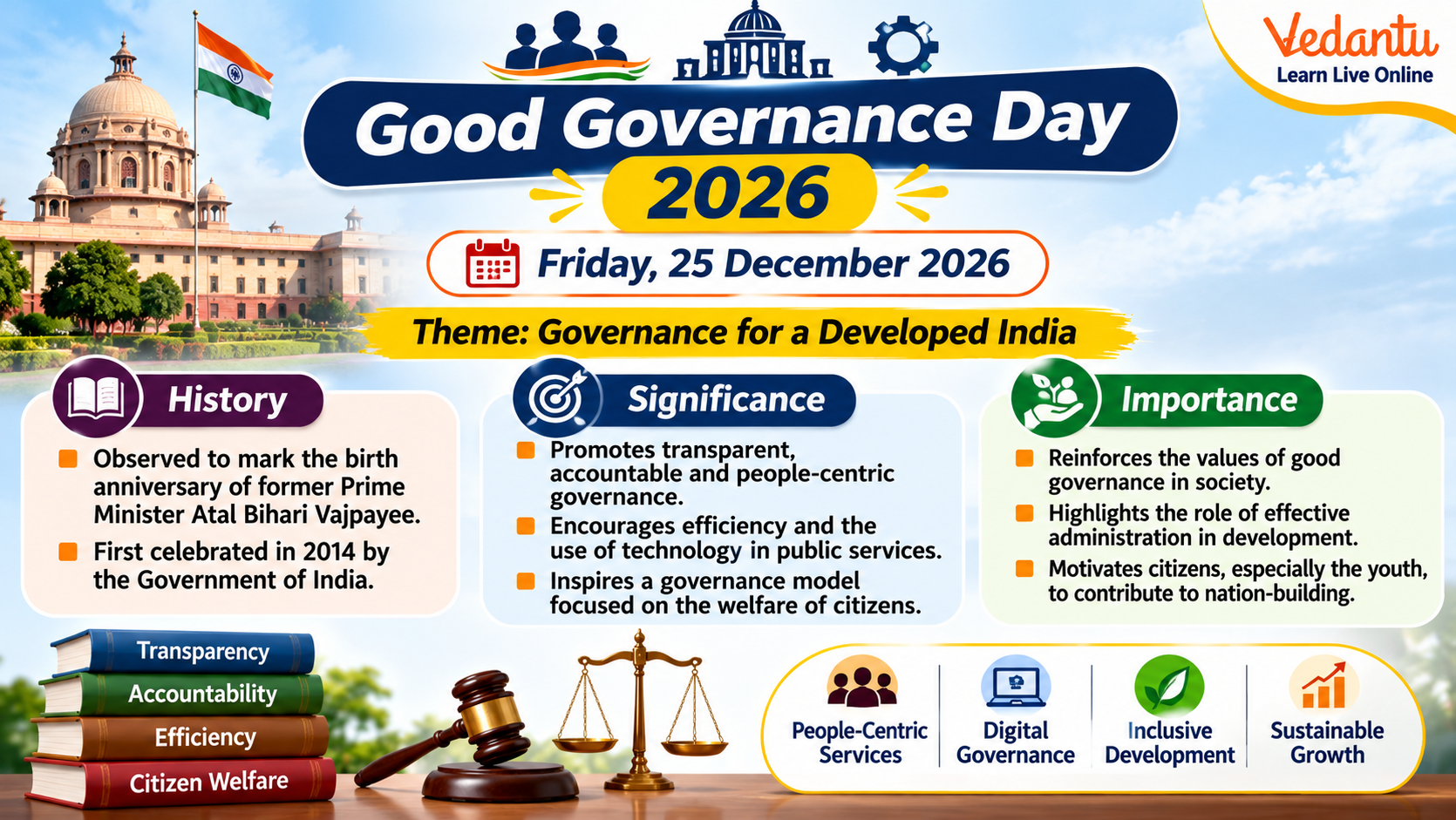
Good Governance Day in India reminds citizens and public institutions about the importance of fair decisions, efficient services and inclusive development. Government departments may organise awareness programmes, discussions and public service initiatives, while schools and colleges can conduct debates, quizzes and educational activities.
Good Governance Day 2026: Date and Key Facts
What Is the Good Governance Day Theme 2026?
No specific official nationwide Good Governance Day theme 2026 has been announced as of 19 November 2026.
The annual observance continues to highlight responsible governance, transparent administration, better public service delivery and citizen participation.
Schools and colleges can organise educational programmes around the following suggested topics:
These are suggested educational topics, not official themes announced by the government.
The phrase Prashasan Gaon Ki Ore, associated with previous Good Governance Week campaigns, should not be confused with a confirmed theme for Good Governance Day 2026.
History of Good Governance Day in India
The Government of India established Good Governance Day in 2014 to commemorate the birth anniversary of former Prime Minister Atal Bihari Vajpayee.
The first observance took place on 25 December 2014, encouraging government institutions to focus on improving public administration, accountability and service delivery.
Over the following years, the observance became associated with administrative reforms, digital governance and public awareness programmes.
Important Events in Good Governance Day History
Who Was Atal Bihari Vajpayee?
Atal Bihari Vajpayee (1924–2018) was an Indian political leader, poet and former Prime Minister of India.
He served as Prime Minister briefly in 1996 and later from 1998 to 2004. His time in public life included initiatives in infrastructure, telecommunications and national development.
Vajpayee received the Bharat Ratna in 2015, one of India's highest civilian honours.
National Good Governance Day commemorates his birth anniversary while encouraging public institutions to improve their administrative practices.
The observance connects his legacy with broader principles such as accountability, public welfare and responsible leadership.
What Is Good Governance?
Good governance means managing public institutions and resources fairly, transparently, efficiently and responsibly while protecting citizens' rights and addressing their needs.
It ensures that government decisions follow the law, public services are accessible and officials remain accountable for their responsibilities.
For example, providing certificates through a clear application process, responding to public complaints and making government information accessible are practical elements of good governance.
Important Principles of Good Governance
These principles help explain why good governance is important in a democratic society.
Why Is Good Governance Day Important in India?
Good Governance Day encourages both public institutions and citizens to understand the importance of effective administration.
1. Promotes Transparency
Clear government procedures help citizens understand how public decisions are made and how services can be accessed.
2. Encourages Accountability
Public institutions should be answerable for their decisions, responsibilities and use of public resources.
3. Improves Public Services
Efficient systems can help people access certificates, healthcare, education and other essential services.
4. Supports Inclusive Development
Good governance encourages fair access to public services, including for communities facing social or economic disadvantages.
5. Strengthens Citizen Participation
Citizens can contribute through community discussions, feedback, lawful civic participation and public consultations.
Good Governance and e-Governance: What Is the Difference?
Good governance focuses on the quality of administration, while e-governance uses digital technology to deliver government information and services.
Examples of e-governance include online certificate applications, digital public records and grievance registration portals.
However, digital technology alone does not guarantee good governance. Services must also remain secure, accessible, fair and accountable.
Good Governance Week and Prashasan Gaon Ki Ore Campaign
Good Governance Week, also called Sushasan Saptah, is an initiative associated with Good Governance Day.
It has generally been observed from 19 to 25 December to promote administrative improvements and citizen-focused services.
The Prashasan Gaon Ki Ore campaign, meaning Administration Towards the Village, has been an important part of recent Good Governance Week programmes.
The campaign focuses on improving service delivery and addressing public grievances, particularly at district and grassroots levels.
Main Focus Areas of Good Governance Week
Public grievance redressal.
Efficient delivery of government services.
Sharing successful administrative practices.
Improving access to services in rural areas.
Encouraging administrative innovation.
Strengthening citizen-oriented governance.
The 2025 campaign followed these priorities. A separate official announcement should be consulted for the detailed 2026 programme and activities.
What Is the Good Governance Index?
The Good Governance Index (GGI) is a framework introduced by the Department of Administrative Reforms and Public Grievances (DARPG) on 25 December 2019.
It helps assess governance performance across Indian states and Union Territories using indicators from different sectors.
These include:
Public health.
Education.
Agriculture and allied sectors.
Infrastructure.
Economic governance.
Social welfare and development.
Public safety.
Environment.
Citizen-centric governance.
The index supports comparison, assessment and improvement in government administration. It does not represent a ranking of individual citizens.
How Is Good Governance Day Celebrated in India?
Good Governance Day is marked through educational activities, awareness programmes and government initiatives.
Programmes vary by institution and location.
For example, MY Bharat listed a local youth activity in Imphal East, Manipur, on 25 December 2025. That was a previous-year event, not a confirmed programme for 2026.
Good Governance Day 2026 Activities for Students
Schools can organise activities that help students understand governance through familiar examples.
Classroom debate: Discuss why transparency matters in public institutions.
Governance quiz: Prepare questions about democratic values, public services and Atal Bihari Vajpayee.
Poster-making competition: Create drawings about accountability and citizen participation.
Role-play activity: Simulate a local government meeting and discuss how public problems can be addressed.
Essay writing: Write about the importance of good governance in India.
Digital awareness activity: Learn how verified government websites provide public information.
Teachers can encourage students to examine real-life examples of fair decision-making rather than focusing only on definitions.
Good Governance Day 2026 Poster Ideas and Slogans
Students can prepare awareness posters showing the relationship between citizens, public institutions and responsible administration.
Good Governance Day Poster Ideas
Good Governance Day Slogans
Good Governance Begins with Accountability.
Transparency Builds Trust.
Better Public Services, Stronger Communities.
Responsible Leadership, Inclusive Development.
Every Citizen Deserves Fair Governance.
Good Governance Supports a Better Future.
These are original educational slogans and are not official government campaign messages.
Conclusion
Good Governance Day 2026 will be observed on Friday, 25 December, marking the 102nd birth anniversary of former Prime Minister Atal Bihari Vajpayee. The day promotes transparent, accountable and citizen-focused administration.
Understanding good governance helps students learn about democratic values, fair public services and the responsibilities of public institutions. Through debates, quizzes, posters and classroom activities, they can explore why effective governance matters in everyday life.
FAQs on Good Governance Day 2026: Date, Theme, History & Significance
1. When is Good Governance Day 2026 celebrated?
Good Governance Day 2026 will be observed in India on Friday, 25 December 2026. It is celebrated annually on the birth anniversary of former Prime Minister Atal Bihari Vajpayee.
2. What is the Good Governance Day theme 2026?
No specific official nationwide theme for Good Governance Day 2026 has been announced as of 19 November 2026. The observance focuses on transparency, accountability, citizen participation and efficient public services.
3. Why is National Good Governance Day celebrated?
National Good Governance Day is observed to honour Atal Bihari Vajpayee's birth anniversary and promote awareness of responsible public administration, transparent decision-making and citizen-focused governance.
4. Who started Good Governance Day in India?
The Government of India established Good Governance Day in 2014. The first observance took place on 25 December 2014 to commemorate Atal Bihari Vajpayee's birth anniversary.
5. What are the main principles of good governance?
The main principles include transparency, accountability, responsiveness, participation, fairness, inclusiveness, efficiency and the rule of law. These principles guide responsible public administration.
6. What is the difference between Good Governance Day and Good Governance Week?
Good Governance Day is observed on 25 December. Good Governance Week generally runs from 19 to 25 December and includes initiatives related to administrative improvements, grievance redressal and public service delivery.
7. What is Prashasan Gaon Ki Ore?
Prashasan Gaon Ki Ore means Administration Towards the Village. It is a campaign associated with Good Governance Week that focuses on improving public services and addressing grievances at grassroots levels.
8. How can schools celebrate Good Governance Day?
Schools can organise debates, quizzes, essay-writing competitions, poster-making activities and discussions about transparency, democratic responsibilities and public administration.


