



How to Choose the Best IB School in India: Admission, Fees, and FAQs
Choosing an IB school in India means choosing both a curriculum and a school environment that suits your child. The International Baccalaureate places importance on inquiry, subject understanding and independent thinking, but schools differ in the programmes, subjects and support they offer. Start with the authorised programme your child needs, then consider teaching, wellbeing and the full cost. For senior students, subject choices and university requirements deserve as much attention as the school’s reputation.
Check Our IB Online Tuition Classes Choose Your IB Home Tutoring for Success
What Makes a School an IB School?
An IB World School is authorised by the International Baccalaureate to offer one or more of its educational programmes. Although families often use the term “IB board”, IB provides distinct programmes rather than one identical course running through every school year. Authorisation for one programme does not automatically mean a school offers the others.
IB learning combines knowledge with questions, investigation and reflection. For example, students studying water might explain scientific processes, interpret usage data and evaluate conservation choices. Inquiry does not remove the need for factual learning, explicit teaching or regular practice; it asks students to use what they know and explain their reasoning.
IB Programmes and the School Stages They Serve
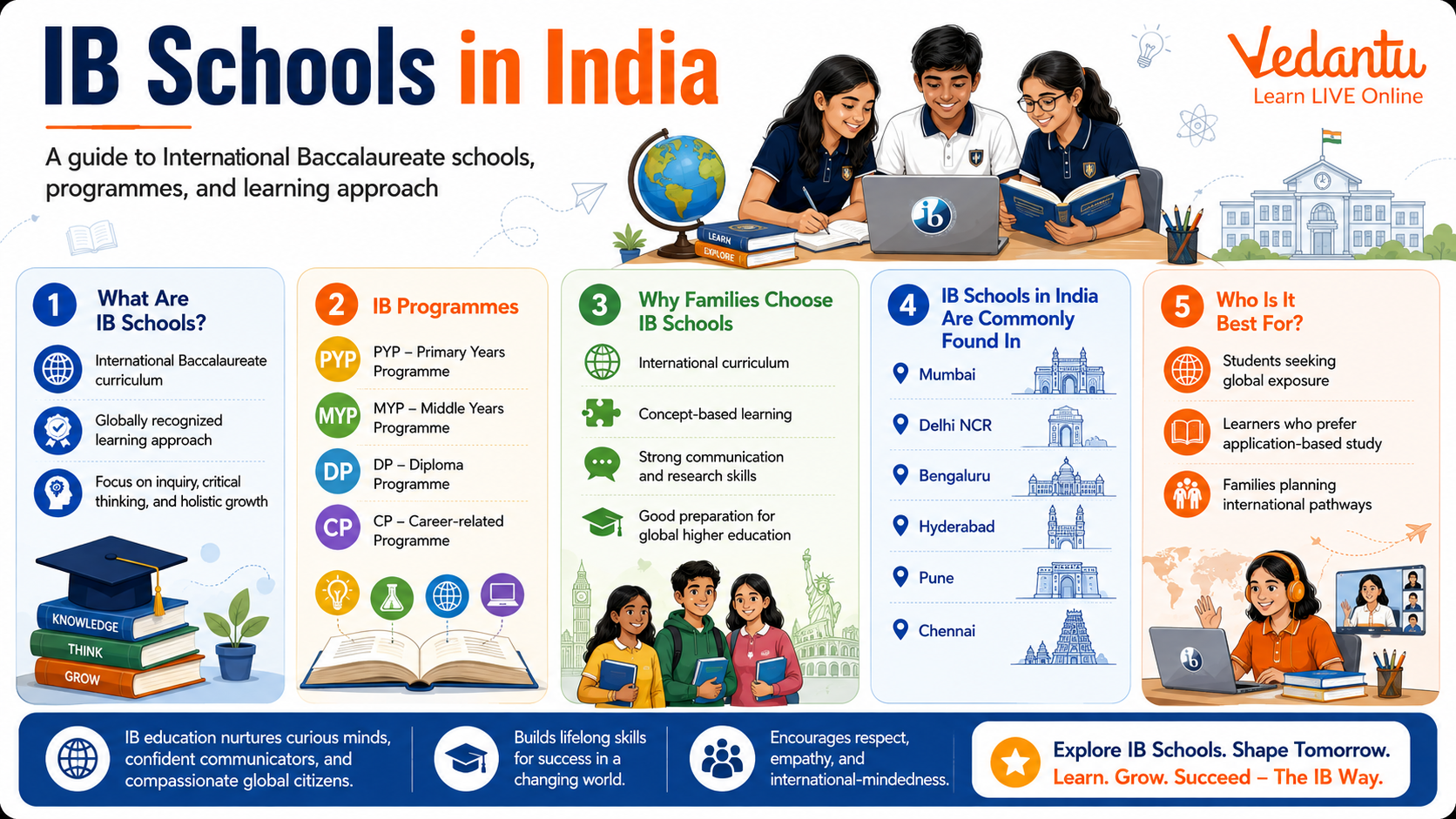
The IB defines four programmes with the age ranges below. Indian grade placement can vary by school, so age bands should not be treated as an exact class-by-class admission chart.
| Programme | IB Age Range | Learning Focus | Important Parent Question |
|---|---|---|---|
| Primary Years Programme (PYP) | 3–12 years | Inquiry across subject boundaries, with student agency and conceptual understanding. | How are reading, writing and numeracy taught alongside inquiry? |
| Middle Years Programme (MYP) | 11–16 years | Subject learning, connections between disciplines and application in real-world contexts. | Which years are offered, and what assessment and certification route is available? |
| Diploma Programme (DP) | 16–19 years | A two-year academic programme combining subjects with a compulsory core. | Are the required subjects and levels available for the student’s university plans? |
| Career-related Programme (CP) | 16–19 years | Career-related study combined with DP courses and a CP core. | What career-related qualification is included, and where does it support progression? |
A student does not need to complete PYP and MYP before applying to the DP. Entry depends on the receiving school’s requirements and the student’s readiness. Similarly, CP and DP are different pathways; families should not assume that universities treat every qualification or combination identically.
How to Verify IB School Authorisation
Check the exact campus and programme, not just the school group’s name. A campus may offer an authorised PYP while using a different curriculum in later grades. A school describing itself as an IB candidate is working towards authorisation; candidacy is not authorisation and does not guarantee it.
- Use the International Baccalaureate’s official “Find an IB World School” directory to search for schools in India and the programme you need.
- Match the campus address and programme listing with the school you are considering.
- Ask the admissions team to explain the pathway through your child’s remaining school years, including any planned curriculum changes.
- If a future programme is still awaiting authorisation, ask what alternative pathway would apply if it is not available when your child needs it.
Vedantu’s IB schools list can provide a starting point for school discovery. Use the official IB directory for authorisation status and the school’s current documents for admissions, subjects and fees.
Is IB a Good Fit for Your Child?
IB can suit students who enjoy asking questions, exploring ideas and explaining their thinking. However, being quiet, needing structure or finding writing difficult does not automatically make a student unsuitable. The more useful question is whether the school teaches the necessary skills and provides support while students develop them.
- For younger children: Look for explicit literacy and numeracy teaching, opportunities to play and investigate, and clear feedback to parents.
- For middle-school students: Ask how teachers build note-taking, research, source evaluation and project-planning skills.
- For students changing curricula: Look for an initial learning assessment and a practical transition plan rather than a vague promise that they will adjust.
- For senior students: Consider subject strengths, willingness to revise written work and the ability to manage several deadlines with guidance.
- For students with additional learning needs: Discuss specialist support, accessibility, language development and assessment arrangements early.
During a visit, ask the student what felt comfortable and what felt difficult. A child who notices approachable teachers and understands how to ask for help may gain more from that environment than from a more impressive-looking campus with unclear support.
Check our Vedantu Learning Centres Near You📍
What Learning and Assessment Look Like
IB is neither an exam-free pathway nor a curriculum made up only of projects. Assessment changes by programme and subject. Younger learners may demonstrate understanding through discussions, tasks and portfolios, while older students encounter more formal coursework and examinations.
In the DP, assessment commonly combines externally assessed examinations with coursework, including internally assessed work that may be externally moderated. In the MYP, school-based assessment is central, and optional external eAssessment arrangements depend on the school’s provision. Ask to see an anonymised assignment, its assessment criteria and the feedback a student receives.
This reveals more than a general claim about academic excellence. Useful feedback identifies what needs improvement—for example, whether a science explanation lacks evidence or a mathematical solution needs clearer reasoning—and gives the student a way to act on it.
Choosing IB for Classes 11 and 12
In India, the two-year DP commonly corresponds to Classes 11 and 12. Diploma students take six subjects, normally with three at Higher Level (HL) and three at Standard Level (SL), although four HL subjects are permitted. HL involves greater depth and teaching time; it should be chosen for academic suitability and future requirements, not prestige.
The DP core includes Theory of Knowledge (TOK), the Extended Essay, and Creativity, Activity, Service (CAS). These involve reflection on knowledge, independent research and experiences beyond subject lessons. Together with subject assessments, they make steady planning important throughout the two years.
- Work backwards from possible university courses to required subjects and levels before finalising choices.
- Ask for the actual subject timetable: a school may offer two subjects individually but be unable to accommodate them together.
- Clarify which mathematics course is appropriate, including Mathematics: Analysis and Approaches or Mathematics: Applications and Interpretation, and the required level.
- Find out whether a subject depends on minimum enrolment and when choices become final.
- Distinguish enrolment in the full diploma from taking individual DP courses; their implications for university entry can differ.
Planning for Universities in India and Abroad
The IB Diploma is an established school-leaving qualification used for university applications in India and internationally. Recognition, however, is not the same as admission eligibility for every degree. Universities may specify subjects, HL grades, overall results, language evidence or separate selection requirements.
Before selecting senior-school subjects, consult the intended universities’ current requirements and applicable Association of Indian Universities equivalence guidance. This is particularly important for CP qualifications or individual DP course results, where families should not assume the same treatment as the full diploma.
For overseas applications, compare the school’s counselling process rather than relying only on destination lists. Ask who supports university research, references, predicted grades and document submission. IB does not guarantee overseas admission, and families should budget for university applications and future study separately from school fees.
Shortlisting Schools by Location and Total Cost
Whether you are searching in Bengaluru, Mumbai, Delhi NCR, Hyderabad, Pune or another location, begin with programme availability and a manageable daily routine. In a large city, the campus address and transport route matter more than the city label. For boarding, add residential supervision, healthcare and communication with parents to the comparison.
IB school fees vary by campus, grade and services. Request a current, written fee schedule for the relevant entry year rather than comparing isolated tuition figures. For senior school, build a budget covering both years, with room for the school’s stated fee-revision policy.
| Cost Category | What to Include in Your Budget | Question to Resolve |
|---|---|---|
| Entry payments | Application, admission and any security deposit. | Which payments are refundable, and under what conditions? |
| Recurring academic charges | Tuition and separately billed annual, laboratory or technology charges. | What is included, and how may charges change? |
| Assessment expenses | Examination or assessment charges billed separately, if applicable. | Which assessment services attract additional payments? |
| Daily and residential needs | Transport, meals, boarding, uniforms and required devices. | Which services are compulsory or optional? |
| Activities and additional support | Trips, clubs and any separately charged specialist support. | Are there additional costs for participation or learning support? |
Making the Admission Visit Useful
There is no single IB-wide admission test or application deadline for schools in India. Individual schools set their processes, which may involve previous reports, an interaction, placement tasks or subject-readiness assessments. Ask for the entry requirements before spending time on an application.
Request the school’s IB parent handbook, assessment policy and academic calendar. Together, these should explain reporting, homework, communication, academic integrity and how concerns are addressed. Use the visit to resolve practical questions rather than only tour the facilities.
- Teaching: Ask how teachers respond when a student repeatedly misunderstands a concept.
- Continuity: Discuss teacher turnover, subject staffing and support during a teacher’s absence.
- Wellbeing: Ask who handles bullying concerns, workload difficulties and pastoral care.
- Results: If results are presented, ask about cohort size and whether figures include all relevant students.
- Withdrawal: Read notice periods, refund conditions and document-transfer arrangements before paying.
After each visit, parents and students can separately note strengths, concerns and unanswered questions. Compare these notes before deciding. Keep essential requirements—such as a needed HL subject or accessible learning support—separate from preferences such as sports facilities.
Supporting an IB Student at Home and Using Vedantu Resources
Support should address a specific difficulty, not simply add more study hours. A student who understands a topic but loses marks for explanations needs different help from one with missing foundational knowledge. Begin with teacher feedback and a sample of the student’s work to identify the gap.
A short weekly planning conversation can help students map deadlines, break a project into smaller tasks and protect time for rest. Parents can ask students to explain their reasoning without rewriting the work. For assessed assignments, the submitted ideas and writing must remain the student’s own.
Vedantu’s reading on personalised tuition for common IB challenges offers a relevant starting point when considering additional academic help. Use it to frame questions about your child’s difficulty and the feedback they need. Before enrolling in any tuition, establish the tutor’s experience with the exact IB subject, programme and level, along with current arrangements and fees.
For research-related difficulties, Vedantu’s resource on online tutoring support for IB Extended Essays can inform a discussion about appropriate guidance. Additional help must respect the school’s rules: a tutor should not write, rewrite or manufacture research for assessed work, and cannot replace the school-appointed supervisor.
Compared with school-based support, Vedantu’s linked articles serve as supplementary reading rather than guidance on an individual school’s assignments. Self-study may be enough for a student who can identify and correct errors; interactive tuition may be more useful when misconceptions persist because the student can explain their thinking and receive feedback. Online sessions avoid a tuition commute, while face-to-face support may suit students who concentrate better in person. No format automatically ensures IB-specific expertise.
Summary
Choose an IB school by its authorised programme, teaching and support, subject availability and sustainable total cost—not reputation alone. Senior students should connect subject choices with university requirements before committing. Build a small shortlist, review each school’s documents and include the student in campus visits and decisions. Vedantu’s school-discovery and IB-support reading can help families organise their questions and consider supplementary help, while the school remains the main source for curriculum delivery, assessment and individual guidance.
FAQs on A Parent and Student Guide to IB Schools in India
1. What is the International Baccalaureate (IB) curriculum offered in India?
The IB curriculum in India focuses on developing global-minded, inquiry-based learners through three main programmes:
- PYP: Primary Years Programme for students aged 3–12
- MYP: Middle Years Programme for ages 11–16
- DP: Diploma Programme for ages 16–19
2. How is the IB Diploma Programme structured for Indian students?
The IB Diploma Programme (DP) in India is a two-year course for students aged 16–19. It comprises:
- Six subject groups including Sciences, Mathematics, Humanities, Languages
- Theory of Knowledge (TOK) course
- Extended Essay (EE)—an independent research project
- Creativity, Activity, Service (CAS) requirements
3. What are the advantages of studying in an IB school in India?
IB schools in India provide several benefits:
- Emphasis on critical thinking and independent learning
- Recognition by leading Indian and international universities
- Focus on research skills, creativity, and extracurricular development
- Flexible subject choices tailored to student interests
4. How does the IB assessment system work in India?
The IB assessment combines:
- External examinations held at the end of the programme
- Internal assessments like projects, portfolios, and oral presentations
- Grading on a scale of 1–7 for each subject, plus 3 points for TOK and EE
- Final diploma awarded based on total points achieved
5. What is the application process to get admission in an IB school?
Admission to an IB school in India usually involves:
- Submitting an application form and academic records
- Entrance assessments or aptitude tests
- Personal interview or interaction with the student and parents
- Fee payment and documentation verification
6. Is the IB curriculum recognised by Indian universities for Academic Year 2026-27 admissions?
Yes, the IB Diploma Programme is widely accepted by Indian universities for 2026-27 admissions:
- Major universities and professional courses accept the IB DP certificate
- Candidates may need eligibility certificates for certain courses
- Some universities equate IB grades to Indian percentage systems
7. How do IB schools support students preparing for Indian competitive exams like NEET 2027 or JEE 2027?
IB schools provide foundational knowledge and skills, but NEET 2027 and JEE 2027 require familiarity with specific Indian syllabi. Some IB schools offer:
- Supplemental coaching or bridge programmes for competitive exams
- Guidance on exam patterns, syllabus mapping, and time management
- Access to mock tests and counselling sessions
8. What is the fee structure for IB schools in India?
The fee structure for IB schools varies widely based on location and facilities:
- Annual tuition fees typically range from ₹2 to ₹6 lakhs
- Additional charges may include registration, transport, meals, and activity fees
- Some schools offer scholarships and financial aid
9. Are there scholarships or financial aid options available in IB schools?
Many IB schools in India offer scholarships and financial aid:
- Merit-based scholarships for academic excellence
- Need-based financial assistance for eligible students
- Talent or sports scholarships in special cases
10. What support systems do IB schools in India offer for student well-being and career counselling?
IB schools emphasise holistic student support:
- Counselling services for academic, emotional, and career guidance
- Workshops on time management, stress management, and study skills
- University placement assistance and mentorship programmes
11. How can parents stay involved with their child's learning in IB schools?
Parents can stay engaged in their child's IB learning through:
- Regular parent-teacher meetings and progress updates
- Participating in school community events and activities
- Accessing online portals or learning platforms for monitoring progress
- Collaborating on service projects and extracurricular activities
12. What are the key differences between IB and other educational boards in India?
The IB curriculum differs from other Indian boards by:
- Offering an international, inquiry-driven approach
- Emphasising research, analysis, and global perspectives
- Allowing flexible subject combinations and project work
- Using a broader assessment system beyond rote learning



