



Key Factors to Consider When Selecting an IGCSE School in India
Choosing an IGCSE school in India means looking beyond an international label or an impressive campus. Start with whether the school offers the right subjects, teaches them well and provides a manageable daily routine for your child. Then consider the full cost and the pathway after Grade 10. A suitable school should meet the student’s present learning needs without making future subject choices or family finances unnecessarily difficult.
Find the IGCSE Online Tuition Here! Get Your Perfect IGCSE Home Tutor
Understand What an IGCSE School Actually Offers
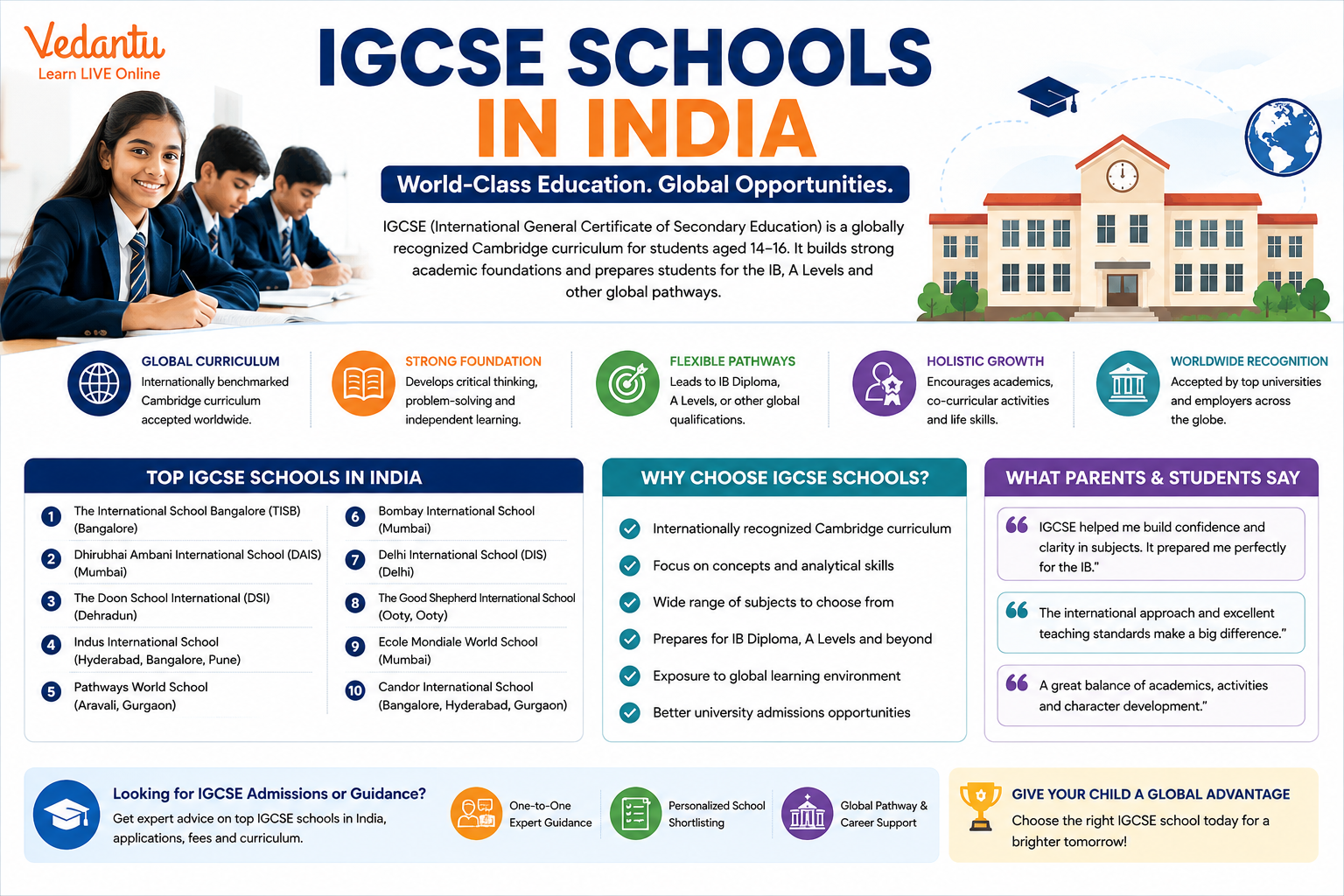
Cambridge IGCSE stands for International General Certificate of Secondary Education. It is a subject-based qualification typically taken by learners aged 14–16, commonly during Grades 9 and 10 in India. It is not the name of an entire school pathway from primary education through Grade 12.
A school may offer Cambridge Primary or Lower Secondary before IGCSE, but these are separate stages. Similarly, offering IGCSE does not automatically mean that the school offers Cambridge International AS & A Levels afterwards. Check the programme at the specific campus and for the grade your child will enter.
Use Cambridge International’s official school directory to establish the school’s registration, then request its current programme and subject information. Registration is an important starting point, but it does not by itself tell you about classroom teaching, student wellbeing or whether every advertised subject runs each year.
Build a Local Shortlist Around Your Child’s Needs
Before comparing schools, write down the student’s preferred subjects, areas needing support and likely senior-secondary plans. Agree on a sustainable budget and a maximum acceptable commute. These limits make the shortlist more useful than a national “top 10” ranking that may not reflect your circumstances.
- For a student changing boards: prioritise transition support, academic English and help with unfamiliar assessment styles.
- For a student with clear subject interests: prioritise actual subject combinations, specialist teaching and access to practical work.
- For a student who needs additional learning support: discuss the school’s support team, classroom adjustments and assessment arrangements before admission.
- For a family expecting relocation: compare syllabus codes, teaching sequences and examination timing, not just the curriculum name.
Whether you are searching in Bengaluru, Chennai, Mumbai, Hyderabad or another city, compare individual campuses rather than assuming that all branches offer the same programmes. Vedantu’s IGCSE schools list can provide a starting point for discovering options; use official school information to establish their present suitability.
Test the journey during school travel hours. Include time spent waiting for transport and travelling to after-school activities. A school with attractive facilities may be a poor everyday fit if the journey regularly takes away sleep, recreation or independent study time.
Compare Subjects, Teaching and Assessment
IGCSE allows subject choice, but each school decides which subjects it can offer within its staffing and timetable. Ask for the subject-selection booklet for the relevant cohort, rather than relying on a general brochure. A subject listed on the website may depend on sufficient enrolment or clash with another option.
| Area | Evidence to Request | Why It Matters |
|---|---|---|
| Subject combinations | Available subjects, syllabus codes and timetable option blocks | Shows whether the student can actually take the intended combination |
| Teaching experience | Teachers’ experience with the relevant syllabuses and arrangements for staff changes | Helps assess subject expertise and teaching continuity |
| Feedback | Anonymised marked work and examples of follow-up tasks | Shows whether students learn how to improve, rather than receive only marks |
| Practical learning | Laboratory schedules, equipment access and subject-specific assessment routes | Distinguishes regular student participation from facilities used mainly for display |
| Academic support | A sample support plan and progress-review process | Makes help for struggling students concrete and accountable |
Some Cambridge IGCSE subjects have Core and Extended routes, with different available grade ranges. This does not apply to every subject. Where relevant, ask how the school recommends a route, when the decision is made and how it affects later subject study.
Assessment components also vary by syllabus. Written papers, practical assessments, oral work or coursework may apply in different combinations. Ask how classroom activities prepare students for their actual components, including explaining reasoning, interpreting unfamiliar information and using subject vocabulary accurately.
Treat examination results as one piece of evidence. A meaningful discussion includes cohort size, subject-wise performance and support for students across attainment levels—not just a few high scores.
Get the School Tuitions to Enhance Your Performance
Check Transition Support and Everyday Wellbeing
Moving into IGCSE can involve changes in terminology, writing expectations and the order in which topics are taught. A useful transition process identifies these gaps before deciding what support is needed. It should not assume that a student changing boards is automatically behind.
Ask the school to explain how it would support a specific difficulty. For example, a student may understand a science concept but struggle to write a precise explanation. Effective support would address vocabulary, answer structure and practice with feedback rather than simply assign more reading.
- Ask how teachers identify gaps and communicate a plan to parents and the student.
- Discuss academic English support separately from general conversational fluency.
- For additional learning needs, ask what documentation and processes apply to classroom support and examination access arrangements; do not assume that every requested arrangement is automatic.
- Review safeguarding, anti-bullying procedures, counselling access and how concerns are escalated.
- Ask the student about classroom comfort, opportunities to participate and whether they would feel able to seek help.
A campus visit should include more than a facilities tour. Where permitted, observe a lesson and meet the relevant academic coordinator. Notice whether students ask questions and whether adults respond respectfully when a learner is unsure.
Compare the Full Cost, Not Just Tuition Fees
There is no single fee that represents IGCSE schools across India. Charges differ by campus, grade, services and boarding arrangements. Request a written, grade-specific schedule covering the admission year and the school’s fee-revision policy.
| Cost Category | What to Include | Important Distinction |
|---|---|---|
| Joining costs | Application, admission and security deposit charges | Separate non-refundable payments from refundable deposits |
| Recurring academic costs | Tuition, books, devices and compulsory academic charges | Identify what tuition includes and what is billed separately |
| Examination costs | Subject entry fees and any applicable administration charges | Request an estimate for the intended subjects and exam session |
| Daily services and activities | Transport, meals, uniforms, trips, clubs and boarding where relevant | Separate compulsory costs from optional choices |
Compare both first-year cash outflow and recurring annual cost. A refundable deposit still affects the money needed at admission, even though it is not necessarily a permanent expense. Read withdrawal notice periods, refund conditions and payment deadlines before paying.
Include any likely additional learning support in the family budget, but do not assume that tuition will be necessary. First establish what help the school provides within its fees.
Plan the Route After IGCSE Before Admission
IGCSE is a secondary-stage qualification, not a Grade 12 school-leaving qualification. A school offering it may continue with Cambridge International AS & A Levels, offer another senior-secondary programme or require students to move elsewhere. Staying on the same campus may still involve a separate admission decision.
- Programme continuity: establish the exact senior-secondary qualification available after IGCSE.
- Entry conditions: request the school’s progression requirements and subject-specific expectations.
- Future prerequisites: work backwards from possible higher-education courses to senior-secondary subjects and then to suitable IGCSE choices.
- Timing: compare examination results and transfer deadlines with the receiving school’s admission calendar.
For higher education in India or overseas, recognition of a qualification does not automatically establish eligibility for every course. Consult the relevant university or admissions authority for subject requirements and any equivalence documentation. This is particularly important before dropping a subject that may be needed later.
We are Now Available in 47 Cities. Visit Your Nearest Centre📍
Use Additional Learning Support for a Defined Need
Extra tuition should address a specific gap, not compensate indefinitely for unsuitable school teaching. Start with the student’s marked work: is the difficulty understanding concepts, expressing answers, managing time or keeping up after a transfer? The answer determines whether school support, independent practice or individual instruction is the most useful next step.
Vedantu’s reading on 1-on-1 online tuition for Cambridge IGCSE exams can help families explore how individual support may fit these needs. Use it to prepare questions about syllabus alignment, feedback and the purpose of each lesson. Before enrolling in a Vedantu offering, confirm its current IGCSE subject coverage, teaching arrangements and fees directly.
Compared with self-study, individual live tuition can provide opportunities to ask questions and receive feedback, depending on the tutor and arrangement. Self-study is useful when a student understands the content and mainly needs practice. School-led support has the advantage of connecting directly with classroom work, while online tuition can avoid an additional journey but requires reliable connectivity and a suitable study space.
None of these options replaces the school’s responsibilities for practical learning, pastoral care and examination arrangements. Agree on a small, observable support goal—such as writing clearer explanations—and review progress through the student’s work rather than simply increasing lesson hours.
Make the Final Decision with Evidence
Apply the same process to each shortlisted school so that a persuasive presentation does not outweigh the details that matter. Separate non-negotiable requirements from preferences: a missing essential subject or an unaffordable fee cannot be balanced out by attractive sports facilities.
- Collect comparable documents: obtain the subject booklet, fee schedule, admission procedure and senior-secondary progression policy.
- Visit and discuss: meet the academic team, assess the commute and involve the student in evaluating the environment.
- Record evidence: note what each school demonstrated, what it only described and which important questions remain unresolved.
- Understand admission requirements: ask about available places, required records and any assessment or interaction. These processes vary by school.
- Review written terms: settle outstanding questions about subjects, support, payments and withdrawal before accepting the place.
Where two schools appear equally suitable, prioritise the one that offers a sustainable routine and communicates clearly about your child’s needs. The student’s comfort matters, but combine it with evidence about teaching, affordability and future options.
Summary
Choose an IGCSE school by matching its actual subjects, teaching, support and post-Grade 10 pathway to your child’s needs. Compare complete costs and realistic travel demands, then use campus visits and written policies to make the decision. Vedantu’s school-discovery and IGCSE tuition resources can support your research and help frame questions about additional academic help. Begin with a manageable local shortlist, and resolve essential questions before paying an admission fee.
FAQs on Guide to Choosing the Right IGCSE School in India
1. What is the IGCSE curriculum and how does it differ from other boards in India?
The IGCSE curriculum is an internationally recognized educational program designed by Cambridge Assessment International Education. It focuses on application-based learning and global perspectives. Key differences from other boards in India include:
- Broader subject choices, including languages, arts, and STEM subjects
- Emphasis on analytical and critical thinking
- International grading system (A* to G)
- Flexible assessment methods like coursework and written exams
- Global recognition for university admissions
2. How do I evaluate if an IGCSE school is the right fit for my child?
Choosing the right IGCSE school involves looking at key factors that meet your child's academic and personal development needs. Consider the following:
- Accreditation by Cambridge or Edexcel
- Subject choices and elective availability
- Teacher qualifications and experience
- Holistic development opportunities (sports, arts, extracurriculars)
- Track record of results and university placements
- Student-teacher ratio for personalized attention
3. What age group or classes are eligible to join IGCSE schools in India?
IGCSE programs are generally open to students aged 14 to 16, typically covering Grades 9 and 10. Students may join earlier if the school offers lower secondary (Checkpoint) programs as prep. Admission criteria may vary by school.
4. What is the recognition status of IGCSE in India and worldwide?
The IGCSE qualification is highly recognized both in India and globally. Universities and educational authorities accept IGCSE as:
- Equivalent to class 10 certificates from Indian boards like CBSE and ICSE
- Valid for pursuing class 11 and 12 in national or international streams
- Accepted for admission to international universities and programs
5. What are the steps to apply for admission to an IGCSE school in India?
Applying to an IGCSE school involves a structured process. Follow these steps:
- Research and shortlist schools based on location, reputation, and offerings
- Check eligibility and prepare required documents
- Fill application form (online or offline)
- Attend entrance tests or interviews (if applicable)
- Submit previous academic records
- Complete admission formalities and pay fees if selected
6. What is the typical fee structure for IGCSE schools in India?
The fee structure for IGCSE schools varies widely based on city, facilities, and school reputation. Typically, it includes:
- Annual tuition (₹2 lakhs–₹7 lakhs per year)
- Admission and registration fees
- Additional charges for activities and extracurriculars
- Optional boarding fees if residential
7. Are IGCSE students eligible for competitive entrance exams in India after class 10?
Yes, IGCSE students are eligible to appear for competitive entrance exams in India after completing class 10, such as medical and engineering exams. They must ensure subject selection aligns with entrance requirements for streams like science or commerce.
8. How is the assessment and grading done in IGCSE schools?
IGCSE assessment is based on both internal and external evaluations. The system uses:
- Written examinations
- Coursework/assignments (for select subjects)
- Grades from A* (highest) to G (lowest)
- Some subjects offer Core/Extended papers for different ability levels
9. Do IGCSE schools offer support for co-curricular and extracurricular activities?
Most IGCSE schools emphasize holistic development and provide strong support for:
- Sports and physical education
- Clubs and societies (debate, coding, arts, music, drama)
- International competitions and Olympiads
- Community service and leadership programs
10. What subjects can students study at the IGCSE level in India?
IGCSE schools in India offer a variety of subjects, allowing students to tailor their education. Common subjects include:
- English (First or Second Language)
- Mathematics
- Sciences (Physics, Chemistry, Biology)
- Social Sciences (History, Geography, Economics)
- Languages (Hindi, French, German, etc.)
- Information & Communication Technology
11. How do I determine if a school is a genuine Cambridge or Edexcel authorized IGCSE centre?
To confirm if a school is a genuine authorized IGCSE centre:
- Check for Cambridge/Edexcel accreditation on the official school website
- Verify the school’s centre number on the Cambridge International or Edexcel official directories
- Review school affiliation certificates during admission process
12. What pathways are available after completing IGCSE in India?
After IGCSE, students can pursue:
- A Levels (Cambridge International AS & A Levels)
- Indian national boards (CBSE/ISC for class 11 and 12)
- International Baccalaureate (IB Diploma)
- Vocational courses or skill-based programs
- Entrance preparation for professional fields



