








Proven Methods to Improve Physics Speed and Accuracy for NEET
Speed in solving Physics questions is a key factor for NEET 2027 aspirants aiming to boost their score. Many students know the concepts but struggle to complete the Physics section on time due to tricky calculations and the demand for fast, accurate reasoning. Mastering speed is not just about solving faster—it’s about smart practice, strong basics, and learning the art of zeroing in on solutions quickly. This guide covers practical, proven strategies to help you increase your speed in solving Physics for NEET while maintaining accuracy and conceptual clarity.
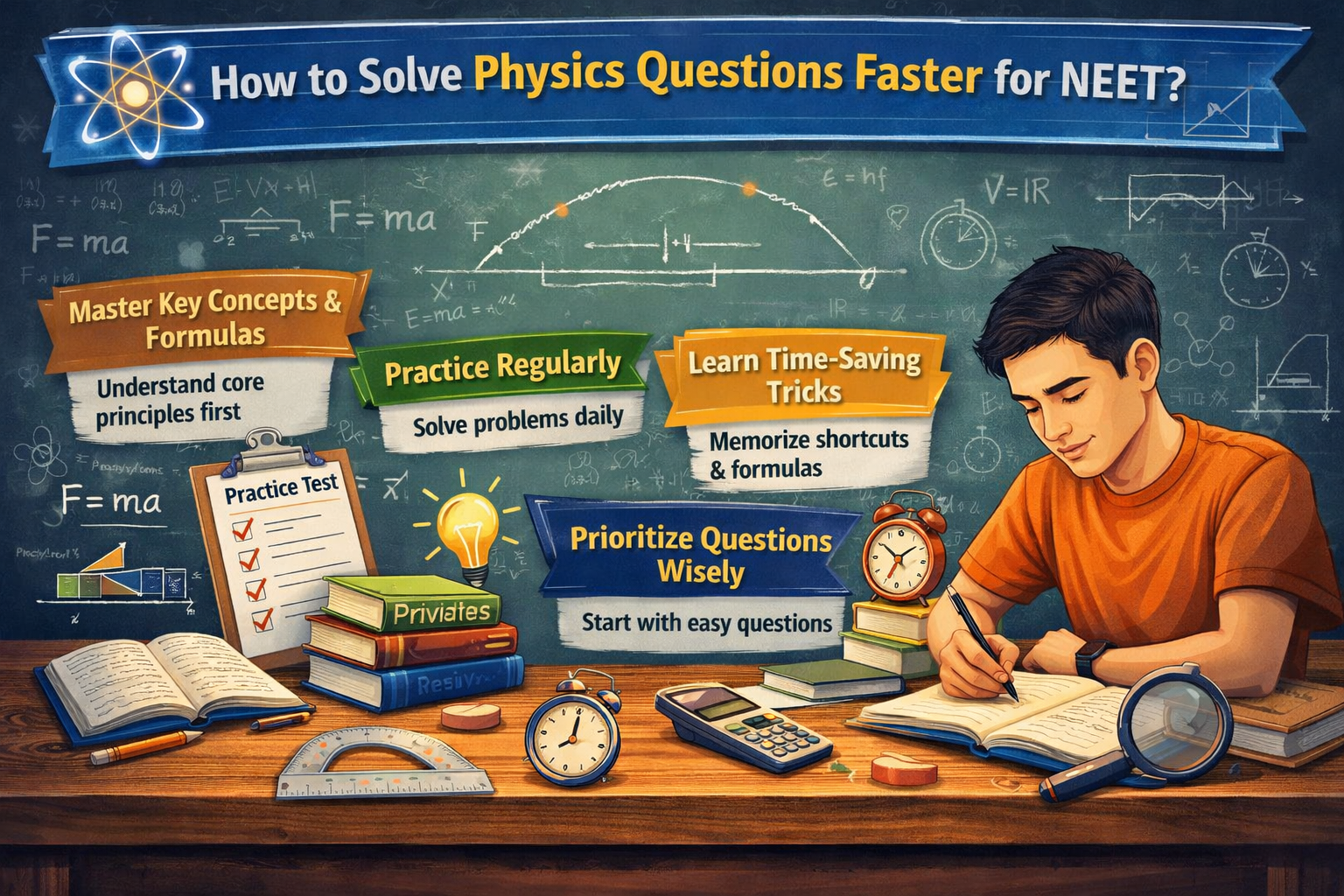
Why Speed Matters in NEET Physics?
NEET has 50 Physics questions to be completed in just 45 minutes if you split your time equally between all three sections. This means you get less than a minute for each Physics question. If you want to maximise your score, you need to solve fast without making errors. Building speed ensures you clear more questions, avoid last-minute panic, and manage time for reviewing your answers and attempting tough questions in NEET 2027.
Foundations First: How Strong Concepts Improve Speed
One common reason for slow problem-solving is weak concept clarity. If you need to re-derive basic formulas or recall basic principles every time, speed suffers. To increase your speed in solving Physics for NEET, strengthen these foundational pillars:
Master all NEET-important Physics formulas and learn when to use each.
Understand physical concepts, not just rote memorisation.
Work on visualising problems—draw diagrams, free-body diagrams, or graphs wherever possible.
Identify direct formula-based questions versus conceptual ones to plan your approach quickly.
Building strong basics will also make memorisation easier and improve your long-term retention. For more guidance on retaining information, see tips on How To Do Long Term Memorization For NEET.
Developing Calculation Speed and Accuracy
Slow calculations can eat up precious time in NEET Physics. Students can increase speed by focusing on:
Practising mental maths for common operations (multiplication, division, squaring, square roots, etc.).
Learning unit conversions and scientific notation tricks to handle SI units more briskly.
Training with questions that require estimates and approximations—sometimes, a quick estimate is all you need to eliminate options.
You can accelerate your preparation by using special strategies and shortcuts. Discover practical approaches for speedy calculations in NEET Physics at Physics Numerical Shortcuts And Tricks For NEET.
Question Selection: Triage and Smart Skipping
Not all Physics questions are meant to be solved linearly. A smart NEET aspirant quickly identifies:
Easy direct formula-based questions—attempt these first to build confidence.
Medium-level problems with two or fewer logical steps.
Complex or time-consuming questions that are better saved for a second round if time allows.
Mark tougher or ambiguous questions to review after finishing the ones you find straightforward. Smart skipping prevents you from getting stuck and losing time.
Timed Practice and Mock Tests: The Secret to Real Improvement
The only way to improve speed under exam pressure is through regular timed practice. Start by:
Setting a timer for every practice session and solving actual NEET Physics sections in 45 minutes.
Keeping track of the time taken for each question and noting topics where you lag.
Building a question solving strategy: e.g., solve all theory/conceptual questions first, then numericals.
Taking full-length mock tests to simulate the NEET environment before 2027 exam day.
Focus not just on speed but also on minimising negative marking—accuracy is as important as speed. To develop an effective full-syllabus approach, review our suggestions on How To Prepare For NEET Physics.
Error Analysis: Learn from Your Mistakes
After every test or practice session, spend time analysing errors rather than just moving on. Categorise your mistakes:
Conceptual errors (misunderstanding the question or physics involved)
Calculation slips (wrong arithmetic, unit errors, sign confusion)
Time management mistakes (spending too long on a single question)
Make a log of recurring error types and revisit those topics. Over time, you’ll notice patterns and get faster at avoiding similar mistakes in NEET 2027.
Revision Strategies for Faster Problem Solving
Regular revision keeps important formulas and techniques at your fingertips, cutting down recall time during the exam. Use these smart revision strategies:
Revise formula sheets and concept maps every week.
Practise one-shot topic-wise question sets under time pressure.
Simulate exam conditions—avoid looking up solutions immediately, and push yourself to recall and solve quickly.
In the final months, focus on high-yield chapters and weak areas. Explore ways to boost your Physics performance closer to the exam date with How To Improve NEET Physics In 1 Month.
Best Daily Habits for Increasing Physics Solving Speed
Building speed is a gradual process; consistency is key. Adopt these daily habits as part of your NEET 2027 journey:
Dedicate at least 30 minutes each day to solving Physics numericals with a timer.
Maintain a personal mistake and formula notebook.
Discuss doubts and challenging problems with friends or through online study groups like Vedantu’s doubt-solving sessions.
Reward yourself for meeting daily speed and accuracy targets to keep motivation high.
Students can also benefit from strategies shared in How To Score 150 Plus In Physics And Chemistry For NEET for target-based preparation.
Improving your speed in solving Physics for NEET 2027 is about practice with purpose, strong concepts, error correction, and developing smart problem-solving routines. With dedication and the right strategies, you can confidently handle the Physics section and make a real difference to your overall NEET result.
FAQs on How to Solve Physics Questions Faster for NEET 2027
1. What are the best ways to increase speed in solving Physics questions for NEET?
The best ways to increase speed in solving Physics for NEET are regular timed practice, mastering formulas, and applying shortcuts effectively.
Focus on practicing previous years’ NEET Physics questions under time constraints.
Memorize important physics formulas and revise them frequently.
Learn and use quick-solving tricks for common question types.
2. Why is speed important in the NEET Physics section?
Speed is crucial in the NEET Physics section because it helps you attempt more questions accurately within the limited exam time.
Faster solving allows for more time to review answers and handle challenging problems.
Efficient time management can improve your overall NEET score.
3. How can I quickly identify the right Physics formula during NEET practice?
To quickly identify the correct Physics formula, understand the question type and practice classifying problems by concepts.
Create a formula sheet for frequent revision.
Solve different varieties of NEET Physics questions regularly to recognize patterns.
4. What type of Physics questions usually take more time in NEET, and how can I solve them faster?
Numerical and multi-step Physics questions typically take more time in NEET, so breaking them into smaller steps can speed up your solving process.
Train to spot question keywords quickly.
Practice mental calculations and approximations where applicable.
5. How does regular mock testing help improve Physics problem-solving speed for NEET?
Regular mock tests help improve your Physics solving speed by simulating real exam conditions and building time management skills.
You can identify your weak areas and types of questions where you are slow.
Analyzing mock test performance helps in strategizing better for speed.
6. What are some common mistakes that slow down Physics solving speed in NEET?
Common mistakes that slow down Physics solving speed include spending too much time on tough questions, making calculation errors, and not reading questions carefully.
Avoid repeatedly attempting the same question if stuck; move to the next and return later.
Double-check calculations only after completing the paper if time permits.
7. Are there specific Physics topics where speed matters most in NEET?
Speed is especially important in Physics topics like Mechanics, Electrodynamics, and Modern Physics due to frequent calculation-based questions.
8. How can I use shortcuts and tricks safely while solving NEET Physics questions?
Use shortcuts and tricks only after practicing them thoroughly during your Physics preparation to avoid errors in NEET.
Always verify the shortcut’s applicability before using it in an exam situation.
Understand the logic behind each trick or formula-based shortcut.
9. Does solving previous years’ Physics questions increase speed for NEET?
Yes, practicing previous years’ NEET Physics questions helps you get familiar with exam patterns and improves your problem-solving speed.
10. Can Vedantu’s online resources help improve my speed in solving NEET Physics questions?
Vedantu offers targeted practice tests, live sessions, and expert tips designed to boost your speed and accuracy in NEET Physics problem-solving.
