




How would zero velocity and non-zero acceleration be represented on a velocity-time graph?
Answer
 Verified
600.6k+ views
Hint: The graph between velocity and time is a straight line graph and its slope is the tan of the angle made by the line with the x-axis. When acceleration is non zero, velocity changes continuously as long as acceleration is not zero. When acceleration is positive, velocity increases. While, when acceleration is negative, velocity decreases.
Complete answer:
Velocity is the change in displacement that takes place per unit time. Its SI unit is $m{{s}^{-1}}$.
$v=\dfrac{d}{t}$
Here, $v$ is the velocity
$d$ is the displacement of the object
$t$ is time taken
The acceleration is the change in velocity that takes place in unit time. Its SI unit is $m{{s}^{-2}}$
$a=\dfrac{v-u}{t}$
Here, $a$ is the acceleration
$v$ is the final velocity
$u$ is the initial velocity
$t$ is time taken
When a graph is drawn between velocity and time, the velocity is the dependent variable and hence taken on the y-axis while time is the independent variable taken on the x-axis.
Let us assume that the acceleration is a constant, therefore we can use the equation of motion,
$v=u+at$
Here, $v$ is the final velocity
$u$ is the initial velocity
$a$ is the acceleration
$t$ is the time taken
The above equation is similar to the equation of a line-
$y=mx+c$
$v=at+u$
Comparing both equations we can say that acceleration is the tangent of the line. Therefore, its graph will be-
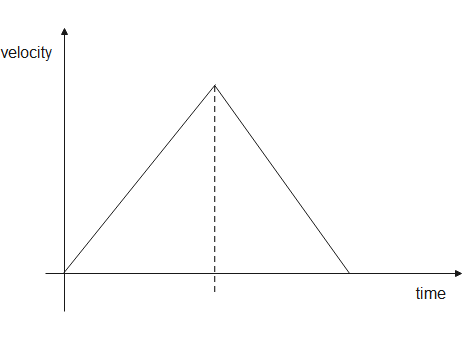
When tangent is positive, the line makes an acute angle with x-axis, when tangent is negative the line makes an obtuse angle with the y-axis.
For zero velocity, the x-axis is the line representing zero velocity as on x-axis $y=0$
Therefore, zero velocity is represented by the x-axis on the graph and accelerated motion is represented by a straight line.
Note:
If acceleration is non-zero, the graph will be a curve. When acceleration is acting on a body, external forces are acting on it by Newton’s second law. The slope of the graph between velocity and time is given by $\dfrac{dx}{dt}$ (the change in displacement is $dx$ and time taken is $dy$).
Complete answer:
Velocity is the change in displacement that takes place per unit time. Its SI unit is $m{{s}^{-1}}$.
$v=\dfrac{d}{t}$
Here, $v$ is the velocity
$d$ is the displacement of the object
$t$ is time taken
The acceleration is the change in velocity that takes place in unit time. Its SI unit is $m{{s}^{-2}}$
$a=\dfrac{v-u}{t}$
Here, $a$ is the acceleration
$v$ is the final velocity
$u$ is the initial velocity
$t$ is time taken
When a graph is drawn between velocity and time, the velocity is the dependent variable and hence taken on the y-axis while time is the independent variable taken on the x-axis.
Let us assume that the acceleration is a constant, therefore we can use the equation of motion,
$v=u+at$
Here, $v$ is the final velocity
$u$ is the initial velocity
$a$ is the acceleration
$t$ is the time taken
The above equation is similar to the equation of a line-
$y=mx+c$
$v=at+u$
Comparing both equations we can say that acceleration is the tangent of the line. Therefore, its graph will be-
When tangent is positive, the line makes an acute angle with x-axis, when tangent is negative the line makes an obtuse angle with the y-axis.
For zero velocity, the x-axis is the line representing zero velocity as on x-axis $y=0$
Therefore, zero velocity is represented by the x-axis on the graph and accelerated motion is represented by a straight line.
Note:
If acceleration is non-zero, the graph will be a curve. When acceleration is acting on a body, external forces are acting on it by Newton’s second law. The slope of the graph between velocity and time is given by $\dfrac{dx}{dt}$ (the change in displacement is $dx$ and time taken is $dy$).
Recently Updated Pages
Master Class 11 English: Engaging Questions & Answers for Success

Master Class 11 Social Science: Engaging Questions & Answers for Success
Master Class 11 Maths: Engaging Questions & Answers for Success
Master Class 11 Biology: Engaging Questions & Answers for Success
Master Class 11 Physics: Engaging Questions & Answers for Success
Master Class 11 Chemistry: Engaging Questions & Answers for Success
Trending doubts
One Metric ton is equal to kg A 10000 B 1000 C 100 class 11 physics CBSE
Difference Between Prokaryotic Cells and Eukaryotic Cells
1 ton equals to A 100 kg B 1000 kg C 10 kg D 10000 class 11 physics CBSE
Find the value of the expression given below sin 30circ class 11 maths CBSE
Two of the body parts which do not appear in MRI are class 11 biology CBSE
What are hard magnetic materials class 11 physics CBSE