




You take two resistors of resistance $ 2R $ and $ 3R $ , connect them in parallel in an electric circuit. Calculate the ratio of the electrical power consumed by $ 2R $ and $ 3R $ ?
Answer
 Verified
571.5k+ views
Hint: To solve this given question we first start with evaluating the equivalent resistance of the given resistance which are connected in parallel connection. By using the equivalent resistance we will obtain the electrical power by using the relation of power and resistance. Then we will obtain the ratio of the electrical power consumed by the respective resistance given.
Formula used:
Electrical power formula
$ P = \dfrac{{{V^2}}}{R}t $
where $ V $ is the potential difference and $ R $ is resistance and $ t $ is the time.
Complete Step-by-step solution
We will consider that the resistance $ 2R $ and $ 3R $ connected in parallel and hence the arrangements is given as
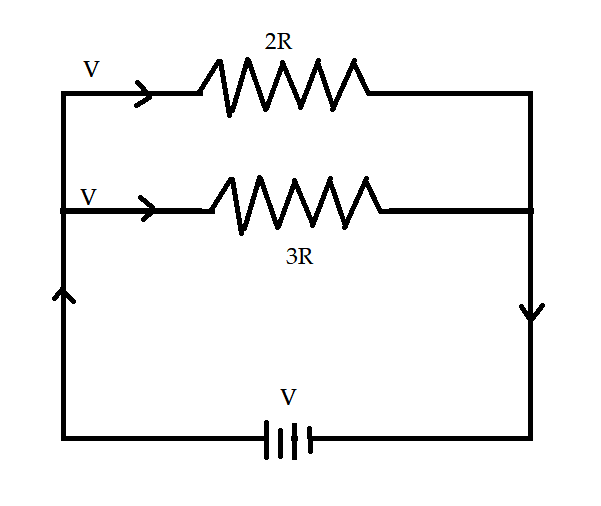
We can conclude from the figure that the resistors are connected in parallel and $ V $ are the voltage across the circuit. According to the ohms law that states that for resistance connected in parallel connection the voltage is considered as constant across resistances. Hence from ohm’s law, we can give the formula for electrical power.
Hence from the electrical power formula
$ P = \dfrac{{{V^2}}}{R}t $
where $ V $ is the potential difference and $ R $ is resistance and $ t $ is the time.
Hence for the resistance with the value of $ 2R $ the electrical power is given as
$ {P_{2R}} = \dfrac{{{V^2}}}{{2R}}t $ ……… $ (1) $
Similarly for the resistance with the value of $ 3R $ the electrical power is given as
$ {P_{3R}} = \dfrac{{{V^2}}}{{3R}}t $ ……… $ (2) $
Now we will evaluate the ratio of electrical power for resistance $ 2R $ and $ 3R $ is given by taking the ratio of the equation $ (1) $ and $ (2) $ ,
$ \dfrac{{{P_{2R}}}}{{{P_{3R}}}} = \dfrac{{\dfrac{{{V^2}}}{{2R}}t}}{{\dfrac{{{V^2}}}{{3R}}t}} $
$ \Rightarrow \dfrac{{{P_{2R}}}}{{{P_{3R}}}} = \dfrac{{3R}}{{2R}} $
$ \therefore \dfrac{{{P_{2R}}}}{{{P_{3R}}}} = \dfrac{3}{2} $
Hence the ratio of the electrical power consumed by $ 2R $ and $ 3R $ is given as $ \dfrac{{{P_{2R}}}}{{{P_{3R}}}} = \dfrac{3}{2} $ .
Note:
We used the formula of power as $ P = \dfrac{{{V^2}}}{R} $ because in the parallel connection voltage across the resistance is found to be constant while for series connection the formula of power can be given by $ P = {i^2}Rt $ , where $ i $ is current and in series connection current remains constant across the resistances.
Formula used:
Electrical power formula
$ P = \dfrac{{{V^2}}}{R}t $
where $ V $ is the potential difference and $ R $ is resistance and $ t $ is the time.
Complete Step-by-step solution
We will consider that the resistance $ 2R $ and $ 3R $ connected in parallel and hence the arrangements is given as
We can conclude from the figure that the resistors are connected in parallel and $ V $ are the voltage across the circuit. According to the ohms law that states that for resistance connected in parallel connection the voltage is considered as constant across resistances. Hence from ohm’s law, we can give the formula for electrical power.
Hence from the electrical power formula
$ P = \dfrac{{{V^2}}}{R}t $
where $ V $ is the potential difference and $ R $ is resistance and $ t $ is the time.
Hence for the resistance with the value of $ 2R $ the electrical power is given as
$ {P_{2R}} = \dfrac{{{V^2}}}{{2R}}t $ ……… $ (1) $
Similarly for the resistance with the value of $ 3R $ the electrical power is given as
$ {P_{3R}} = \dfrac{{{V^2}}}{{3R}}t $ ……… $ (2) $
Now we will evaluate the ratio of electrical power for resistance $ 2R $ and $ 3R $ is given by taking the ratio of the equation $ (1) $ and $ (2) $ ,
$ \dfrac{{{P_{2R}}}}{{{P_{3R}}}} = \dfrac{{\dfrac{{{V^2}}}{{2R}}t}}{{\dfrac{{{V^2}}}{{3R}}t}} $
$ \Rightarrow \dfrac{{{P_{2R}}}}{{{P_{3R}}}} = \dfrac{{3R}}{{2R}} $
$ \therefore \dfrac{{{P_{2R}}}}{{{P_{3R}}}} = \dfrac{3}{2} $
Hence the ratio of the electrical power consumed by $ 2R $ and $ 3R $ is given as $ \dfrac{{{P_{2R}}}}{{{P_{3R}}}} = \dfrac{3}{2} $ .
Note:
We used the formula of power as $ P = \dfrac{{{V^2}}}{R} $ because in the parallel connection voltage across the resistance is found to be constant while for series connection the formula of power can be given by $ P = {i^2}Rt $ , where $ i $ is current and in series connection current remains constant across the resistances.
Recently Updated Pages
Basicity of sulphurous acid and sulphuric acid are

Master Class 12 English: Engaging Questions & Answers for Success
Master Class 12 Social Science: Engaging Questions & Answers for Success
Master Class 12 Maths: Engaging Questions & Answers for Success
Master Class 12 Economics: Engaging Questions & Answers for Success
Master Class 12 Physics: Engaging Questions & Answers for Success
Trending doubts
Draw a labelled sketch of the human eye class 12 physics CBSE
Which are the Top 10 Largest Countries of the World?
Draw ray diagrams each showing i myopic eye and ii class 12 physics CBSE
Giving reasons state the signs positive or negative class 12 physics CBSE
Explain esterification reaction with the help of a class 12 chemistry CBSE
What is defined as a solenoid Depict a diagram with class 12 physics CBSE