




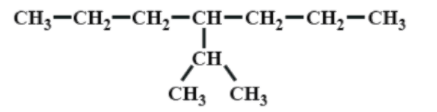
Write the systematic name of the organic compound having the structure
Answer
 Verified
598.8k+ views
Hint:
To answer this question, you should recall the concept of IUPAC nomenclature of IUPAC compounds. We shall find the longest carbon chain, which will be the parent chain and then assign the lowest number possible to the substituent group.
Complete step by step solution:
According to the Guidelines set by IUPAC, the nomenclature of compounds must follow these steps:
1) The Longest Chain Rule
2) The Lowest Set of Locants: Numbering of parent chains in which the lowest number is assigned to the carbon atom which carries the substituents.
3) Multiple instances of the same substituent
4) The naming of different substituents
5) Correct naming of different substituents in case they are present at the same positions
6) Naming Complex Substituents
7) The longest carbon chain is composed of 7 carbon chains and the substituent is isopropyl or 1-methylethyl at the fourth carbon atom.
8) Hence, the systematic name of the given compound is 4-(1-methylethyl) heptane.
Note:
You should know about different types of isomerism and their naming. We know that isomers are defined as the molecules with the same molecular formula but possess a different arrangement of the atoms in space or different connectivity of atoms. The phenomenon in which the molecules in which the atoms that form the isomers are connected differently is known as structural isomerism. The phenomenon in which the connectivity of atoms is the same in isomers but a different spatial arrangement is a stereoisomerism. 2-Butene can exist as cis and trans isomers because of the double bond that leads to the restricted rotation. For example, in 2-Butene, this results in two isomers where the cis-isomer formed have the two methyl groups on the same side and the trans-isomer formed has the two methyl groups on opposite sides. 2-methyl propene and 2-methyl-2-butene contain a double bond but the groups attached to one of the C of the double bond are the same.
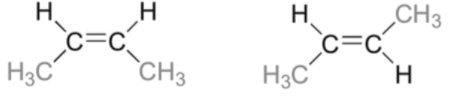
Cis-2-butene trans-2-butene
To answer this question, you should recall the concept of IUPAC nomenclature of IUPAC compounds. We shall find the longest carbon chain, which will be the parent chain and then assign the lowest number possible to the substituent group.
Complete step by step solution:
According to the Guidelines set by IUPAC, the nomenclature of compounds must follow these steps:
1) The Longest Chain Rule
2) The Lowest Set of Locants: Numbering of parent chains in which the lowest number is assigned to the carbon atom which carries the substituents.
3) Multiple instances of the same substituent
4) The naming of different substituents
5) Correct naming of different substituents in case they are present at the same positions
6) Naming Complex Substituents
7) The longest carbon chain is composed of 7 carbon chains and the substituent is isopropyl or 1-methylethyl at the fourth carbon atom.
8) Hence, the systematic name of the given compound is 4-(1-methylethyl) heptane.
Note:
You should know about different types of isomerism and their naming. We know that isomers are defined as the molecules with the same molecular formula but possess a different arrangement of the atoms in space or different connectivity of atoms. The phenomenon in which the molecules in which the atoms that form the isomers are connected differently is known as structural isomerism. The phenomenon in which the connectivity of atoms is the same in isomers but a different spatial arrangement is a stereoisomerism. 2-Butene can exist as cis and trans isomers because of the double bond that leads to the restricted rotation. For example, in 2-Butene, this results in two isomers where the cis-isomer formed have the two methyl groups on the same side and the trans-isomer formed has the two methyl groups on opposite sides. 2-methyl propene and 2-methyl-2-butene contain a double bond but the groups attached to one of the C of the double bond are the same.
Cis-2-butene trans-2-butene
Recently Updated Pages
Basicity of sulphurous acid and sulphuric acid are

Master Class 11 English: Engaging Questions & Answers for Success
Master Class 11 Physics: Engaging Questions & Answers for Success
Master Class 11 Computer Science: Engaging Questions & Answers for Success
Master Class 11 Chemistry: Engaging Questions & Answers for Success
Master Class 11 Social Science: Engaging Questions & Answers for Success
Trending doubts
Difference Between Prokaryotic Cells and Eukaryotic Cells
Two of the body parts which do not appear in MRI are class 11 biology CBSE
One Metric ton is equal to kg A 10000 B 1000 C 100 class 11 physics CBSE
10 examples of friction in our daily life
Draw a diagram of nephron and explain its structur class 11 biology CBSE
What will happen if the mucus is not secreted by the class 11 biology CBSE