




Write the structure of propanol.
Answer
 Verified
668.4k+ views
Hint: Propanol is primary alcohol with general structure RCOH where R is alkyl group and –OH is the functional group. It is also known as ethyl carbinol.
Complete step by step answer:
Propanol has chemical formula \[{\text{C}}{{\text{H}}_{\text{3}}}{\text{C}}{{\text{H}}_{\text{2}}}{\text{C}}{{\text{H}}_{\text{2}}}{\text{OH}}\] or ${{\text{C}}_{\text{3}}}{{\text{H}}_{\text{8}}}{\text{O}}$ .
Propanol is also known as ${\text{propan - 1 - ol}}$ or n-propanol. Its structure is given below-
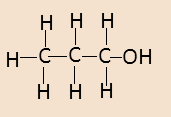
It has a simple straight chain structure. Its properties are as follows-
1.It is a clear colorless liquid.
2.It has a musty odor similar to ethanol or rubbing alcohol.
3.It has a ripe, fruity flavor.
4.It is highly flammable.
5.It is soluble in acetone and benzene and miscible with other organic solvents.
5.It is also soluble in water.
6.It is found in apple, cognac, apricot, banana, papaya, pineapple and cherry.
It is prepared by hydrogenation of propionaldehyde. The reaction is as follows-
$ \Rightarrow C{H_3}C{H_2}CHO + {H_2} \to C{H_3}C{H_2}C{H_2}OH$
In this reaction the two hydrogen molecules get attached to the carbon of the aldehyde functional group and propanol is obtained. It is easily ignited by heat and its vapors form explosive mixtures with air. Its vapours are heavier than air so they can easily spread along the ground and collect in low confined areas.
Note:
The uses of propanol are-
1.As a solvent for natural gums, polishes, pharmaceuticals.
2.In cosmetics, dental lotions and lacquers.
3.As a specialty solvent in printing inks for printing on polyolefin and polyamide film.
4.In manufacture of n-propyl acetate and glycol ethers.
5.As a chemical intermediate in reactions.
6.As a flavoring agent and fragrance in foods.
7.As a co-solvent in pesticide formulation.
Complete step by step answer:
Propanol has chemical formula \[{\text{C}}{{\text{H}}_{\text{3}}}{\text{C}}{{\text{H}}_{\text{2}}}{\text{C}}{{\text{H}}_{\text{2}}}{\text{OH}}\] or ${{\text{C}}_{\text{3}}}{{\text{H}}_{\text{8}}}{\text{O}}$ .
Propanol is also known as ${\text{propan - 1 - ol}}$ or n-propanol. Its structure is given below-
It has a simple straight chain structure. Its properties are as follows-
1.It is a clear colorless liquid.
2.It has a musty odor similar to ethanol or rubbing alcohol.
3.It has a ripe, fruity flavor.
4.It is highly flammable.
5.It is soluble in acetone and benzene and miscible with other organic solvents.
5.It is also soluble in water.
6.It is found in apple, cognac, apricot, banana, papaya, pineapple and cherry.
It is prepared by hydrogenation of propionaldehyde. The reaction is as follows-
$ \Rightarrow C{H_3}C{H_2}CHO + {H_2} \to C{H_3}C{H_2}C{H_2}OH$
In this reaction the two hydrogen molecules get attached to the carbon of the aldehyde functional group and propanol is obtained. It is easily ignited by heat and its vapors form explosive mixtures with air. Its vapours are heavier than air so they can easily spread along the ground and collect in low confined areas.
Note:
The uses of propanol are-
1.As a solvent for natural gums, polishes, pharmaceuticals.
2.In cosmetics, dental lotions and lacquers.
3.As a specialty solvent in printing inks for printing on polyolefin and polyamide film.
4.In manufacture of n-propyl acetate and glycol ethers.
5.As a chemical intermediate in reactions.
6.As a flavoring agent and fragrance in foods.
7.As a co-solvent in pesticide formulation.
Recently Updated Pages
Which will be the least stable resonating structure class 11 chemistry CBSE

How many 5 digit telephone numbers can be construc-class-11-maths-CBSE
How do you find the angle of the resultant vector class 11 physics CBSE
Draw labelled diagram of the following i Gram seed class 11 biology CBSE
1 Quintal is equal to a 110 kg b 10 kg c 100kg d 1000 class 11 physics CBSE
What is the need and importance of classification class 11 biology CBSE
Trending doubts
Find the value of the expression given below sin 30circ class 11 maths CBSE
One Metric ton is equal to kg A 10000 B 1000 C 100 class 11 physics CBSE
10 examples of friction in our daily life
Draw a diagram of a plant cell and label at least eight class 11 biology CBSE
Difference between physical and chemical change class 11 chemistry CBSE
Proton was discovered by A Thomson B Rutherford C Chadwick class 11 chemistry CBSE