




Write the name of the parts of the stomata given in the below diagram.
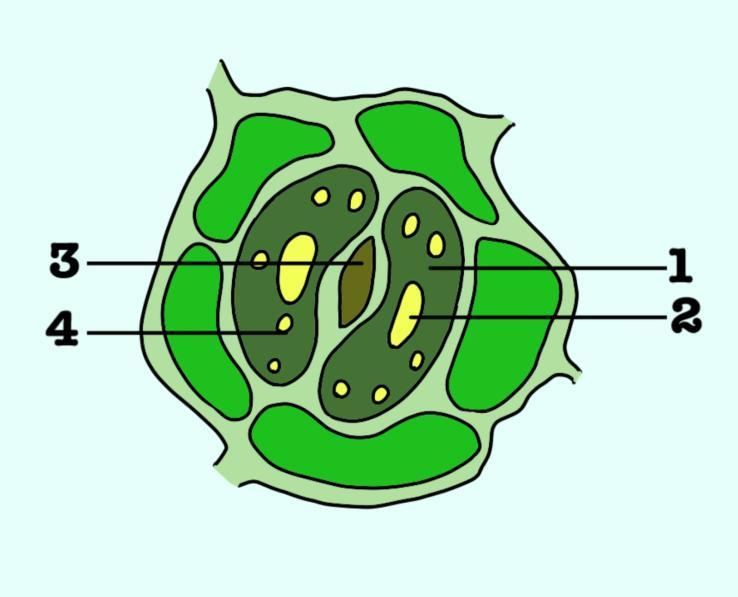
(A) I. Guard cell, II. Stoma, III. Starch granule, IV. Nucleus
(B) I. Cytoplasm, II. Nucleus, III. Stoma, IV. Chloroplast
(C) I. Guard cell, II. Starch, III. Nucleus, IV. Stoma
(D) I. Cytoplasm, II. Chloroplast, III. Stoma, IV. Nucleus
Answer
 Verified
535.5k+ views
Hint: They provide for the exchange of gases between the outside air and the branched system of interconnecting air canals within the leaf. In response to the internal pressure of two sausage-shaped guard cells, it opens and closes that encompass it.
Complete answer
Stomata are little pores present inside the epidermis of leaves. They control the cycle of transpiration and gaseous exchange. The stomatal pore is encased between two bean-formed guard cells. The inward walls of guard cells are thick, while the external wall is slender. The guard cells are encircled by auxiliary cells. These are the specific epidermal cells present around the guard cells. The pores, the guard cells, and the auxiliary cells together establish the stomatal apparatus.
The guard cells work to manage extreme water loss, shutting on hot, dry, or blustery days and opening when conditions are greater for gas exchange. For most plants, sunrise triggers an abrupt expansion in the stomatal opening, arriving at the greatest close to early afternoon, which is trailed by decay on account of water loss. In plants that photosynthesize with the CAM carbon fixation pathway, like bromeliads and members of the Crassulaceae, stomata are opened in the dark to scale back water loss from evapotranspiration.
So the correct answer is ‘I. Cytoplasm, II. Nucleus, III. Stoma, IV. Chloroplast’.
Note:
Smaller stomatal openings can be utilized related to a delegate atom with a high carbon dioxide partiality, PEPcase (Phosphoenolpyruvate carboxylase). Recovering the results of carbon obsession from PEPCase is an energy-concentrated cycle, be that as it may. Subsequently, the PEPCase elective is best just where water is restricting yet the daylight is abundant, or where high temperatures increase the dissolvability of oxygen comparative with that of carbon dioxide, amplifying RuBisCo's oxygenation issue.
Complete answer
Stomata are little pores present inside the epidermis of leaves. They control the cycle of transpiration and gaseous exchange. The stomatal pore is encased between two bean-formed guard cells. The inward walls of guard cells are thick, while the external wall is slender. The guard cells are encircled by auxiliary cells. These are the specific epidermal cells present around the guard cells. The pores, the guard cells, and the auxiliary cells together establish the stomatal apparatus.
The guard cells work to manage extreme water loss, shutting on hot, dry, or blustery days and opening when conditions are greater for gas exchange. For most plants, sunrise triggers an abrupt expansion in the stomatal opening, arriving at the greatest close to early afternoon, which is trailed by decay on account of water loss. In plants that photosynthesize with the CAM carbon fixation pathway, like bromeliads and members of the Crassulaceae, stomata are opened in the dark to scale back water loss from evapotranspiration.
So the correct answer is ‘I. Cytoplasm, II. Nucleus, III. Stoma, IV. Chloroplast’.
Note:
Smaller stomatal openings can be utilized related to a delegate atom with a high carbon dioxide partiality, PEPcase (Phosphoenolpyruvate carboxylase). Recovering the results of carbon obsession from PEPCase is an energy-concentrated cycle, be that as it may. Subsequently, the PEPCase elective is best just where water is restricting yet the daylight is abundant, or where high temperatures increase the dissolvability of oxygen comparative with that of carbon dioxide, amplifying RuBisCo's oxygenation issue.
Recently Updated Pages
Master Class 12 Economics: Engaging Questions & Answers for Success

Master Class 12 English: Engaging Questions & Answers for Success
Master Class 12 Social Science: Engaging Questions & Answers for Success
Master Class 12 Maths: Engaging Questions & Answers for Success
Master Class 12 Physics: Engaging Questions & Answers for Success
Master Class 9 General Knowledge: Engaging Questions & Answers for Success
Trending doubts
One Metric ton is equal to kg A 10000 B 1000 C 100 class 11 physics CBSE
Difference Between Prokaryotic Cells and Eukaryotic Cells
Two of the body parts which do not appear in MRI are class 11 biology CBSE
1 ton equals to A 100 kg B 1000 kg C 10 kg D 10000 class 11 physics CBSE
Draw a diagram of nephron and explain its structur class 11 biology CBSE
10 examples of friction in our daily life