




Write the name of the gland that secretes the insulin hormone. What is the mechanism of control the quantity of insulin of the gland and how does it secrete?
Answer
 Verified
588.6k+ views
Hint: Insulin is secreted by a gland that is present in the abdomen having an exocrine function. It also produces enzymes such as amylase and lipase and hormones such as somatostatin and glucagon. The gland lies close to the duodenum of the intestine.
Complete answer:
Insulin is secreted in the islets of Langerhans present in the pancreas, specifically the beta cells. Insulin is a peptide hormone that regulates the amount of blood glucose and controls the metabolism of carbohydrates.
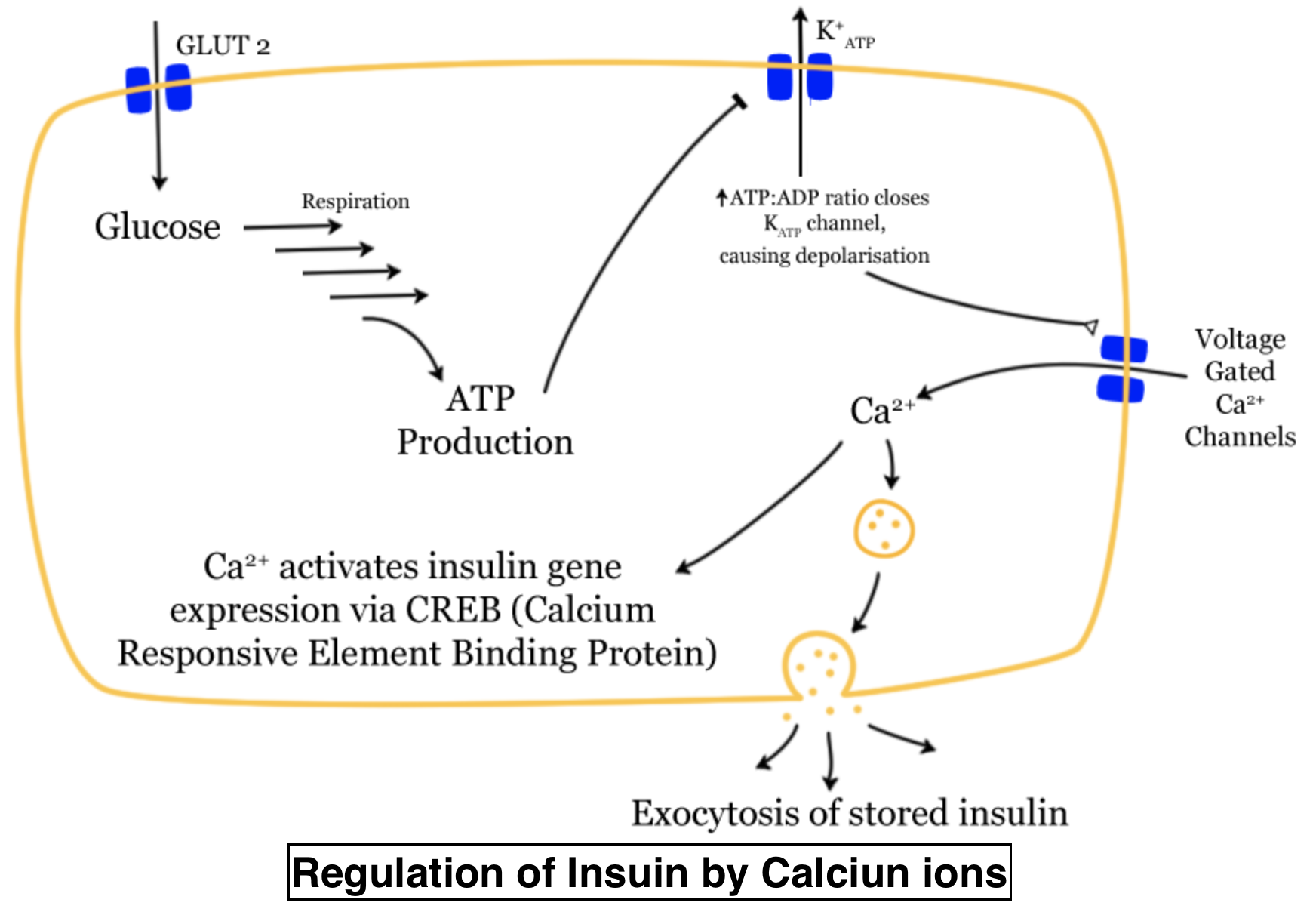
The beta cells of the pancreatic islets are sensitive to the blood sugar levels and thus they secrete insulin into the blood in response to a high glucose level in the bloodstream and inhibit insulin secretion if the blood glucose levels are lower than the ideal concentration. Insulin secretion and release can be due to any stimuli such as a rise in plasma glucose and amino acid concentration due to any reason like increased catabolism of proteins and glycogen or immediately after food consumption.
Additional Information:
- Pancreas also secretes the hormone glucagon which helps in the regulation of blood sugar levels.
- Insulin helps in lowering the blood glucose levels by increasing the formation of glycogen, i.e. promote glycogenesis and thus reduce the blood glucose levels.
- Glucagon, on the other hand, increases the blood glucose level by promoting glycogenolysis, and thus there is a breakdown of stored glycogen to increase blood sugar.
- This glucagon hormone is secreted in the alpha cells of the islets of Langerhans.
Note:
- Pancreas is known as an exocrine gland, i.e., it performs both endocrine and exocrine functions. - Endocrine functions include the secretion of hormones like glucagon, insulin, and somatostatin whereas the exocrine function is in the digestive system. It secretes enzymes such as pancreatic amylase and pancreatic lipase that have functions in the digestion of food.
- Diabetes is a condition in which there is an increase in the blood glucose levels due to two possible reasons, either there is a shortage in the production of insulin or the cells become less sensitive to the insulin.
Recently Updated Pages
Master Class 11 Social Science: Engaging Questions & Answers for Success

Master Class 11 Physics: Engaging Questions & Answers for Success
Master Class 11 Maths: Engaging Questions & Answers for Success
Master Class 11 Economics: Engaging Questions & Answers for Success
Master Class 11 Computer Science: Engaging Questions & Answers for Success
Master Class 11 Chemistry: Engaging Questions & Answers for Success
Trending doubts
One Metric ton is equal to kg A 10000 B 1000 C 100 class 11 physics CBSE
There are 720 permutations of the digits 1 2 3 4 5 class 11 maths CBSE
1 Quintal is equal to a 110 kg b 10 kg c 100kg d 1000 class 11 physics CBSE
State and prove Bernoullis theorem class 11 physics CBSE
Difference Between Prokaryotic Cells and Eukaryotic Cells
Which among the following are examples of coming together class 11 social science CBSE