




Write the mechanism of hydration of ethene to yield ethanol.
Answer
 Verified
596.3k+ views
Hint: We know that in a hydration reaction, the water molecule reacts with a compound which is not saturated but unsaturated to generate an alcohol.
Complete step-by-step solution:
Let us see the example of hydration reaction:
$C_{2}H_{4} + H_{2}SO_{4} \overset{H_{2}O}{\rightarrow} CH_{3}CH_{2}OH$
In this reaction the ethene molecules we see that react with sulphuric acid generating an alcohol, that is ethanol.
In a hydration reaction, the water molecule reacts with an alkene to generate an alcohol. Ethanol can be prepared by the reaction of alkene with the water molecule. Ethene molecules react with sulphuric acid generating an alcohol, that is ethanol.
This conversion of ethene molecule to ethanol molecule involves three steps. The three steps are:
1) Electrophilic attack on the hydronium ion takes place which pronates the ethene to form a carbocation.
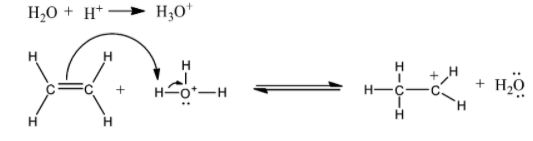
2) In the second step, the carbocation is attacked by the water molecule.

3) The deprotonation lastly generates the ethanol.

Note: Students may get confused between hydration reaction and hydrolysis reaction. In a hydration reaction, the water molecule reacts with an unsaturated compound to generate an alcohol but in hydrolysis reaction chemical bonds are broken due to addition of water.
Complete step-by-step solution:
Let us see the example of hydration reaction:
$C_{2}H_{4} + H_{2}SO_{4} \overset{H_{2}O}{\rightarrow} CH_{3}CH_{2}OH$
In this reaction the ethene molecules we see that react with sulphuric acid generating an alcohol, that is ethanol.
In a hydration reaction, the water molecule reacts with an alkene to generate an alcohol. Ethanol can be prepared by the reaction of alkene with the water molecule. Ethene molecules react with sulphuric acid generating an alcohol, that is ethanol.
This conversion of ethene molecule to ethanol molecule involves three steps. The three steps are:
1) Electrophilic attack on the hydronium ion takes place which pronates the ethene to form a carbocation.
2) In the second step, the carbocation is attacked by the water molecule.
3) The deprotonation lastly generates the ethanol.
Note: Students may get confused between hydration reaction and hydrolysis reaction. In a hydration reaction, the water molecule reacts with an unsaturated compound to generate an alcohol but in hydrolysis reaction chemical bonds are broken due to addition of water.
Recently Updated Pages
Which of the following graphs shows the variation of class 12 physics CBSE

Draw a labelled diagram of the human male reproductive class 12 biology CBSE
Describe the experiment to compare the emf of two cells class 12 physics CBSE
What is standard hydrogen electrode
What is conventional current and electric current class 12 physics CBSE
2Bromopentane is treated with an alcoholic KOH solution class 12 chemistry CBSE
Trending doubts
Draw a labelled sketch of the human eye class 12 physics CBSE
Which are the Top 10 Largest Countries of the World?
Draw ray diagrams each showing i myopic eye and ii class 12 physics CBSE
Which is the correct genotypic ratio of mendel dihybrid class 12 biology CBSE
Which is the strongest oxidising agent out of the following class 12 chemistry CBSE
Differentiate between homogeneous and heterogeneous class 12 chemistry CBSE