




Write the IUPAC name of \[Ph-CH=CH-CHO\].
Answer
 Verified
633k+ views
Hint:
Try solving this question selecting the main chain, numbering it and choosing the root word. The main chain is the one with the greatest number of carbons. Numbering in IUPAC is done such that the branched atom gets the lowest number.
Complete step by step answer:
Let us draw the structure of the given compound –
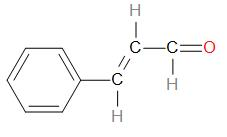
1. Let us number the given compound. Numbering in IUPAC is done such that the group at higher rank in priority order gets the lowest number.
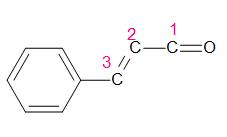
2.The compound consists of 3 carbons. Therefore, the root word is ‘prop’.
3. Now, we see that there is a double bond at the second carbon. Therefore, we will add ‘2-ene’ as a suffix. The name becomes – ‘prop-2-ene’.
4. As we can see, there are two functional groups – aldehyde and phenol. Since, aldehyde has a greater priority, there it will be added in the suffix. Phenol will be added in the prefix. Since it is attached to the third carbon, we will add the prefix ‘3-phenol’. The name of the compound is – ‘3-phenylprop-2-ene-al’.
Therefore, the IUPAC name of this compound is 3-phenylprop-2-ene-al.
Additional Information: The common name of this compound is \[\text{ }\!\!\beta\!\!\text{ -}\] phenyl acrolein.
Note: Alkanes are known as saturated hydrocarbons, whereas alkenes and alkynes are known as unsaturated hydrocarbons. The table for root words of organic compound according to the number of carbons is as follows –
Try solving this question selecting the main chain, numbering it and choosing the root word. The main chain is the one with the greatest number of carbons. Numbering in IUPAC is done such that the branched atom gets the lowest number.
Complete step by step answer:
Let us draw the structure of the given compound –
1. Let us number the given compound. Numbering in IUPAC is done such that the group at higher rank in priority order gets the lowest number.
2.The compound consists of 3 carbons. Therefore, the root word is ‘prop’.
3. Now, we see that there is a double bond at the second carbon. Therefore, we will add ‘2-ene’ as a suffix. The name becomes – ‘prop-2-ene’.
4. As we can see, there are two functional groups – aldehyde and phenol. Since, aldehyde has a greater priority, there it will be added in the suffix. Phenol will be added in the prefix. Since it is attached to the third carbon, we will add the prefix ‘3-phenol’. The name of the compound is – ‘3-phenylprop-2-ene-al’.
Therefore, the IUPAC name of this compound is 3-phenylprop-2-ene-al.
Additional Information: The common name of this compound is \[\text{ }\!\!\beta\!\!\text{ -}\] phenyl acrolein.
Note: Alkanes are known as saturated hydrocarbons, whereas alkenes and alkynes are known as unsaturated hydrocarbons. The table for root words of organic compound according to the number of carbons is as follows –
| Number of Carbons | Root word |
| 1 | Meth |
| 2 | Eth |
| 3 | Prop |
| 4 | But |
| 5 | Pent |
| 6 | Hex |
| 7 | Hept |
| 8 | Oct |
| 9 | Non |
| 10 | Dec |
| 11 | Undec |
| 12 | Dodec |
Recently Updated Pages
Master Class 12 Economics: Engaging Questions & Answers for Success

Master Class 12 English: Engaging Questions & Answers for Success
Master Class 12 Social Science: Engaging Questions & Answers for Success
Master Class 12 Maths: Engaging Questions & Answers for Success
Master Class 12 Physics: Engaging Questions & Answers for Success
Master Class 11 Social Science: Engaging Questions & Answers for Success
Trending doubts
One Metric ton is equal to kg A 10000 B 1000 C 100 class 11 physics CBSE
Difference Between Prokaryotic Cells and Eukaryotic Cells
Two of the body parts which do not appear in MRI are class 11 biology CBSE
1 ton equals to A 100 kg B 1000 kg C 10 kg D 10000 class 11 physics CBSE
Draw a diagram of nephron and explain its structur class 11 biology CBSE
10 examples of friction in our daily life