




Write the important characters of chrysophytes?
Answer
 Verified
621k+ views
Hint: Chrysophytes are protists that behave similarly to plants which are commonly seen in both saline and freshwater habitats and are mostly low in calcium. The three major kinds of chrysophytes are bacillariophyta, Chrysophyceae, and Xanthophyceae
Complete answer:
The important characteristics of chrysophytes are:
-Dual flagella with different lengths
Chrysophytes have two flagella with different lengths. Chrysophytes are motile and motility is controlled by these flagella. The lengthier flagella provide motility and a shorter one which rotates helically.
-Pigmentation
Chrysophytes produce accessory pigments which provide them a golden yellow color. This pigment helps in the easy identification of chrysophytes. The pigment they produce is fucoxanthin.
-Cellulose and silica-rich cell wall.
The chrysophytes have distinct cell walls with both cellulose and silica. This provides rigidity and structural support to them. This is the reason why they are able to survive in cold temperatures. In some kind of chrysophytes, chitin is also present on the cell wall.
-Unicellular
Chrysophytes are unicellular organisms with membrane-bounded organelles.
-Present in both fresh and saline water
Chrysophytes are found in both marine and freshwater bodies which have low calcium levels.
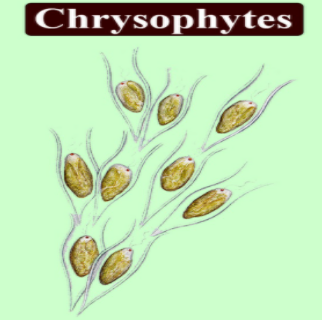
Note: -Certain members of chrysophytes are amoeboid and some have very complex life cycles with the formation of multiple Nucleus.
-Even though most of the chrysophytes are motile and free swimming, some are found non-motile.
-Chrysophytes is one of the major causes of eutrophication in certain water bodies where the nitrogen-rich topsoil washes in the water bodies and chrysophytes utilize these nutrients and multiply.
Complete answer:
The important characteristics of chrysophytes are:
-Dual flagella with different lengths
Chrysophytes have two flagella with different lengths. Chrysophytes are motile and motility is controlled by these flagella. The lengthier flagella provide motility and a shorter one which rotates helically.
-Pigmentation
Chrysophytes produce accessory pigments which provide them a golden yellow color. This pigment helps in the easy identification of chrysophytes. The pigment they produce is fucoxanthin.
-Cellulose and silica-rich cell wall.
The chrysophytes have distinct cell walls with both cellulose and silica. This provides rigidity and structural support to them. This is the reason why they are able to survive in cold temperatures. In some kind of chrysophytes, chitin is also present on the cell wall.
-Unicellular
Chrysophytes are unicellular organisms with membrane-bounded organelles.
-Present in both fresh and saline water
Chrysophytes are found in both marine and freshwater bodies which have low calcium levels.
Note: -Certain members of chrysophytes are amoeboid and some have very complex life cycles with the formation of multiple Nucleus.
-Even though most of the chrysophytes are motile and free swimming, some are found non-motile.
-Chrysophytes is one of the major causes of eutrophication in certain water bodies where the nitrogen-rich topsoil washes in the water bodies and chrysophytes utilize these nutrients and multiply.
Recently Updated Pages
Master Class 5 English: Engaging Questions & Answers for Success

Master Class 5 Maths: Engaging Questions & Answers for Success
Master Class 5 Social Science: Engaging Questions & Answers for Success
Master Class 5 Science: Engaging Questions & Answers for Success
Class 5 Question and Answer - Your Ultimate Solutions Guide
Master Class 9 General Knowledge: Engaging Questions & Answers for Success
Trending doubts
One Metric ton is equal to kg A 10000 B 1000 C 100 class 11 physics CBSE
What is cell theory Who formulated it class 11 biology CBSE
Phyllotaxy is the arrangement of ALeaflets BLeaves class 11 biology CBSE
Difference Between Prokaryotic Cells and Eukaryotic Cells
The symbiotic association of fungi and algae is called class 11 biology CBSE
Cell theory was formulated by A Schleiden and Schwann class 11 biology CBSE