




Write the full name of PVC.
Answer
 Verified
640.5k+ views
Hint: It is a synthetic plastic polymer produced by the polymerization of vinyl chloride. PVC is a thermoplastic material.
Complete step by step answer:
The full name of PVC is Poly Vinyl Chloride. PVC is a synthetic plastic polymer which is produced by the polymerization of vinyl chloride. It is the world's third-most widely produced synthetic plastic polymer, after polyethylene and polypropylene. The chemical formula of vinyl chloride is \[C{H_2} = CHCl\]. PVC is a thermoplastic material. Thermoplastic materials melt on heating and solidify on cooling. The repeating unit of PVC is \[ - (C{H_2}CHCl) - \]. About 40 million tons of PVC are produced each year.
PVC comes in two basic forms: rigid and flexible.
Rigid PVC is used in the construction of pipes and in manufacturing of doors and windows. It can be made softer and more flexible by the addition of plasticizers, the most widely used being phthalates. It can also be used in plumbing.
PVC has an inherent insulation that aids in reducing condensation formation and resisting internal temperature changes for hot and cold liquids.
Pure polyvinyl chloride is a white, brittle solid. It is insoluble in alcohol but slightly soluble in tetrahydrofuran.
The chemical reaction demonstrating the polymerisation of vinyl chloride to form Poly vinyl chloride is:
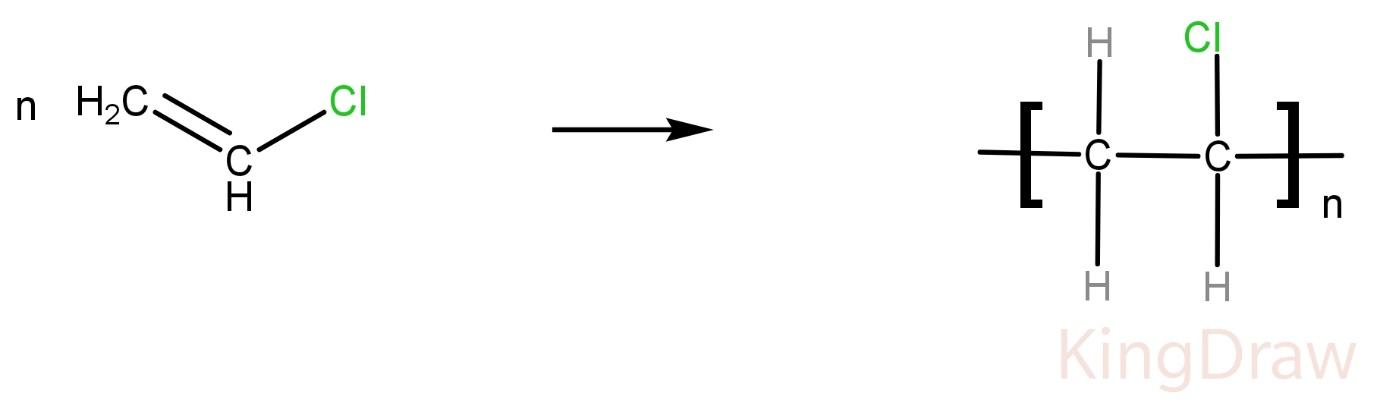
Note: Remember that in a polymer, the monomer and the repeating units aren't the same. For example, in PVC, the monomer is vinyl chloride, and the repeating unit is \[ - (C{H_2}CHCl) - \].
Complete step by step answer:
The full name of PVC is Poly Vinyl Chloride. PVC is a synthetic plastic polymer which is produced by the polymerization of vinyl chloride. It is the world's third-most widely produced synthetic plastic polymer, after polyethylene and polypropylene. The chemical formula of vinyl chloride is \[C{H_2} = CHCl\]. PVC is a thermoplastic material. Thermoplastic materials melt on heating and solidify on cooling. The repeating unit of PVC is \[ - (C{H_2}CHCl) - \]. About 40 million tons of PVC are produced each year.
PVC comes in two basic forms: rigid and flexible.
Rigid PVC is used in the construction of pipes and in manufacturing of doors and windows. It can be made softer and more flexible by the addition of plasticizers, the most widely used being phthalates. It can also be used in plumbing.
PVC has an inherent insulation that aids in reducing condensation formation and resisting internal temperature changes for hot and cold liquids.
Pure polyvinyl chloride is a white, brittle solid. It is insoluble in alcohol but slightly soluble in tetrahydrofuran.
The chemical reaction demonstrating the polymerisation of vinyl chloride to form Poly vinyl chloride is:
Note: Remember that in a polymer, the monomer and the repeating units aren't the same. For example, in PVC, the monomer is vinyl chloride, and the repeating unit is \[ - (C{H_2}CHCl) - \].
Recently Updated Pages
Master Class 12 Business Studies: Engaging Questions & Answers for Success

Master Class 12 Biology: Engaging Questions & Answers for Success
Master Class 12 Chemistry: Engaging Questions & Answers for Success
Class 12 Question and Answer - Your Ultimate Solutions Guide
Master Class 11 Social Science: Engaging Questions & Answers for Success
Master Class 11 English: Engaging Questions & Answers for Success
Trending doubts
Which are the Top 10 Largest Countries of the World?
Draw a labelled sketch of the human eye class 12 physics CBSE
Differentiate between homogeneous and heterogeneous class 12 chemistry CBSE
Why is the cell called the structural and functional class 12 biology CBSE
Draw ray diagrams each showing i myopic eye and ii class 12 physics CBSE
Which is the correct genotypic ratio of mendel dihybrid class 12 biology CBSE