




Write the formula for TSA of cylinder.
Answer
 Verified
626.7k+ views
Hint: We have the formula for the total surface area of any figure is given as
\[TSA=\left( \text{Height} \right)\left( \text{Base perimeter} \right)+\left( \text{Base area} \right)+\left( \text{Top area} \right)\]
We use this formula for the cylinder to find the TSA of any cylinder assuming the required dimensions for the cylinder.
Complete step by step answer:
We are asked to write the TSA of the cylinder.
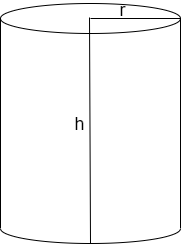
Let us assume a cylinder of base radius \[r\] and height \[h\] as follows
We know that the base and top of the cylinder is a circle.
We know that the formula of the perimeter of a circle having the radius \[r\] is given as
\[C=2\pi r\]
We also know that the formula of area of a circle having the radius \[r\] is given as
\[A=\pi {{r}^{2}}\]
Now, let us find the total surface area of the cylinder.
We know that the formula for total surface area for any figure is given as
\[TSA=\left( \text{Height} \right)\left( \text{Base perimeter} \right)+\left( \text{Base area} \right)+\left( \text{Top area} \right)\]
Here, we can see that the base and top of the cylinder is a circle.
Let us assume that the total surface area of the cylinder as \[TSA\]
Now, by using the above formula of total surface area of any figure to cylinder then we get
\[\begin{align}
& \Rightarrow TSA=\left( h \right)\left( 2\pi r \right)+\left( \pi {{r}^{2}} \right)+\left( \pi {{r}^{2}} \right) \\
& \Rightarrow TSA=2\pi rh+2\pi {{r}^{2}} \\
\end{align}\]
Therefore, we can conclude that the total surface area of the cylinder is given as
\[TSA=2\pi rh+2\pi {{r}^{2}}\]
Where, \[r\] is the base radius of the cylinder and \[h\] is the height of the cylinder.
Note:
Students may do mistake in taking the general formula of total surface area of any 3D figure.
We have the formula for the total surface area of any figure is given as
\[TSA=\left( \text{Height} \right)\left( \text{Base perimeter} \right)+\left( \text{Base area} \right)+\left( \text{Top area} \right)\]
Here, we can see that there are two areas of the base area and the top area.
But students may take the formula as
\[TSA=\left( \text{Height} \right)\left( \text{Base perimeter} \right)+2\left( \text{Base area} \right)\]
This may be correct for the cylinder but there are some figures where there will be no top surface like a cone. In that case, there will be no twice the area of the base.
\[TSA=\left( \text{Height} \right)\left( \text{Base perimeter} \right)+\left( \text{Base area} \right)+\left( \text{Top area} \right)\]
We use this formula for the cylinder to find the TSA of any cylinder assuming the required dimensions for the cylinder.
Complete step by step answer:
We are asked to write the TSA of the cylinder.
Let us assume a cylinder of base radius \[r\] and height \[h\] as follows
We know that the base and top of the cylinder is a circle.
We know that the formula of the perimeter of a circle having the radius \[r\] is given as
\[C=2\pi r\]
We also know that the formula of area of a circle having the radius \[r\] is given as
\[A=\pi {{r}^{2}}\]
Now, let us find the total surface area of the cylinder.
We know that the formula for total surface area for any figure is given as
\[TSA=\left( \text{Height} \right)\left( \text{Base perimeter} \right)+\left( \text{Base area} \right)+\left( \text{Top area} \right)\]
Here, we can see that the base and top of the cylinder is a circle.
Let us assume that the total surface area of the cylinder as \[TSA\]
Now, by using the above formula of total surface area of any figure to cylinder then we get
\[\begin{align}
& \Rightarrow TSA=\left( h \right)\left( 2\pi r \right)+\left( \pi {{r}^{2}} \right)+\left( \pi {{r}^{2}} \right) \\
& \Rightarrow TSA=2\pi rh+2\pi {{r}^{2}} \\
\end{align}\]
Therefore, we can conclude that the total surface area of the cylinder is given as
\[TSA=2\pi rh+2\pi {{r}^{2}}\]
Where, \[r\] is the base radius of the cylinder and \[h\] is the height of the cylinder.
Note:
Students may do mistake in taking the general formula of total surface area of any 3D figure.
We have the formula for the total surface area of any figure is given as
\[TSA=\left( \text{Height} \right)\left( \text{Base perimeter} \right)+\left( \text{Base area} \right)+\left( \text{Top area} \right)\]
Here, we can see that there are two areas of the base area and the top area.
But students may take the formula as
\[TSA=\left( \text{Height} \right)\left( \text{Base perimeter} \right)+2\left( \text{Base area} \right)\]
This may be correct for the cylinder but there are some figures where there will be no top surface like a cone. In that case, there will be no twice the area of the base.
Recently Updated Pages
Class 10 Question and Answer - Your Ultimate Solutions Guide

Master Class 10 Computer Science: Engaging Questions & Answers for Success
Master Class 10 General Knowledge: Engaging Questions & Answers for Success
Master Class 12 Economics: Engaging Questions & Answers for Success
Master Class 12 Social Science: Engaging Questions & Answers for Success
Master Class 12 English: Engaging Questions & Answers for Success
Trending doubts
Explain the Treaty of Vienna of 1815 class 10 social science CBSE
The slogan Jai Hind was given by A Lal Bahadur Shastri class 10 social science CBSE
10 examples of evaporation in daily life with explanations
What is the full form of POSCO class 10 social science CBSE
Identify the feminine form of noun nephew a shenephew class 10 english CBSE
CSIR full form?