




How do you write the equation of circle with center $ \left( 2,4 \right) $ and containing the point $ \left( -2,1 \right) $ ?
Answer
 Verified
583.8k+ views
Hint: All points on a circle are equidistant from the center of the circle. Radius is the distance between center and any point on the circle. So we can find out the radius of the circle as we have the coordinates of center and a point on the circle. We have the radius and center of the circle these 2 things are enough to write the equation of a circle.
Complete step by step answer:
The center of given circle= $ \left( 2,4 \right) $
Circle contains the point $ \left( -2,1 \right) $ .
The distance between center of circle and any point on the circle is the radius. So the distance between $ \left( 2,4 \right) $ and $ \left( -2,1 \right) $
Applying distance formula $ \sqrt{{{\left( {{x}_{2}}-{{x}_{1}} \right)}^{2}}+{{\left( {{y}_{2}}-{{y}_{1}} \right)}^{2}}} $
$ =\sqrt{{{\left( 2-\left( -2 \right) \right)}^{2}}+{{\left( 4-1 \right)}^{2}}} $
Further solving
$ \Rightarrow \sqrt{{{\left( 2-\left( -2 \right) \right)}^{2}}+{{\left( 4-1 \right)}^{2}}}=\sqrt{16+9} $
$ =5 $
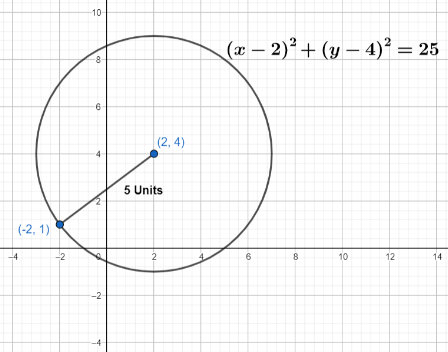
So the we get the radius of circle equal to 5 units.
We know that the collection of all points at equal distance from a fixed point forms a circle. The fixed point is the center of the circle. The fixed distance is the radius of the circle.
Let us assume the coordinate of center of circle is $ \left( \alpha ,\beta \right) $ and radius is r then the locus of all point at distance of r units from $ \left( \alpha ,\beta \right) $ would be $ \sqrt{{{\left( x-\alpha \right)}^{2}}+{{\left( y-\beta \right)}^{2}}}=r $
Further solving the equation squaring both sides
$ \Rightarrow {{\left( x-\alpha \right)}^{2}}+{{\left( y-\beta \right)}^{2}}={{r}^{2}} $
So the equation of circle having center $ \left( \alpha ,\beta \right) $ and radius r is $ {{\left( x-\alpha \right)}^{2}}+{{\left( y-\beta \right)}^{2}}={{r}^{2}} $
Our center is $ \left( 2,4 \right) $ and radius is 5 so the equation will be
$ {{\left( x-2 \right)}^{2}}+{{\left( y-4 \right)}^{2}}=25 $
Further solving the equation we get
$ {{x}^{2}}+{{y}^{2}}-4x-8y-5=0 $
Now we can draw the graph
Note:
The equation of circle generally written in the format $ {{\left( x-\alpha \right)}^{2}}+{{\left( y-\beta \right)}^{2}}={{r}^{2}} $ sometime it is written as $ {{x}^{2}}+{{y}^{2}}+2gx+2fy+c=0 $ in this equation the center of circle is $ \left( -g,-f \right) $ and the radius $ r=\sqrt{{{g}^{2}}+{{f}^{2}}-c} $ so here we can see that $ {{g}^{2}}+{{f}^{2}} $ should be greater than $ c $ otherwise the equation will not form a circle. Always remember that in the equation of circle, coefficient of $ {{x}^{2}} $ and $ {{y}^{2}} $ is always same.
Complete step by step answer:
The center of given circle= $ \left( 2,4 \right) $
Circle contains the point $ \left( -2,1 \right) $ .
The distance between center of circle and any point on the circle is the radius. So the distance between $ \left( 2,4 \right) $ and $ \left( -2,1 \right) $
Applying distance formula $ \sqrt{{{\left( {{x}_{2}}-{{x}_{1}} \right)}^{2}}+{{\left( {{y}_{2}}-{{y}_{1}} \right)}^{2}}} $
$ =\sqrt{{{\left( 2-\left( -2 \right) \right)}^{2}}+{{\left( 4-1 \right)}^{2}}} $
Further solving
$ \Rightarrow \sqrt{{{\left( 2-\left( -2 \right) \right)}^{2}}+{{\left( 4-1 \right)}^{2}}}=\sqrt{16+9} $
$ =5 $
So the we get the radius of circle equal to 5 units.
We know that the collection of all points at equal distance from a fixed point forms a circle. The fixed point is the center of the circle. The fixed distance is the radius of the circle.
Let us assume the coordinate of center of circle is $ \left( \alpha ,\beta \right) $ and radius is r then the locus of all point at distance of r units from $ \left( \alpha ,\beta \right) $ would be $ \sqrt{{{\left( x-\alpha \right)}^{2}}+{{\left( y-\beta \right)}^{2}}}=r $
Further solving the equation squaring both sides
$ \Rightarrow {{\left( x-\alpha \right)}^{2}}+{{\left( y-\beta \right)}^{2}}={{r}^{2}} $
So the equation of circle having center $ \left( \alpha ,\beta \right) $ and radius r is $ {{\left( x-\alpha \right)}^{2}}+{{\left( y-\beta \right)}^{2}}={{r}^{2}} $
Our center is $ \left( 2,4 \right) $ and radius is 5 so the equation will be
$ {{\left( x-2 \right)}^{2}}+{{\left( y-4 \right)}^{2}}=25 $
Further solving the equation we get
$ {{x}^{2}}+{{y}^{2}}-4x-8y-5=0 $
Now we can draw the graph
Note:
The equation of circle generally written in the format $ {{\left( x-\alpha \right)}^{2}}+{{\left( y-\beta \right)}^{2}}={{r}^{2}} $ sometime it is written as $ {{x}^{2}}+{{y}^{2}}+2gx+2fy+c=0 $ in this equation the center of circle is $ \left( -g,-f \right) $ and the radius $ r=\sqrt{{{g}^{2}}+{{f}^{2}}-c} $ so here we can see that $ {{g}^{2}}+{{f}^{2}} $ should be greater than $ c $ otherwise the equation will not form a circle. Always remember that in the equation of circle, coefficient of $ {{x}^{2}} $ and $ {{y}^{2}} $ is always same.
Recently Updated Pages
Three beakers labelled as A B and C each containing 25 mL of water were taken A small amount of NaOH anhydrous CuSO4 and NaCl were added to the beakers A B and C respectively It was observed that there was an increase in the temperature of the solutions contained in beakers A and B whereas in case of beaker C the temperature of the solution falls Which one of the following statements isarecorrect i In beakers A and B exothermic process has occurred ii In beakers A and B endothermic process has occurred iii In beaker C exothermic process has occurred iv In beaker C endothermic process has occurred

Master Class 10 Social Science: Engaging Questions & Answers for Success
Master Class 10 Science: Engaging Questions & Answers for Success
Master Class 10 Maths: Engaging Questions & Answers for Success
Master Class 10 General Knowledge: Engaging Questions & Answers for Success
Master Class 10 Computer Science: Engaging Questions & Answers for Success
Three beakers labelled as A B and C each containing 25 mL of water were taken A small amount of NaOH anhydrous CuSO4 and NaCl were added to the beakers A B and C respectively It was observed that there was an increase in the temperature of the solutions contained in beakers A and B whereas in case of beaker C the temperature of the solution falls Which one of the following statements isarecorrect i In beakers A and B exothermic process has occurred ii In beakers A and B endothermic process has occurred iii In beaker C exothermic process has occurred iv In beaker C endothermic process has occurred
Master Class 10 Social Science: Engaging Questions & Answers for Success
Master Class 10 Science: Engaging Questions & Answers for Success
Trending doubts
Explain the Treaty of Vienna of 1815 class 10 social science CBSE
In cricket, what is the term for a bowler taking five wickets in an innings?
Who Won 36 Oscar Awards? Record Holder Revealed
What is the name of Japan Parliament?
What is the median of the first 10 natural numbers class 10 maths CBSE
Why is it 530 pm in india when it is 1200 afternoon class 10 social science CBSE