




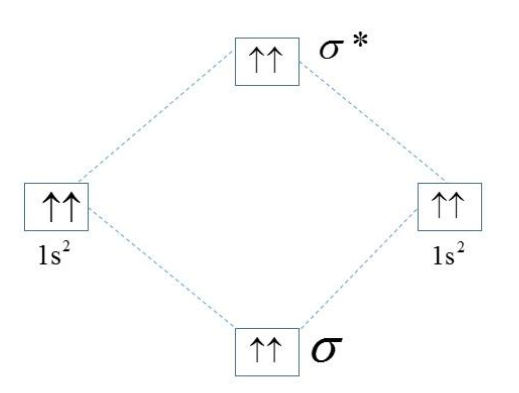
Write the electronic configuration based on molecular orbital theory for the molecular orbital of helium \[\text{H}{{\text{e}}_{\text{2}}}\] molecule. Calculate its bond order and comment on its magnetic property.
Answer
 Verified
588.6k+ views
Hint:Molecular Orbital Theory is the quantum mechanical way of describing the electronic arrangement of the electrons in a molecule. The atomic orbitals combine to form low energy bonding and high energy antibonding orbitals.
Complete answer:
In the helium atom, there are two electrons in the valance 1s orbital. The other helium atom also has two electrons hence the linear combination of atomic orbitals (LCAO) of the 1s orbitals lead to the formation of a sigma bonding and antibonding orbitals. So one electron pair goes to the bonding while the other one goes to the antibonding molecular orbital. The bond order between any two atoms in a molecule has the formula,
$\text{B}\text{.O}\text{.=}\dfrac{\text{No}\text{. of bonding electrons -No}\text{. of antibonding electrons}}{\text{2}}$ .
For the helium atom, the number of bonding electrons and the number of antibonding electrons are the same and equal to two. Hence the bond order.
$\text{B}\text{.O}\text{.=}\dfrac{\text{2 - 2}}{\text{2}}=\dfrac{0}{2}$= 0.
Hence, there cannot be any bond between the helium atoms as the bond order between the atoms is zero. As there are no unpaired electrons in the atom of the helium, its magnetic moment is equal to zero.
Note:
According to the molecular orbital theory, the electrons in a molecule are arranged in three different molecular orbitals: the bonding, the anti-bonding, and the non-bonding molecular orbitals. The bonding and the antibonding orbitals can be further divided into sigma and pi molecular orbitals. These orbitals are as a result of the linear combination of atomic orbitals (LCAO) resulting from the bonds between different atoms.
Complete answer:
In the helium atom, there are two electrons in the valance 1s orbital. The other helium atom also has two electrons hence the linear combination of atomic orbitals (LCAO) of the 1s orbitals lead to the formation of a sigma bonding and antibonding orbitals. So one electron pair goes to the bonding while the other one goes to the antibonding molecular orbital. The bond order between any two atoms in a molecule has the formula,
$\text{B}\text{.O}\text{.=}\dfrac{\text{No}\text{. of bonding electrons -No}\text{. of antibonding electrons}}{\text{2}}$ .
For the helium atom, the number of bonding electrons and the number of antibonding electrons are the same and equal to two. Hence the bond order.
$\text{B}\text{.O}\text{.=}\dfrac{\text{2 - 2}}{\text{2}}=\dfrac{0}{2}$= 0.
Hence, there cannot be any bond between the helium atoms as the bond order between the atoms is zero. As there are no unpaired electrons in the atom of the helium, its magnetic moment is equal to zero.
Note:
According to the molecular orbital theory, the electrons in a molecule are arranged in three different molecular orbitals: the bonding, the anti-bonding, and the non-bonding molecular orbitals. The bonding and the antibonding orbitals can be further divided into sigma and pi molecular orbitals. These orbitals are as a result of the linear combination of atomic orbitals (LCAO) resulting from the bonds between different atoms.
Recently Updated Pages
Master Class 11 English: Engaging Questions & Answers for Success

Master Class 11 Maths: Engaging Questions & Answers for Success
Class 11 Question and Answer - Your Ultimate Solutions Guide
Master Class 11 Biology: Engaging Questions & Answers for Success
Master Class 11 Physics: Engaging Questions & Answers for Success
Master Class 11 Accountancy: Engaging Questions & Answers for Success
Trending doubts
Differentiate between an exothermic and an endothermic class 11 chemistry CBSE
One Metric ton is equal to kg A 10000 B 1000 C 100 class 11 physics CBSE
Difference Between Prokaryotic Cells and Eukaryotic Cells
There are 720 permutations of the digits 1 2 3 4 5 class 11 maths CBSE
Draw a diagram of a plant cell and label at least eight class 11 biology CBSE
1 Quintal is equal to a 110 kg b 10 kg c 100kg d 1000 class 11 physics CBSE