




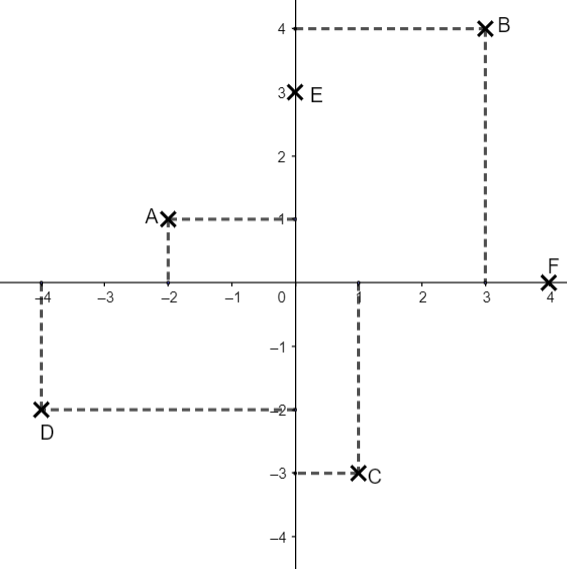
Write the coordinates of points A, B, C, D, E and F on the cartesian plane.
Answer
 Verified
602.7k+ views
Hint: To write the x – coordinate of a point, see its distance from the y – axis and to write the y – coordinate of a point, see its distance from the x – axis. Use the information that: - if a point lies in \[{{1}^{st}}\] quadrant then both of its coordinates are positive, if the point lies in \[{{2}^{nd}}\] quadrant then its x – coordinate is negative and y – coordinate is positive, if the point lies in \[{{3}^{rd}}\] quadrant then both x and x and y – coordinates are negative and if a point lies in \[{{4}^{th}}\] quadrant then its x – coordinate is positive and y – coordinate is negative. If a point lies on x - axis then its y - coordinate is 0 and if it lies on y – axis then its x – coordinate is 0.
Complete step-by-step answer:
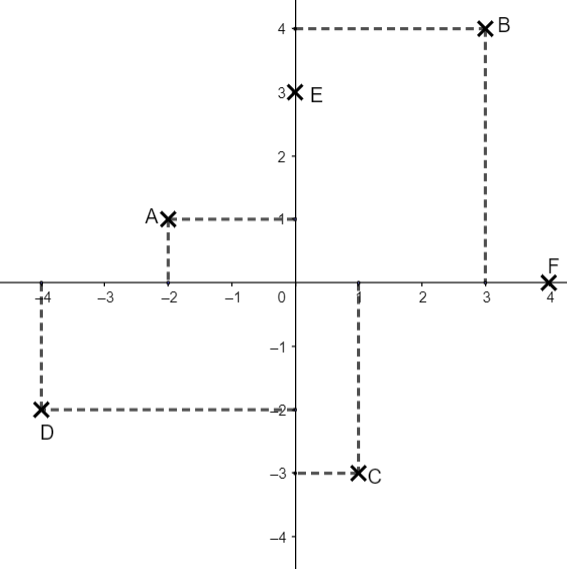
Here, we have been given a graph on which six points A, B, C, D, E and F are plotted and we have been asked to write the coordinates of these points. So, we have,
(i) For point A,
Here, we can see that point lies in \[{{2}^{nd}}\] quadrant, so its x – coordinate will be negative and y - coordinate will be positive. Now, the distance of the point from the x axis is 1 unit and from the y – axis is 2 units. Hence, the coordinates of the point A can be written as A (-2, -1).
(ii) For point B,
Here, we can see that the point lies in \[{{1}^{st}}\] quadrant, so its x and y – coordinate will both be positive.
Now, the distance of the point from the x – axis is 4 units and from the y – axis is 3 units. Hence, the coordinates of the point B can be written as B (3, 4).
(iii) For point C,
Here, we can see that the point lies in \[{{4}^{th}}\] quadrant, so its x – coordinate will be positive and y – coordinate will be negative.
Now, the distance of the point from the x – axis is 3 units and from the y – axis is 1 unit. Hence, the coordinates of the point C can be written as C (1, -3).
(iv) For point D,
Here, we can see that the point lies in \[{{3}^{rd}}\] quadrant, so it's both x and y – coordinate will be negative.
Now, the distance of the point from the x – axis is 2 units and from the y – axis is 4 units. Hence, the coordinates of the point D can be written as D (-2, -4).
(v) For point E,
Here, we can see that the point lies on the positive y – axis, therefore its x – coordinate will be 0 and y – coordinate will be positive.
Now, the distance of the point from the x – axis is 3 units. Hence, the coordinates of the point E can be written as E (0, 3).
(vi) For point F,
Here, we can see that the point lies on the positive x – axis, therefore, its y – coordinate will be 0 and x – coordinate will be positive.
Now, the distance of the point from the y – axis is 4 units. Hence, the coordinates of the point F can be written as F (4, 0).
Note: One must remember the signs of coordinates in all the quadrants otherwise you will not be able to solve the question. Remember that the coordinates of a point is negative or positive but its distance from the axes cannot be negative. This is because distance is a scalar quantity and hence it is always positive. You can see that we have not written any of the point’s distances as negative value. You must remember all the rules of writing the coordinates of a point.
Complete step-by-step answer:
Here, we have been given a graph on which six points A, B, C, D, E and F are plotted and we have been asked to write the coordinates of these points. So, we have,
(i) For point A,
Here, we can see that point lies in \[{{2}^{nd}}\] quadrant, so its x – coordinate will be negative and y - coordinate will be positive. Now, the distance of the point from the x axis is 1 unit and from the y – axis is 2 units. Hence, the coordinates of the point A can be written as A (-2, -1).
(ii) For point B,
Here, we can see that the point lies in \[{{1}^{st}}\] quadrant, so its x and y – coordinate will both be positive.
Now, the distance of the point from the x – axis is 4 units and from the y – axis is 3 units. Hence, the coordinates of the point B can be written as B (3, 4).
(iii) For point C,
Here, we can see that the point lies in \[{{4}^{th}}\] quadrant, so its x – coordinate will be positive and y – coordinate will be negative.
Now, the distance of the point from the x – axis is 3 units and from the y – axis is 1 unit. Hence, the coordinates of the point C can be written as C (1, -3).
(iv) For point D,
Here, we can see that the point lies in \[{{3}^{rd}}\] quadrant, so it's both x and y – coordinate will be negative.
Now, the distance of the point from the x – axis is 2 units and from the y – axis is 4 units. Hence, the coordinates of the point D can be written as D (-2, -4).
(v) For point E,
Here, we can see that the point lies on the positive y – axis, therefore its x – coordinate will be 0 and y – coordinate will be positive.
Now, the distance of the point from the x – axis is 3 units. Hence, the coordinates of the point E can be written as E (0, 3).
(vi) For point F,
Here, we can see that the point lies on the positive x – axis, therefore, its y – coordinate will be 0 and x – coordinate will be positive.
Now, the distance of the point from the y – axis is 4 units. Hence, the coordinates of the point F can be written as F (4, 0).
Note: One must remember the signs of coordinates in all the quadrants otherwise you will not be able to solve the question. Remember that the coordinates of a point is negative or positive but its distance from the axes cannot be negative. This is because distance is a scalar quantity and hence it is always positive. You can see that we have not written any of the point’s distances as negative value. You must remember all the rules of writing the coordinates of a point.
Recently Updated Pages
Master Class 12 Economics: Engaging Questions & Answers for Success

Master Class 12 English: Engaging Questions & Answers for Success
Master Class 12 Social Science: Engaging Questions & Answers for Success
Master Class 12 Maths: Engaging Questions & Answers for Success
Master Class 12 Physics: Engaging Questions & Answers for Success
Master Class 9 General Knowledge: Engaging Questions & Answers for Success
Trending doubts
One Metric ton is equal to kg A 10000 B 1000 C 100 class 11 physics CBSE
Difference Between Prokaryotic Cells and Eukaryotic Cells
Two of the body parts which do not appear in MRI are class 11 biology CBSE
1 ton equals to A 100 kg B 1000 kg C 10 kg D 10000 class 11 physics CBSE
Draw a diagram of nephron and explain its structur class 11 biology CBSE
10 examples of friction in our daily life