




Write the conditions for no refraction.
Answer
 Verified
519.6k+ views
Hint: In order to solve this question, we should know about optically rarer and denser mediums. Rarer mediums are those in which speed of light is more as compared to other mediums and Denser mediums are those in which speed of light is less as compared to other mediums, Here we will discuss refraction phenomenon and will figure out conditions for no refraction.
Complete answer:
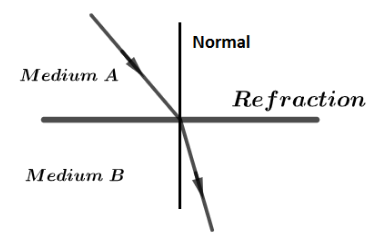
In optical physics, refraction is the phenomenon of bending of light when it goes from one medium to another. If it travels from rarer medium to denser medium, the ray of light bends towards the normal and if it goes from denser to rarer, the ray of light moves away from the normal. Refraction from medium A (rarer medium) to medium B (denser medium) is shown as,
Two conditions in which there will be no refraction of light while going from medium say A to medium say B.
(i) If both medium A and medium B have the same value of refractive index. such that ${\mu _A} = {\mu _B}$ which means both mediums are neither rarer or denser with respect to each other.
(ii) If a ray of light enters in the second medium normally to the interface between two mediums like if ray of light enters normally between medium A and medium B, there will be no refraction irrespective of the value of refractive index of two mediums.
Note: It should be remembered that, refractive index is defined as the ratio of speed of light in vacuum and to the speed of light in that medium and speed of light is maximum in vacuum having a universal speed limit value of $c = 3 \times {10^8}\,m{s^{ - 1}}$.
Complete answer:
In optical physics, refraction is the phenomenon of bending of light when it goes from one medium to another. If it travels from rarer medium to denser medium, the ray of light bends towards the normal and if it goes from denser to rarer, the ray of light moves away from the normal. Refraction from medium A (rarer medium) to medium B (denser medium) is shown as,
Two conditions in which there will be no refraction of light while going from medium say A to medium say B.
(i) If both medium A and medium B have the same value of refractive index. such that ${\mu _A} = {\mu _B}$ which means both mediums are neither rarer or denser with respect to each other.
(ii) If a ray of light enters in the second medium normally to the interface between two mediums like if ray of light enters normally between medium A and medium B, there will be no refraction irrespective of the value of refractive index of two mediums.
Note: It should be remembered that, refractive index is defined as the ratio of speed of light in vacuum and to the speed of light in that medium and speed of light is maximum in vacuum having a universal speed limit value of $c = 3 \times {10^8}\,m{s^{ - 1}}$.
Recently Updated Pages
Master Class 12 Business Studies: Engaging Questions & Answers for Success

Master Class 12 Biology: Engaging Questions & Answers for Success
Master Class 12 Chemistry: Engaging Questions & Answers for Success
Class 12 Question and Answer - Your Ultimate Solutions Guide
Master Class 11 Social Science: Engaging Questions & Answers for Success
Master Class 11 English: Engaging Questions & Answers for Success
Trending doubts
Explain the Treaty of Vienna of 1815 class 10 social science CBSE
Who Won 36 Oscar Awards? Record Holder Revealed
What is the median of the first 10 natural numbers class 10 maths CBSE
Why is it 530 pm in india when it is 1200 afternoon class 10 social science CBSE
Why is there a time difference of about 5 hours between class 10 social science CBSE
What is the full form of POSCO class 10 social science CBSE