




Write the characteristics of Channa marulius.
Answer
 Verified
597.3k+ views
Hint: It is a type of fish. This fish has dorsal and anal fins that are long.
The fins don’t have spines or rays. This fish can grow to a size of about 1.2 m
Complete answer: Channa marulius is a type of fish. It is also known by the name of a giant snakehead.
1. Channa marulius is cultured in pisciculture along with other fishes.
This fish serves as an important source of food.
2. There are no patches of scales on the gular region of the head.
3. The scale rows between the posterior margin of the orbit and the preopercular angle at 10 degrees. The scales on the top of the head are moderate-sized with a rosette of head scales between the orbits. The pectoral fin length is about half of the head length.
4. There is a distinctive reddish-orange spot on its caudal peduncle.
5. Channa marulius has a large mouth with a lower jaw containing 7 to 18 canines behind a single row of villiform teeth that widens to five to six rows at the jaw symphysis.
.
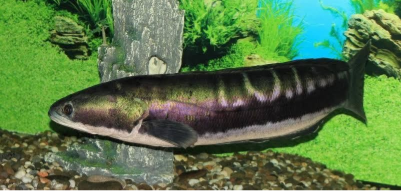
Additional information: Channa marulius is native to South Asia.
Populations of this fish in Southeast Asia are now regarded as a separate species.
It has been introduced recently to the United States, where it is considered an invasive species. Invasive species are those that were introduced to a new niche and proliferate enormously due to the abundance of food and the lack of competition and predators.
Note: This fish is an important commercial, aquaculture, game, and aquarium fish in various regions worldwide. The bullseye snakehead has been cultured in ponds, rice fields, and irrigation wells that generally does not support other fishes.
The fins don’t have spines or rays. This fish can grow to a size of about 1.2 m
Complete answer: Channa marulius is a type of fish. It is also known by the name of a giant snakehead.
1. Channa marulius is cultured in pisciculture along with other fishes.
This fish serves as an important source of food.
2. There are no patches of scales on the gular region of the head.
3. The scale rows between the posterior margin of the orbit and the preopercular angle at 10 degrees. The scales on the top of the head are moderate-sized with a rosette of head scales between the orbits. The pectoral fin length is about half of the head length.
4. There is a distinctive reddish-orange spot on its caudal peduncle.
5. Channa marulius has a large mouth with a lower jaw containing 7 to 18 canines behind a single row of villiform teeth that widens to five to six rows at the jaw symphysis.
.
Additional information: Channa marulius is native to South Asia.
Populations of this fish in Southeast Asia are now regarded as a separate species.
It has been introduced recently to the United States, where it is considered an invasive species. Invasive species are those that were introduced to a new niche and proliferate enormously due to the abundance of food and the lack of competition and predators.
Note: This fish is an important commercial, aquaculture, game, and aquarium fish in various regions worldwide. The bullseye snakehead has been cultured in ponds, rice fields, and irrigation wells that generally does not support other fishes.
Recently Updated Pages
Basicity of sulphurous acid and sulphuric acid are

Master Class 11 Business Studies: Engaging Questions & Answers for Success
Master Class 11 Computer Science: Engaging Questions & Answers for Success
Master Class 11 Economics: Engaging Questions & Answers for Success
Master Class 11 Social Science: Engaging Questions & Answers for Success
Master Class 11 English: Engaging Questions & Answers for Success
Trending doubts
One Metric ton is equal to kg A 10000 B 1000 C 100 class 11 physics CBSE
The largest wind power cluster is located in the state class 11 social science CBSE
Explain zero factorial class 11 maths CBSE
What steps did the French revolutionaries take to create class 11 social science CBSE
Which among the following are examples of coming together class 11 social science CBSE
Can anyone list 10 advantages and disadvantages of friction