




Write IUPAC names of the products obtained by the ozonolysis of the following compounds:
(i) Pent-\[2\]-ene
(ii) \[3,4\]-Dimethylhept-\[3\]-ene
(iii) \[2\]-Ethylbut-\[1\]-ene
(iv) \[1\]-Phenylbut-\[1\]-ene
Answer
 Verified
636.9k+ views
Hint: Ozonolysis is an organic chemical reaction in which an alkene reacts with ozone and undergoes a bond cleavage reaction. A variety of products are obtained during ozonolysis reactions.
Complete step by step answer:
Ozonolysis is the summation of two words ozone and lysis. This means ozone is used in this reaction as a reagent. The lysis means that the reaction undergoes a cleavage reaction which is known as bond breaking reaction. The reaction is shown as:
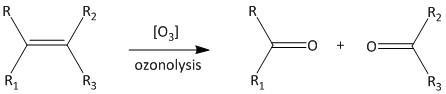
A number of products can be formed with ozonolysis such as alcohols, aldehydes, ketones or carboxylic acids. The cleavage can be predicted as addition of oxygen atom to either side of the double bonded carbon. IUPAC refers to the International Union of Pure and Applied Chemistry. It gives a worldwide method for naming of organic compounds.
Let us determine the product and their IUPAC name after ozonolysis of the given starting materials.
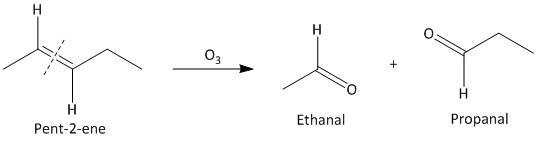
(i) Pent-\[2\]-ene. The ozonolysis of pent-\[2\]-ene leads to formation of two aldehydes ethanal and propanal. The cleavage of the double bond gives two aldehydes as the double bonded carbon atoms has hydrogen atoms as substituent attached. The reaction is shown as:
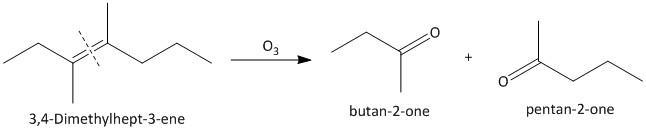
(ii) \[3,4\]-Dimethylhept-\[3\]-ene. The ozonolysis of \[3,4\]-Dimethylhept-\[3\]-ene leads to formation of two ketones as butane-\[2\]-one and pentan-\[2\]-one . The cleavage of the double bond gives two ketones as the double bonded carbon atoms are tetra substituted. The reaction is shown as:
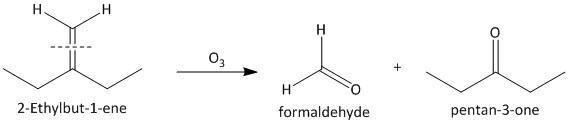
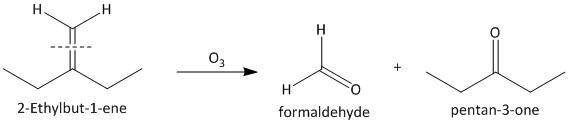
(iii) \[2\]-Ethylbut-\[1\]-ene. The ozonolysis of \[2\]-ethylbut-\[1\]-ene leads to formation of one aldehyde formaldehyde and a ketone. The cleavage of the double bond gives one aldehyde as one of the double bonded carbon atoms has two hydrogen atoms as substituent attached. The reaction is shown as:
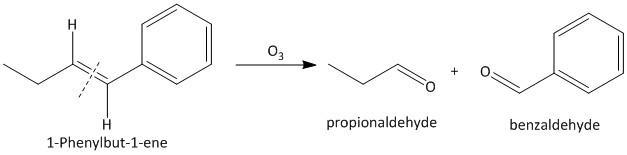
(iv) \[1\]-Phenylbut-\[1\]-ene. The ozonolysis of \[1\]-phenylbut-\[1\]-ene leads to formation of two aldehydes as propionaldehyde and benzaldehyde. The cleavage of the double bond gives two aldehydes as the double bonded carbon atoms have two hydrogen atoms as substituent attached. The reaction is shown as:
(Source: The image is drawn in chemdraw.)
(iv) \[1\]-Phenylbut-\[1\]-ene. The ozonolysis of \[1\]-phenylbut-\[1\]-ene leads to formation of two aldehydes as propionaldehyde and benzaldehyde. The cleavage of the double bond gives two aldehydes as the double bonded carbon atoms have two hydrogen atoms as substituent attached. The reaction is shown as:
Note:
Ozonolysis reaction is also applicable in case of alkynes and azo compounds. The products obtained from alkenes and alkynes are carbonyl compounds and the product obtained from azo compounds is nitrosamines.
Complete step by step answer:
Ozonolysis is the summation of two words ozone and lysis. This means ozone is used in this reaction as a reagent. The lysis means that the reaction undergoes a cleavage reaction which is known as bond breaking reaction. The reaction is shown as:
A number of products can be formed with ozonolysis such as alcohols, aldehydes, ketones or carboxylic acids. The cleavage can be predicted as addition of oxygen atom to either side of the double bonded carbon. IUPAC refers to the International Union of Pure and Applied Chemistry. It gives a worldwide method for naming of organic compounds.
Let us determine the product and their IUPAC name after ozonolysis of the given starting materials.
(i) Pent-\[2\]-ene. The ozonolysis of pent-\[2\]-ene leads to formation of two aldehydes ethanal and propanal. The cleavage of the double bond gives two aldehydes as the double bonded carbon atoms has hydrogen atoms as substituent attached. The reaction is shown as:
(ii) \[3,4\]-Dimethylhept-\[3\]-ene. The ozonolysis of \[3,4\]-Dimethylhept-\[3\]-ene leads to formation of two ketones as butane-\[2\]-one and pentan-\[2\]-one . The cleavage of the double bond gives two ketones as the double bonded carbon atoms are tetra substituted. The reaction is shown as:
(iii) \[2\]-Ethylbut-\[1\]-ene. The ozonolysis of \[2\]-ethylbut-\[1\]-ene leads to formation of one aldehyde formaldehyde and a ketone. The cleavage of the double bond gives one aldehyde as one of the double bonded carbon atoms has two hydrogen atoms as substituent attached. The reaction is shown as:
(iv) \[1\]-Phenylbut-\[1\]-ene. The ozonolysis of \[1\]-phenylbut-\[1\]-ene leads to formation of two aldehydes as propionaldehyde and benzaldehyde. The cleavage of the double bond gives two aldehydes as the double bonded carbon atoms have two hydrogen atoms as substituent attached. The reaction is shown as:
(Source: The image is drawn in chemdraw.)
(iv) \[1\]-Phenylbut-\[1\]-ene. The ozonolysis of \[1\]-phenylbut-\[1\]-ene leads to formation of two aldehydes as propionaldehyde and benzaldehyde. The cleavage of the double bond gives two aldehydes as the double bonded carbon atoms have two hydrogen atoms as substituent attached. The reaction is shown as:
Note:
Ozonolysis reaction is also applicable in case of alkynes and azo compounds. The products obtained from alkenes and alkynes are carbonyl compounds and the product obtained from azo compounds is nitrosamines.
Recently Updated Pages
If x a + bt + ct2 where x is in meters and t is in class 11 physics CBSE

A car covers the first half distance between two places class 11 physics CBSE
The resultant of two vectors overrightarrow P and overrightarrow class 11 physics CBSE
Find the value of cos 135 class 11 maths CBSE
A mass M is held in place by an applied force F and class 11 physics CBSE
A solution of glucose in water is labelled as 10 dfracwv class 11 chemistry CBSE
Trending doubts
One Metric ton is equal to kg A 10000 B 1000 C 100 class 11 physics CBSE
Find the value of the expression given below sin 30circ class 11 maths CBSE
Draw a diagram of nephron and explain its structur class 11 biology CBSE
10 examples of friction in our daily life
Proton was discovered by A Thomson B Rutherford C Chadwick class 11 chemistry CBSE
Bond order ofO2 O2+ O2 and O22 is in order A O2 langle class 11 chemistry CBSE