




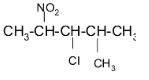
Write IUPAC name of the following
Answer
 Verified
564.9k+ views
Hint: IUPAC (international union of pure and applied chemistry). The IUPAC nomenclature is a method which is used for naming of organic compounds recommended by the international union of pure and applied chemistry. IUPAC is a universally recognized authority for chemical nomenclature, and has established the rules of nomenclature for all chemical compounds.
Complete step by step solution: For naming the organic compounds the IUPAC nomenclature system requires some important information s
Recognize and prioritize the functional group which is present in the compound .
Identify the number of longest continuous carbon chains and give the most priority group the lowest possible number.
Cite the substituents alphabetically using the numbering which is determined above
Here when we look at the compound, there are three substituents present that are -NO2 and -Cl and -CH3.
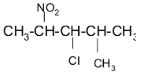
Here the functional group which has more priority is -NO2 so the numbering of the longest carbon chain makes it in a way that the Nitro group gets the lowest possible number followed by Cl and that of -CH2.
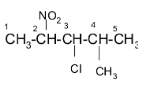
The longest carbon chain is one which has five carbon atoms, no double or triple bond is present hence it comes under the alkane group so the name of the parent chain is pentane.
Next, we have organize all the substituent in alphabetical order so here we get
3-Chloro-4-methyl-2-nitro-pentane.
So here the IUPAC name of the compound is 3-Chloro-4-methyl-2-nitro-pentane.
Note: A rational nomenclature system has at least two things. First it should indicate how the carbon atoms of a given compound are bonded together in a chain or rings. Second it should identify and locate any functional groups which are present in the compound. Whereas in IUPAC nomenclature system there is a set of rules to be followed. So by knowing such rules , we are able to write the unique name for every compound. Also from the given IUPAC name one should be able to write the structural formula.
Complete step by step solution: For naming the organic compounds the IUPAC nomenclature system requires some important information s
Recognize and prioritize the functional group which is present in the compound .
Identify the number of longest continuous carbon chains and give the most priority group the lowest possible number.
Cite the substituents alphabetically using the numbering which is determined above
Here when we look at the compound, there are three substituents present that are -NO2 and -Cl and -CH3.
Here the functional group which has more priority is -NO2 so the numbering of the longest carbon chain makes it in a way that the Nitro group gets the lowest possible number followed by Cl and that of -CH2.
The longest carbon chain is one which has five carbon atoms, no double or triple bond is present hence it comes under the alkane group so the name of the parent chain is pentane.
Next, we have organize all the substituent in alphabetical order so here we get
3-Chloro-4-methyl-2-nitro-pentane.
So here the IUPAC name of the compound is 3-Chloro-4-methyl-2-nitro-pentane.
Note: A rational nomenclature system has at least two things. First it should indicate how the carbon atoms of a given compound are bonded together in a chain or rings. Second it should identify and locate any functional groups which are present in the compound. Whereas in IUPAC nomenclature system there is a set of rules to be followed. So by knowing such rules , we are able to write the unique name for every compound. Also from the given IUPAC name one should be able to write the structural formula.
Recently Updated Pages
Master Class 11 Social Science: Engaging Questions & Answers for Success

Master Class 11 Chemistry: Engaging Questions & Answers for Success
Master Class 12 Business Studies: Engaging Questions & Answers for Success
Master Class 12 Chemistry: Engaging Questions & Answers for Success
Master Class 12 Biology: Engaging Questions & Answers for Success
Class 12 Question and Answer - Your Ultimate Solutions Guide
Trending doubts
One Metric ton is equal to kg A 10000 B 1000 C 100 class 11 physics CBSE
Difference Between Prokaryotic Cells and Eukaryotic Cells
How many of the following diseases can be studied with class 11 biology CBSE
Two of the body parts which do not appear in MRI are class 11 biology CBSE
Which of the following enzymes is used for carboxylation class 11 biology CBSE
Explain zero factorial class 11 maths CBSE