




How do you write a vector CD as the sum of unit vectors for points $C(7,4)$ and $D(-8,-1)$ ?
Answer
 Verified
575.7k+ views
Hint: The difference in the positions between the two given points that are $C(7,4)$ and $D(-8,-1)$ with respect to the origin in the Cartesian coordinate plane will give us the vector CD as a sum of unit vectors. In the Cartesian plane, any point is described in the format $P(x,y)$ where P is the point, $x$ is the horizontal distance of the point from the origin and $y$ is the vertical distance of the point from the origin.
Complete answer:
Let the origin be termed as O. Then, the coordinates of O are $(0,0)$.
Also, the coordinates of C and D are given to us as:
$\begin{align}
& =C(7,4)=7\widehat{i}+4\widehat{j} \\
& =D(-8,-1)=-8\widehat{i}-\widehat{j} \\
\end{align}$
Therefore the vectors $\overrightarrow{OC}$ and $\overrightarrow{OD}$ can be given as:
$\begin{align}
& \Rightarrow \overrightarrow{OC}=(7\widehat{i}+4\widehat{j})-(0\widehat{i}+0\widehat{j}) \\
& \Rightarrow \overrightarrow{OC}=7\widehat{i}+4\widehat{j} \\
\end{align}$
And,
$\begin{align}
& \Rightarrow \overrightarrow{OD}=(-8\widehat{i}-\widehat{j})-(0\widehat{i}+0\widehat{j}) \\
& \Rightarrow \overrightarrow{OD}=-8\widehat{i}-\widehat{j} \\
\end{align}$
Now that we have obtained the values of $\overrightarrow{OC}$ and $\overrightarrow{OD}$ , we can easily calculate the value of $\overrightarrow{CD}$ using the Triangle Law of vector addition. The Triangle law of vector addition can be understood by the following diagram:
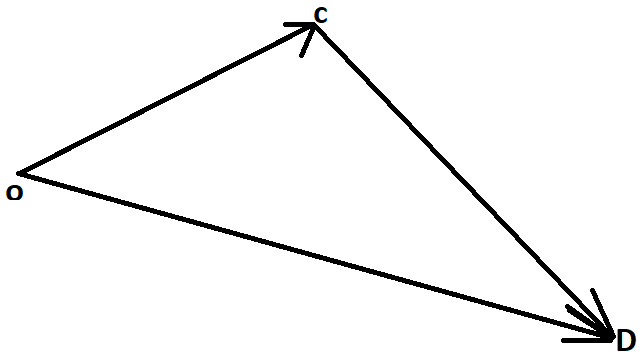
Here, the sum of vector OC and vector CD gives us the vector OD. Mathematically, it can be written as:
$\begin{align}
& \Rightarrow \overrightarrow{OC}+\overrightarrow{CD}=\overrightarrow{OD} \\
& \Rightarrow \overrightarrow{CD}=\overrightarrow{OD}-\overrightarrow{OC} \\
\end{align}$
Putting the values of vector OD and vector OC, we get Vector CD as:
$\begin{align}
& \Rightarrow \overrightarrow{CD}=(-8\widehat{i}-\widehat{j})-(7\widehat{i}+4\widehat{j}) \\
& \Rightarrow \overrightarrow{CD}=-15\widehat{i}-5\widehat{j} \\
\end{align}$
Hence, the vector CD as a sum of unit vectors is $-15\widehat{i}-5\widehat{j}$ .
Note:
We saw the definition of a point in a cartesian system co-ordinate and then the application of triangle rule of vector addition. These are some key theorems and concepts in basic physics. Here, we could have performed the vector addition using the parallelogram method for vector addition too as both the theorems work on the same basic principle.
Complete answer:
Let the origin be termed as O. Then, the coordinates of O are $(0,0)$.
Also, the coordinates of C and D are given to us as:
$\begin{align}
& =C(7,4)=7\widehat{i}+4\widehat{j} \\
& =D(-8,-1)=-8\widehat{i}-\widehat{j} \\
\end{align}$
Therefore the vectors $\overrightarrow{OC}$ and $\overrightarrow{OD}$ can be given as:
$\begin{align}
& \Rightarrow \overrightarrow{OC}=(7\widehat{i}+4\widehat{j})-(0\widehat{i}+0\widehat{j}) \\
& \Rightarrow \overrightarrow{OC}=7\widehat{i}+4\widehat{j} \\
\end{align}$
And,
$\begin{align}
& \Rightarrow \overrightarrow{OD}=(-8\widehat{i}-\widehat{j})-(0\widehat{i}+0\widehat{j}) \\
& \Rightarrow \overrightarrow{OD}=-8\widehat{i}-\widehat{j} \\
\end{align}$
Now that we have obtained the values of $\overrightarrow{OC}$ and $\overrightarrow{OD}$ , we can easily calculate the value of $\overrightarrow{CD}$ using the Triangle Law of vector addition. The Triangle law of vector addition can be understood by the following diagram:
Here, the sum of vector OC and vector CD gives us the vector OD. Mathematically, it can be written as:
$\begin{align}
& \Rightarrow \overrightarrow{OC}+\overrightarrow{CD}=\overrightarrow{OD} \\
& \Rightarrow \overrightarrow{CD}=\overrightarrow{OD}-\overrightarrow{OC} \\
\end{align}$
Putting the values of vector OD and vector OC, we get Vector CD as:
$\begin{align}
& \Rightarrow \overrightarrow{CD}=(-8\widehat{i}-\widehat{j})-(7\widehat{i}+4\widehat{j}) \\
& \Rightarrow \overrightarrow{CD}=-15\widehat{i}-5\widehat{j} \\
\end{align}$
Hence, the vector CD as a sum of unit vectors is $-15\widehat{i}-5\widehat{j}$ .
Note:
We saw the definition of a point in a cartesian system co-ordinate and then the application of triangle rule of vector addition. These are some key theorems and concepts in basic physics. Here, we could have performed the vector addition using the parallelogram method for vector addition too as both the theorems work on the same basic principle.
Recently Updated Pages
Master Class 11 English: Engaging Questions & Answers for Success

Master Class 11 Social Science: Engaging Questions & Answers for Success
Master Class 11 Maths: Engaging Questions & Answers for Success
Master Class 11 Biology: Engaging Questions & Answers for Success
Master Class 11 Physics: Engaging Questions & Answers for Success
Master Class 11 Chemistry: Engaging Questions & Answers for Success
Trending doubts
One Metric ton is equal to kg A 10000 B 1000 C 100 class 11 physics CBSE
Difference Between Prokaryotic Cells and Eukaryotic Cells
1 ton equals to A 100 kg B 1000 kg C 10 kg D 10000 class 11 physics CBSE
Find the value of the expression given below sin 30circ class 11 maths CBSE
Two of the body parts which do not appear in MRI are class 11 biology CBSE
What are hard magnetic materials class 11 physics CBSE