




Write a note on the function of the human heart?
Answer
 Verified
612k+ views
Hint: Heart is the main organ of the blood vascular system, which is made up of muscles and consists of four chambers two auricle and two ventricles.
It has a closed network of the blood vessels through which the blood and the fluid circulate all over the body.
Complete answer: Heart is an autonomous (self-excited) organ which is made up of cardiac muscles, the muscular layer of the ventricles is thicker than that of the auricular walls.
1. A bundle of the nodal tissue is present in the right upper corner of the right atrium and this bundle is known as the sinoatrial node and such bundle is also present in the left lower corner of the right atrium this is known as the atrioventricular nodes.
2. A number of AV fibres emerge from the AV node and these fibres pass through the atrioventricular septa and spread all over the ventricular muscles.
These fibres spread in both the ventricles and known as the Purkinje fibres.
3. The nodal muscles have the capacity of the self excitable property and created action potential, this action potential is transferred to the SA node and the maximum number of an action potential that is generated in one minute will bev70-75 per minute.
4. These will lead to the contraction of the atrium. From the SA node, the potential difference is passed to the Purkinje fibers this will leads to the contraction of the ventricles.
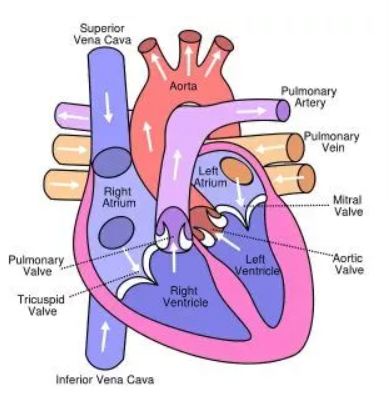
Note: Ventricles have thick muscle fibers to pump the blood strongly so that it can flow to all over the body.
It has a closed network of the blood vessels through which the blood and the fluid circulate all over the body.
Complete answer: Heart is an autonomous (self-excited) organ which is made up of cardiac muscles, the muscular layer of the ventricles is thicker than that of the auricular walls.
1. A bundle of the nodal tissue is present in the right upper corner of the right atrium and this bundle is known as the sinoatrial node and such bundle is also present in the left lower corner of the right atrium this is known as the atrioventricular nodes.
2. A number of AV fibres emerge from the AV node and these fibres pass through the atrioventricular septa and spread all over the ventricular muscles.
These fibres spread in both the ventricles and known as the Purkinje fibres.
3. The nodal muscles have the capacity of the self excitable property and created action potential, this action potential is transferred to the SA node and the maximum number of an action potential that is generated in one minute will bev70-75 per minute.
4. These will lead to the contraction of the atrium. From the SA node, the potential difference is passed to the Purkinje fibers this will leads to the contraction of the ventricles.
Note: Ventricles have thick muscle fibers to pump the blood strongly so that it can flow to all over the body.
Recently Updated Pages
Master Class 12 Business Studies: Engaging Questions & Answers for Success

Master Class 12 Biology: Engaging Questions & Answers for Success
Master Class 12 Chemistry: Engaging Questions & Answers for Success
Class 12 Question and Answer - Your Ultimate Solutions Guide
Master Class 11 Social Science: Engaging Questions & Answers for Success
Master Class 11 English: Engaging Questions & Answers for Success
Trending doubts
Explain the Treaty of Vienna of 1815 class 10 social science CBSE
Which Indian city is known as the "City of Victory"?
Which instrument is used to measure the Blood Pressure?
Who Won 36 Oscar Awards? Record Holder Revealed
What is the median of the first 10 natural numbers class 10 maths CBSE
Why is it 530 pm in india when it is 1200 afternoon class 10 social science CBSE