




Write a note on Parenchyma.
Answer
 Verified
626.4k+ views
Hint: Permanent tissues are the tissues which have lost the power to divide. The cellular tissue, typically soft and succulent, found chiefly in the softer parts of leaves, the pulp of fruits, bark and pith of stems, etc. It is a living tissue.
Complete answer:
Parenchyma is round or oval-shaped cells having spaces between them and they are Simple tissues are tissues composed of cells that are structurally and functionally similar i.e. they are made up of some type of cells. It is present in the stem, leaves, flowers, fruits and seeds. Most of them contain leucoplast and store food. Chloroplast containing parenchyma is named as chlorenchyma and affects photosynthesis. Parenchyma with large air spaces is named aerenchyma and is found in aquatic plants. Plant parenchyma cells will make the bulk of leaves, flowers, and the growing, dividing inner parts of stems and roots. They perform functions such as photosynthesis, food storage, sap secretion, and gas exchange.
Types of parenchyma:
There are four sorts of parenchyma consistent with their function:
-Photosynthetic parenchyma of camellia leaf.
-Storage parenchyma of the buttercup root cortex.
-Aquiferous parenchyma of a cactus.
-Aeriferous parenchyma of a rush stem.
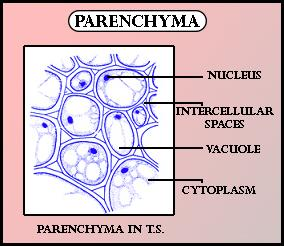
Note: The parenchyma cells are found in many places throughout plant bodies and, as long as they're alive, are actively involved in photosynthesis, secretion, food storage, and other activities of flowers. Parenchyma is one of the three main kinds of ground, or fundamental, tissue in plants, in conjunction with sclerenchyma (dead support tissues with thick walls) and collenchyma (living support tissues with irregular walls).
Complete answer:
Parenchyma is round or oval-shaped cells having spaces between them and they are Simple tissues are tissues composed of cells that are structurally and functionally similar i.e. they are made up of some type of cells. It is present in the stem, leaves, flowers, fruits and seeds. Most of them contain leucoplast and store food. Chloroplast containing parenchyma is named as chlorenchyma and affects photosynthesis. Parenchyma with large air spaces is named aerenchyma and is found in aquatic plants. Plant parenchyma cells will make the bulk of leaves, flowers, and the growing, dividing inner parts of stems and roots. They perform functions such as photosynthesis, food storage, sap secretion, and gas exchange.
Types of parenchyma:
There are four sorts of parenchyma consistent with their function:
-Photosynthetic parenchyma of camellia leaf.
-Storage parenchyma of the buttercup root cortex.
-Aquiferous parenchyma of a cactus.
-Aeriferous parenchyma of a rush stem.
Note: The parenchyma cells are found in many places throughout plant bodies and, as long as they're alive, are actively involved in photosynthesis, secretion, food storage, and other activities of flowers. Parenchyma is one of the three main kinds of ground, or fundamental, tissue in plants, in conjunction with sclerenchyma (dead support tissues with thick walls) and collenchyma (living support tissues with irregular walls).
Recently Updated Pages
Master Class 11 English: Engaging Questions & Answers for Success

Master Class 11 Social Science: Engaging Questions & Answers for Success
Master Class 11 Maths: Engaging Questions & Answers for Success
Master Class 11 Chemistry: Engaging Questions & Answers for Success
Master Class 11 Biology: Engaging Questions & Answers for Success
Master Class 11 Physics: Engaging Questions & Answers for Success
Trending doubts
One Metric ton is equal to kg A 10000 B 1000 C 100 class 11 physics CBSE
Difference Between Prokaryotic Cells and Eukaryotic Cells
Find the value of the expression given below sin 30circ class 11 maths CBSE
1 ton equals to A 100 kg B 1000 kg C 10 kg D 10000 class 11 physics CBSE
Two of the body parts which do not appear in MRI are class 11 biology CBSE
What are hard magnetic materials class 11 physics CBSE