




Write a note of Amphioxus with a diagram.
Answer
 Verified
524.4k+ views
Hint: A notochord, a dorsal hollow (tubular) nerve cord, pharyngeal gill arches or slits, a post-anal tail, and an endostyle/thyroid gland are five fundamental characteristics that arise at some point during development in Chordata animals. Lancelets, also known as Amphioxus, are little worm-like marine organisms that spend the majority of their life buried in the seafloor and filter-feed through jawless, ciliated mouths.
Complete answer:
Any member of the invertebrate subphylum Cephalochordata of the phylum Chordata known as an Amphioxus, plural amphioxi, or Amphioxuses, also known as a lancelet. Amphioxi are little marine organisms that live in the warmest sections of the world's coastal waters, although they are less abundant in temperate areas. They are close relatives of vertebrates, according to both morphological and molecular data.
PHYLUM :- CHORDATA (Notochord, dorsal
tubular nerve cord present and gill slits present).
Group :- ACRANIATA (No head, cranium or brain)
Sub-phylum :- CEPHALOCHORDATA
(Notochord along entire body length and persistent.)
Class :- Leptocardii (Numerous pharyngeal gill-slits.)
Genus :- Amphioxus.
Amphioxus is a remarkable creature with a notochord, dorsal tubelike nerve cord, pharyngeal gill slits, postanal tail, and segmented somites, all of which are thought to have originated with the common chordate ancestor. According to Kowalevsky, its embryonic development resembles that of invertebrates and vertebrates (1867).
The excretory organs of Amphioxus are segmentally structured structures that run the length of the pharyngeal area and are separated into three parts: solenocytes, renal tubules, and renal glomeruli. The solenocytes have foot processes that rest on the ligamentum denticulatum's coelomic surface.
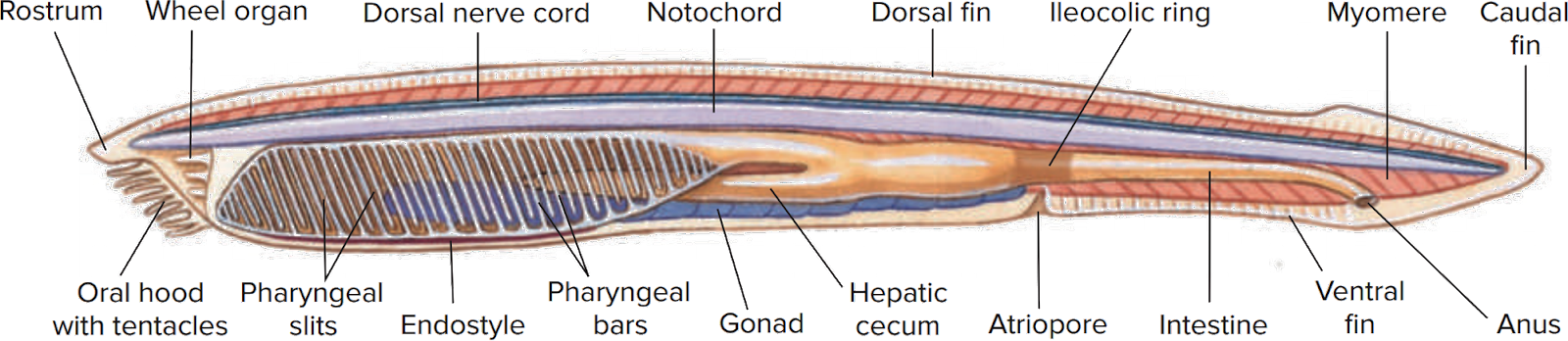
Note:-
Lancelets have a closed circulatory system and reproduce sexually, having a heart-like pumping apparatus on the ventral side. Lancelets, unlike other aquatic chordates, do not breathe through their pharyngeal slits. Tunicates have a strong cardiovascular and circulatory system. Just below the gut is the heart, which is a double U-shaped tube. Blood vessels are simple connective tissue tubes with a variety of corpuscle kinds in their blood.
Complete answer:
Any member of the invertebrate subphylum Cephalochordata of the phylum Chordata known as an Amphioxus, plural amphioxi, or Amphioxuses, also known as a lancelet. Amphioxi are little marine organisms that live in the warmest sections of the world's coastal waters, although they are less abundant in temperate areas. They are close relatives of vertebrates, according to both morphological and molecular data.
PHYLUM :- CHORDATA (Notochord, dorsal
tubular nerve cord present and gill slits present).
Group :- ACRANIATA (No head, cranium or brain)
Sub-phylum :- CEPHALOCHORDATA
(Notochord along entire body length and persistent.)
Class :- Leptocardii (Numerous pharyngeal gill-slits.)
Genus :- Amphioxus.
Amphioxus is a remarkable creature with a notochord, dorsal tubelike nerve cord, pharyngeal gill slits, postanal tail, and segmented somites, all of which are thought to have originated with the common chordate ancestor. According to Kowalevsky, its embryonic development resembles that of invertebrates and vertebrates (1867).
The excretory organs of Amphioxus are segmentally structured structures that run the length of the pharyngeal area and are separated into three parts: solenocytes, renal tubules, and renal glomeruli. The solenocytes have foot processes that rest on the ligamentum denticulatum's coelomic surface.
Note:-
Lancelets have a closed circulatory system and reproduce sexually, having a heart-like pumping apparatus on the ventral side. Lancelets, unlike other aquatic chordates, do not breathe through their pharyngeal slits. Tunicates have a strong cardiovascular and circulatory system. Just below the gut is the heart, which is a double U-shaped tube. Blood vessels are simple connective tissue tubes with a variety of corpuscle kinds in their blood.
Recently Updated Pages
Master Class 11 Social Science: Engaging Questions & Answers for Success

Master Class 11 English: Engaging Questions & Answers for Success
Master Class 11 Maths: Engaging Questions & Answers for Success
Master Class 11 Chemistry: Engaging Questions & Answers for Success
Master Class 11 Biology: Engaging Questions & Answers for Success
Class 11 Question and Answer - Your Ultimate Solutions Guide
Trending doubts
One Metric ton is equal to kg A 10000 B 1000 C 100 class 11 physics CBSE
Difference Between Prokaryotic Cells and Eukaryotic Cells
Find the value of the expression given below sin 30circ class 11 maths CBSE
1 ton equals to A 100 kg B 1000 kg C 10 kg D 10000 class 11 physics CBSE
Two of the body parts which do not appear in MRI are class 11 biology CBSE
Draw a diagram of nephron and explain its structur class 11 biology CBSE