




With what type of source of light cylindrical wave-fronts formed.
Answer
 Verified
548.4k+ views
Hint: Wavefront is basically the surface which forms over the surface of the constant phase of the wave. Wave fronts are mainly of three types: Spherical Wavefront, Plane Wavefront and Cylindrical Wavefront. We must have knowledge of how these Wavefront formed. Each Wavefront has a different source of light.
Complete answer:
Wavefront can be defined as a locus of points in the path of the wave potion on which the disturbances at each point of the locus will have the same phase. Based upon the source of light these wavefronts can be classified into three categories. One of them is the Cylindrical Wavefront which is formed when the point source is linear, then the wavefront obtained from such a point source is called a cylindrical wavefront.
In cylindrical wavefront all the points are equidistant from the linear source and they lie on the surface of the cylinder. The cylindrical wavefront is usually obtained when the distance between the linear source and screen is small. For example: Fine rectangular slit. When light is passed through a fine rectangular slit then we get a cylindrical wavefront. Cylindrical wavefront can be shown as:
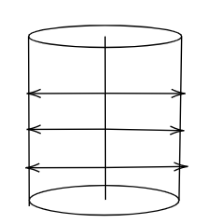
Hence the source of light to obtain a cylindrical wavefront must be a linear source of light.
Note: The point source of light is taken so as the wave produced by the source must be coherent in nature. Also if we do not use point source then it is hard to observe the wavefront. The particles of wavefronts will always vibrate in the same phase. Wavefront is the pictorial representation like ripples of water when stone is thrown in water.
Complete answer:
Wavefront can be defined as a locus of points in the path of the wave potion on which the disturbances at each point of the locus will have the same phase. Based upon the source of light these wavefronts can be classified into three categories. One of them is the Cylindrical Wavefront which is formed when the point source is linear, then the wavefront obtained from such a point source is called a cylindrical wavefront.
In cylindrical wavefront all the points are equidistant from the linear source and they lie on the surface of the cylinder. The cylindrical wavefront is usually obtained when the distance between the linear source and screen is small. For example: Fine rectangular slit. When light is passed through a fine rectangular slit then we get a cylindrical wavefront. Cylindrical wavefront can be shown as:
Hence the source of light to obtain a cylindrical wavefront must be a linear source of light.
Note: The point source of light is taken so as the wave produced by the source must be coherent in nature. Also if we do not use point source then it is hard to observe the wavefront. The particles of wavefronts will always vibrate in the same phase. Wavefront is the pictorial representation like ripples of water when stone is thrown in water.
Recently Updated Pages
Basicity of sulphurous acid and sulphuric acid are

Master Class 11 English: Engaging Questions & Answers for Success
Master Class 11 Physics: Engaging Questions & Answers for Success
Master Class 11 Computer Science: Engaging Questions & Answers for Success
Master Class 11 Chemistry: Engaging Questions & Answers for Success
Master Class 11 Social Science: Engaging Questions & Answers for Success
Trending doubts
Difference Between Prokaryotic Cells and Eukaryotic Cells
Two of the body parts which do not appear in MRI are class 11 biology CBSE
One Metric ton is equal to kg A 10000 B 1000 C 100 class 11 physics CBSE
10 examples of friction in our daily life
Draw a diagram of nephron and explain its structur class 11 biology CBSE
What will happen if the mucus is not secreted by the class 11 biology CBSE