




With the rise in turgidity the wall pressure will
(a) Decrease
(b) Increase
(c) Fluctuate
(d) Remain unchanged
Answer
 Verified
650.1k+ views
Hint: Turgidity is the state of the cell developed due to turgor pressure. The turgor pressure is the hydrostatic pressure developed inside the cell on the cell wall due to the entry of water inside the cells of the plant.
Complete answer:
With the rise in turgidity, the wall pressure will increase because the water entering the cells of the plant will create pressure on the cell wall of the plants. The cell wall being rigid exerts equal and opposite pressure in the opposite direction, thus increasing the wall pressure.
- Diffusion is the movement of the molecules of either gases, liquids, and solutes from a region of higher concentration to a region of lower concentration.
- Osmosis is a special type of diffusion of a liquid when solvents move through a semipermeable membrane. From a higher diffusion pressure to a place of lower diffusion pressure.
- Importance of turgor pressure:
1. Plants live and grow due to turgidity in cells
2. The rigidity of plant organs is maintained by turgidity.
3. Leaves remain erect and expanded due to turgidity and do not wilt.
4. The opening of stomata occurs due to the turgidity of the cell.
5. Movement of plant parts such as in ‘touch me not plant’ occurs due to turgidity.
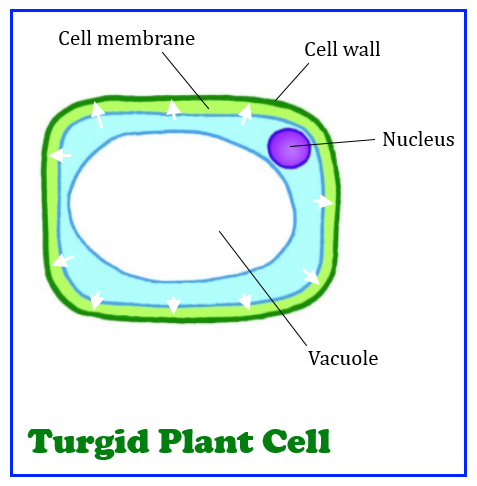
So, the correct answer is, ‘Increase.’
Note: When the wall pressure equals the turgor pressure, the entry of water into the cell stops. At this stage, the water potential (number of water molecules) of the cell is equal to that of the environment. Thus at this stage, the dynamic equilibrium sets in with no net movement. However, an equal exchange of water molecules can occur across the cell.
Complete answer:
With the rise in turgidity, the wall pressure will increase because the water entering the cells of the plant will create pressure on the cell wall of the plants. The cell wall being rigid exerts equal and opposite pressure in the opposite direction, thus increasing the wall pressure.
- Diffusion is the movement of the molecules of either gases, liquids, and solutes from a region of higher concentration to a region of lower concentration.
- Osmosis is a special type of diffusion of a liquid when solvents move through a semipermeable membrane. From a higher diffusion pressure to a place of lower diffusion pressure.
- Importance of turgor pressure:
1. Plants live and grow due to turgidity in cells
2. The rigidity of plant organs is maintained by turgidity.
3. Leaves remain erect and expanded due to turgidity and do not wilt.
4. The opening of stomata occurs due to the turgidity of the cell.
5. Movement of plant parts such as in ‘touch me not plant’ occurs due to turgidity.
So, the correct answer is, ‘Increase.’
Note: When the wall pressure equals the turgor pressure, the entry of water into the cell stops. At this stage, the water potential (number of water molecules) of the cell is equal to that of the environment. Thus at this stage, the dynamic equilibrium sets in with no net movement. However, an equal exchange of water molecules can occur across the cell.
Recently Updated Pages
Master Class 11 Social Science: Engaging Questions & Answers for Success

Master Class 11 English: Engaging Questions & Answers for Success
Master Class 11 Accountancy: Engaging Questions & Answers for Success
Master Class 11 Physics: Engaging Questions & Answers for Success
Master Class 11 Computer Science: Engaging Questions & Answers for Success
Master Class 11 Business Studies: Engaging Questions & Answers for Success
Trending doubts
Find the value of the expression given below sin 30circ class 11 maths CBSE
One Metric ton is equal to kg A 10000 B 1000 C 100 class 11 physics CBSE
Draw a diagram of nephron and explain its structur class 11 biology CBSE
10 examples of friction in our daily life
Proton was discovered by A Thomson B Rutherford C Chadwick class 11 chemistry CBSE
The teeth used for biting and cutting food are called class 11 biology CBSE