




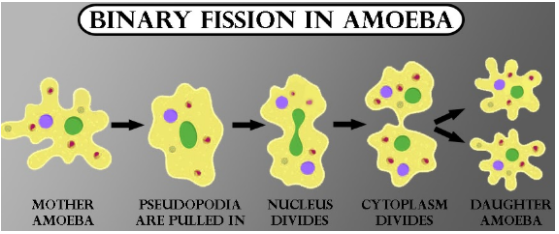
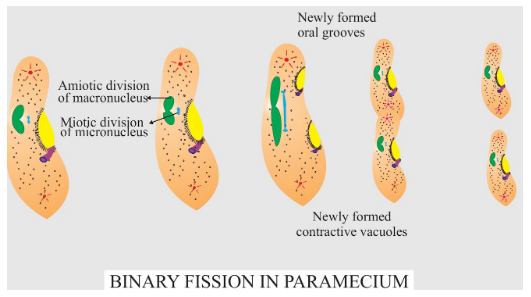
With the help of suitable diagrams describe binary fission.
Answer
 Verified
580.2k+ views
Hint: The process of division of the parent organism into different identical daughter cells is known as asexual reproduction. It involves mitosis, where cell organelles are duplicated and two separate sets of daughter cells are formed.
Complete answer:
Asexual reproduction takes place in various ways, one of which is fission. There are two types of fission that are binary fission and multiple fission. In binary fission, two cells are produced that have the ability to grow into a complete new organism while in the case of multiple fission two more than two cells are produced that have the ability to grow into a complete new organism. Both the processes result in the formation of new daughter cells that are identical to the parent cells.
Fission is a type of asexual reproduction. The process of asexual reproductin where the parent organisms divides itself in two identical daughter cells called binary fission. Binary fission is generally found in certain eukaryotic organisms that mainly include bacteria. It is classified into various types based on the direction in which fission occurs. It may be longitudinal (fission occurs along the longitudinal axis), irregular (fission takes place at any plane), oblique (fission occurs obliquely), and transverse (fission occurs along a transverse axis). Multiple fission is usually found in protists.
Characteristics of Binary fission are:
-The parent cell divides itself into two equal and identical daughter cells.
-In prokaryotes it is the most common form of reproduction.
-It occurs during favorable conditions.
-It has a definite pattern of division.
-It divides only once.
-In this process, the division of both the cytoplasm and nucleus occurs simultaneously.
-Example: Bacteria, Amoeba, Euglena, etc.
Note:
There are generally two ways through which the Living beings reproduce to produce their offspring that is sexual reproduction and asexual reproduction. When the fusion of the gametes of two parents occurs that result in the formation of offsprings then it is known as sexual reproduction while in asexual reproduction only one parent is involved in producing offspring. Asexual reproduction is of various types including fragmentation, budding, spore formation, fission, and vegetative propagation.
Complete answer:
Asexual reproduction takes place in various ways, one of which is fission. There are two types of fission that are binary fission and multiple fission. In binary fission, two cells are produced that have the ability to grow into a complete new organism while in the case of multiple fission two more than two cells are produced that have the ability to grow into a complete new organism. Both the processes result in the formation of new daughter cells that are identical to the parent cells.
Fission is a type of asexual reproduction. The process of asexual reproductin where the parent organisms divides itself in two identical daughter cells called binary fission. Binary fission is generally found in certain eukaryotic organisms that mainly include bacteria. It is classified into various types based on the direction in which fission occurs. It may be longitudinal (fission occurs along the longitudinal axis), irregular (fission takes place at any plane), oblique (fission occurs obliquely), and transverse (fission occurs along a transverse axis). Multiple fission is usually found in protists.
Characteristics of Binary fission are:
-The parent cell divides itself into two equal and identical daughter cells.
-In prokaryotes it is the most common form of reproduction.
-It occurs during favorable conditions.
-It has a definite pattern of division.
-It divides only once.
-In this process, the division of both the cytoplasm and nucleus occurs simultaneously.
-Example: Bacteria, Amoeba, Euglena, etc.
Note:
There are generally two ways through which the Living beings reproduce to produce their offspring that is sexual reproduction and asexual reproduction. When the fusion of the gametes of two parents occurs that result in the formation of offsprings then it is known as sexual reproduction while in asexual reproduction only one parent is involved in producing offspring. Asexual reproduction is of various types including fragmentation, budding, spore formation, fission, and vegetative propagation.
Recently Updated Pages
Master Class 12 Economics: Engaging Questions & Answers for Success

Master Class 12 English: Engaging Questions & Answers for Success
Master Class 12 Social Science: Engaging Questions & Answers for Success
Master Class 12 Maths: Engaging Questions & Answers for Success
Master Class 12 Physics: Engaging Questions & Answers for Success
Master Class 11 Social Science: Engaging Questions & Answers for Success
Trending doubts
One Metric ton is equal to kg A 10000 B 1000 C 100 class 11 physics CBSE
Difference Between Prokaryotic Cells and Eukaryotic Cells
Find the value of the expression given below sin 30circ class 11 maths CBSE
1 ton equals to A 100 kg B 1000 kg C 10 kg D 10000 class 11 physics CBSE
Two of the body parts which do not appear in MRI are class 11 biology CBSE
Draw a diagram of nephron and explain its structur class 11 biology CBSE